QUESTION IMAGE
Question
name: homework
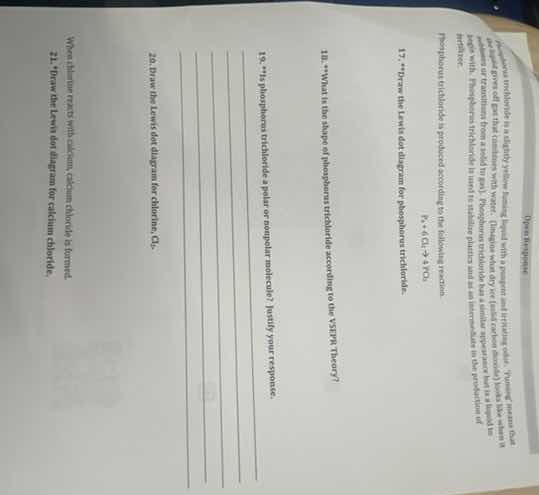
phosphorus trichloride is a slightly yellow fuming liquid with a pungent and irritating odor. when it comes into contact with water, it reacts violently with water. challenge why are actual covalent molecules like this when we draw them with the octet rule. phosphorus trichloride is an important reagent in the production of pesticides. phosphorus trichloride is used to produce pesticides such as parathion in the production of pesticides.
p₄ + 6cl₂→4pcl₃
- *draw the lewis dot diagram for phosphorus trichloride.
- *what is the shape of phosphorus trichloride according to the vsepr theory?
- *is phosphorus trichloride a polar or nonpolar molecule? justify your response.
- draw the lewis dot diagram for chlorine, cl₂.
- draw the lewis dot diagram for calcium chloride.
when chlorine reacts with calcium, calcium chloride is formed.
17.
Step1: Count total valence electrons
Phosphorus (P): 5 valence electrons; Each chlorine (Cl): 7 valence electrons. Total = $5 + 3\times7 = 26$
Step2: Place central atom, form bonds
Place P as central atom, form 3 P-Cl single bonds. Electrons used: $3\times2=6$, remaining: $26-6=20$
Step3: Assign lone pairs to outer atoms
Each Cl gets 3 lone pairs ($3\times6=18$ electrons). Remaining electrons: $20-18=2$, assign to P as 1 lone pair.
Step1: Identify electron domains
$\text{PCl}_3$ has 3 bonding pairs + 1 lone pair = 4 total electron domains.
Step2: Apply VSEPR theory
4 electron domains correspond to tetrahedral electron geometry. With 1 lone pair, molecular shape is trigonal pyramidal.
Step1: Analyze molecular symmetry
$\text{PCl}_3$ has a trigonal pyramidal shape. The P-Cl bonds are polar (Cl is more electronegative than P).
Step2: Check dipole moment cancellation
The polar bonds are not symmetrically arranged; their individual dipole moments do not cancel out, creating a net molecular dipole moment.

Snap & solve any problem in the app
Get step-by-step solutions on Sovi AI
Photo-based solutions with guided steps
Explore more problems and detailed explanations
Lewis dot diagram for $\text{PCl}_3$:
      ..
:Cl:P:Cl:
      ..
      :Cl:
      ..
(Note: The central P has one lone pair, each Cl has three lone pairs, and single bonds connect P to each Cl.)
---