QUESTION IMAGE
Question
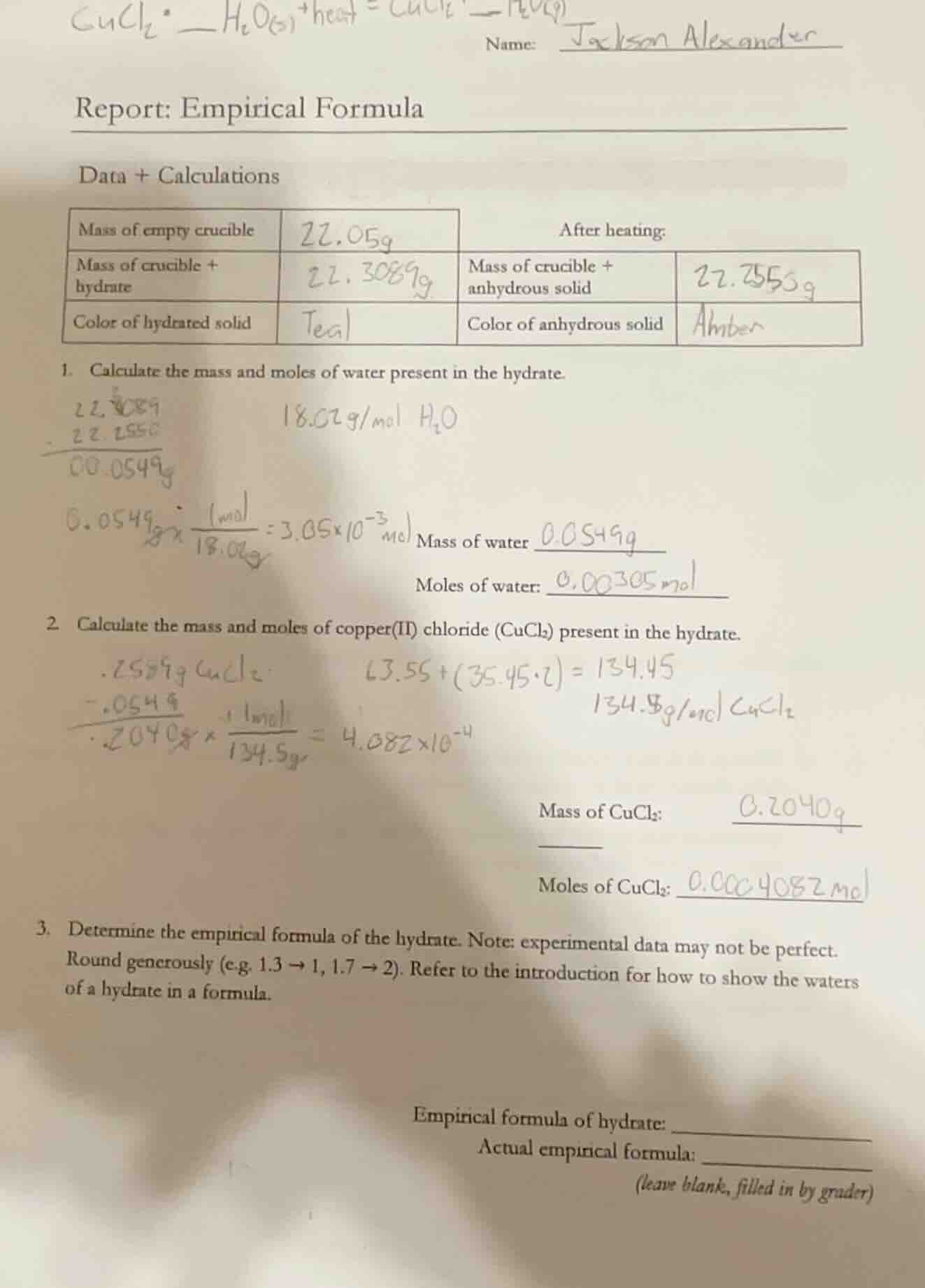
name: jackson alexander
report: empirical formula
data + calculations
mass of empty crucible: 22.05g
mass of crucible + hydrate: 22.3089g
color of hydrated solid: teal
after heating:
mass of crucible + anhydrous solid: 22.2555g
color of anhydrous solid: amber
- calculate the mass and moles of water present in the hydrate.
18.02g/mol h₂o
mass of water ____
moles of water: ____
- calculate the mass and moles of copper(ii) chloride (cucl₂) present in the hydrate.
63.55+(35.45·2)=134.45
134.5g/mol cucl₂
mass of cucl₂: ____
moles of cucl₂: ____
- determine the empirical formula of the hydrate. note: experimental data may not be perfect. round generously (e.g. 1.3 → 1, 1.7 → 2). refer to the introduction for how to show the waters of a hydrate in a formula.
empirical formula of hydrate: ____
actual empirical formula: ____
(leave blank, filled in by grader)
Step1: Find mole ratio of $\text{H}_2\text{O}$ to $\text{CuCl}_2$
Divide moles of $\text{H}_2\text{O}$ by moles of $\text{CuCl}_2$:
$\frac{3.05\times10^{-3}\ \text{mol}}{4.082\times10^{-4}\ \text{mol}} \approx 7.47$
Step2: Round to whole number
Round 7.47 to nearest integer: $7.47
ightarrow 7$
Step3: Write hydrate formula
Attach the whole number as the coefficient for $\text{H}_2\text{O}$ after $\text{CuCl}_2$.

Snap & solve any problem in the app
Get step-by-step solutions on Sovi AI
Photo-based solutions with guided steps
Explore more problems and detailed explanations
Empirical formula of hydrate: $\text{CuCl}_2 \cdot 7\text{H}_2\text{O}$