QUESTION IMAGE
Question
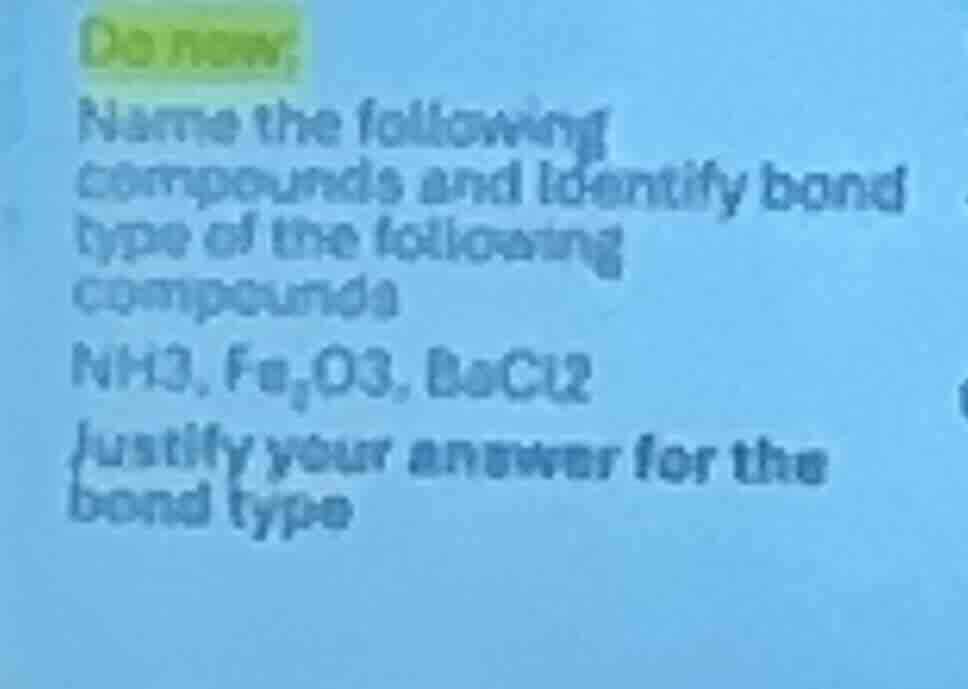
do now: name the following compounds and identify bond type of the following compounds nh3, fe₂o3, bacl2 justify your answer for the bond type
1. For $\ce{NH3}$:
Naming the compound:
The compound $\ce{NH3}$ is named ammonia (or nitrogen trihydride).
Identifying bond type:
- Bond type: Covalent bond (polar covalent bond).
- Justification: $\ce{NH3}$ is formed between nitrogen (a non - metal) and hydrogen (a non - metal). In a covalent bond, atoms share electrons to achieve a stable electron configuration. Nitrogen has 5 valence electrons and each hydrogen has 1 valence electron. Nitrogen shares one electron with each of the three hydrogen atoms, and also has one lone pair of electrons. The electronegativity difference between nitrogen ($\chi = 3.04$) and hydrogen ($\chi=2.20$) is about $0.84$, which is less than $1.7$ (the typical threshold for ionic bonding), so the bond is covalent. Since there is an electronegativity difference, the covalent bond is polar.
2. For $\ce{Fe2O3}$:
Naming the compound:
The compound $\ce{Fe2O3}$ is named iron(III) oxide (or ferric oxide). The Roman numeral (III) is used because iron has a +3 oxidation state in this compound (since in $\ce{Fe2O3}$, let the oxidation state of Fe be $x$, then $2x + 3\times(- 2)=0\Rightarrow2x=6\Rightarrow x = + 3$).
Identifying bond type:
- Bond type: Ionic bond.
- Justification: $\ce{Fe2O3}$ is formed between iron (a metal) and oxygen (a non - metal). Metals tend to lose electrons and non - metals tend to gain electrons. Iron (a metal) loses electrons to form $\ce{Fe^{3+}}$ ions and oxygen (a non - metal) gains electrons to form $\ce{O^{2-}}$ ions. The electrostatic attraction between the positively charged $\ce{Fe^{3+}}$ ions and negatively charged $\ce{O^{2-}}$ ions forms the ionic bond.
3. For $\ce{BaCl2}$:
Naming the compound:
The compound $\ce{BaCl2}$ is named barium chloride. Barium has a +2 oxidation state (since in $\ce{BaCl2}$, let the oxidation state of Ba be $x$, then $x+2\times(-1) = 0\Rightarrow x=+2$) and chlorine has a - 1 oxidation state.
Identifying bond type:
- Bond type: Ionic bond.
- Justification: $\ce{BaCl2}$ is formed between barium (a metal) and chlorine (a non - metal). Barium (a metal) loses 2 electrons to form $\ce{Ba^{2+}}$ ions and chlorine (a non - metal) gains 1 electron each to form $\ce{Cl^{-}}$ ions. The electrostatic attraction between the positively charged $\ce{Ba^{2+}}$ ions and negatively charged $\ce{Cl^{-}}$ ions forms the ionic bond.
Final Answers (Bond Types)
- $\ce{NH3}$: Covalent (polar covalent) bond
- $\ce{Fe2O3}$: Ionic bond
- $\ce{BaCl2}$: Ionic bond

Snap & solve any problem in the app
Get step-by-step solutions on Sovi AI
Photo-based solutions with guided steps
Explore more problems and detailed explanations
1. For $\ce{NH3}$:
Naming the compound:
The compound $\ce{NH3}$ is named ammonia (or nitrogen trihydride).
Identifying bond type:
- Bond type: Covalent bond (polar covalent bond).
- Justification: $\ce{NH3}$ is formed between nitrogen (a non - metal) and hydrogen (a non - metal). In a covalent bond, atoms share electrons to achieve a stable electron configuration. Nitrogen has 5 valence electrons and each hydrogen has 1 valence electron. Nitrogen shares one electron with each of the three hydrogen atoms, and also has one lone pair of electrons. The electronegativity difference between nitrogen ($\chi = 3.04$) and hydrogen ($\chi=2.20$) is about $0.84$, which is less than $1.7$ (the typical threshold for ionic bonding), so the bond is covalent. Since there is an electronegativity difference, the covalent bond is polar.
2. For $\ce{Fe2O3}$:
Naming the compound:
The compound $\ce{Fe2O3}$ is named iron(III) oxide (or ferric oxide). The Roman numeral (III) is used because iron has a +3 oxidation state in this compound (since in $\ce{Fe2O3}$, let the oxidation state of Fe be $x$, then $2x + 3\times(- 2)=0\Rightarrow2x=6\Rightarrow x = + 3$).
Identifying bond type:
- Bond type: Ionic bond.
- Justification: $\ce{Fe2O3}$ is formed between iron (a metal) and oxygen (a non - metal). Metals tend to lose electrons and non - metals tend to gain electrons. Iron (a metal) loses electrons to form $\ce{Fe^{3+}}$ ions and oxygen (a non - metal) gains electrons to form $\ce{O^{2-}}$ ions. The electrostatic attraction between the positively charged $\ce{Fe^{3+}}$ ions and negatively charged $\ce{O^{2-}}$ ions forms the ionic bond.
3. For $\ce{BaCl2}$:
Naming the compound:
The compound $\ce{BaCl2}$ is named barium chloride. Barium has a +2 oxidation state (since in $\ce{BaCl2}$, let the oxidation state of Ba be $x$, then $x+2\times(-1) = 0\Rightarrow x=+2$) and chlorine has a - 1 oxidation state.
Identifying bond type:
- Bond type: Ionic bond.
- Justification: $\ce{BaCl2}$ is formed between barium (a metal) and chlorine (a non - metal). Barium (a metal) loses 2 electrons to form $\ce{Ba^{2+}}$ ions and chlorine (a non - metal) gains 1 electron each to form $\ce{Cl^{-}}$ ions. The electrostatic attraction between the positively charged $\ce{Ba^{2+}}$ ions and negatively charged $\ce{Cl^{-}}$ ions forms the ionic bond.
Final Answers (Bond Types)
- $\ce{NH3}$: Covalent (polar covalent) bond
- $\ce{Fe2O3}$: Ionic bond
- $\ce{BaCl2}$: Ionic bond