QUESTION IMAGE
Question
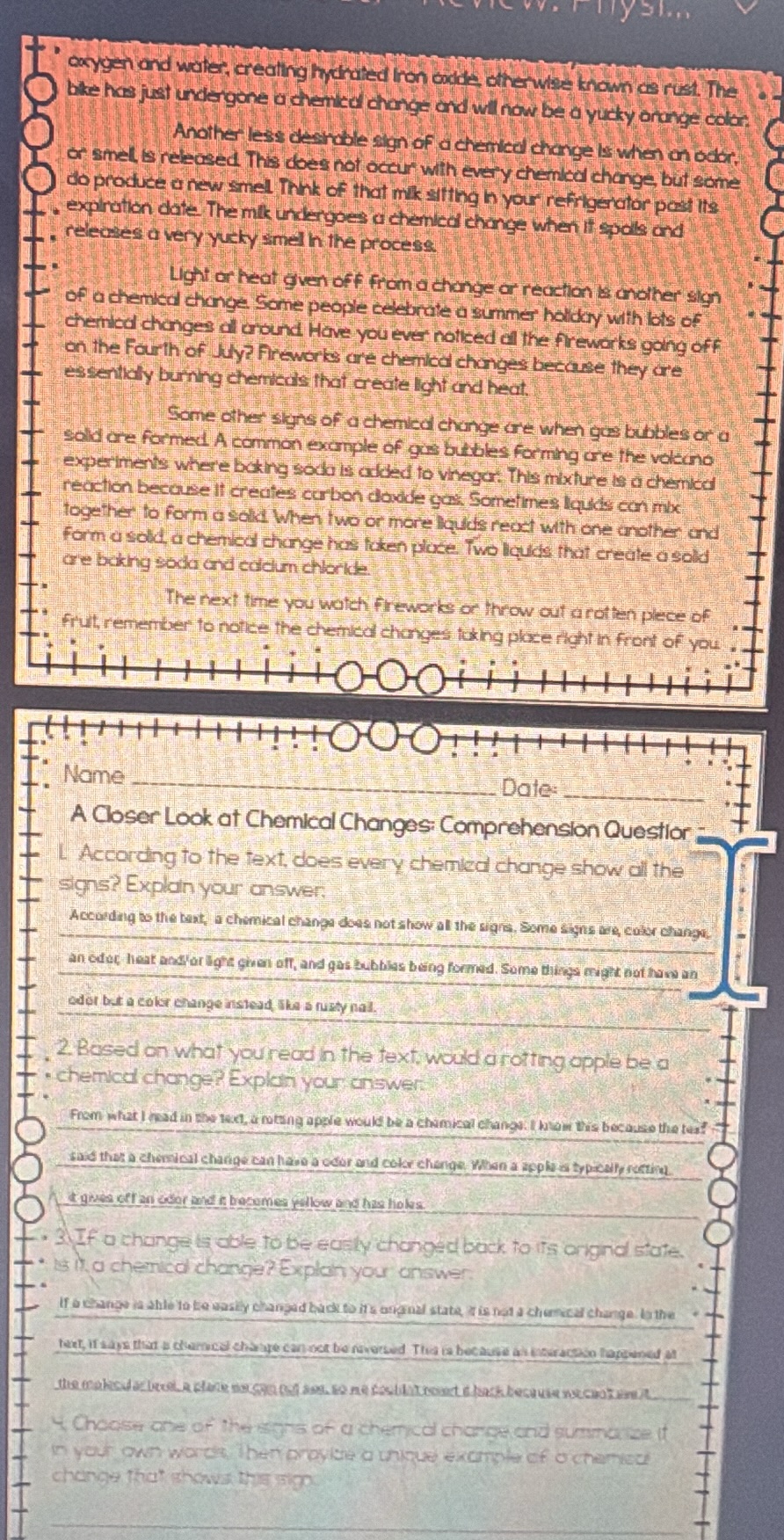
oxygen and water, creating hydrated iron oxide, otherwise known as rust. the bike has just undergone a chemical change and will now be a yucky orange color.
another less desirable sign of a chemical change is when an odor, or smell, is released. this does not occur with every chemical change, but some do produce a new smell. think of that milk sitting in your refrigerator past its expiration date. the milk undergoes a chemical change when it spoils and releases a very yucky smell in the process.
light or heat given off from a change or reaction is another sign of a chemical change. some people celebrate a summer holiday with lots of chemical changes all around. have you ever noticed all the fireworks going off on the fourth of july? fireworks are chemical changes because they are essentially burning chemicals that create light and heat.
some other signs of a chemical change are when gas bubbles or a solid are formed. a common example of gas bubbles forming are the volcano experiments where baking soda is added to vinegar. this mixture is a chemical reaction because it creates carbon dioxide gas. sometimes liquids can mix together to form a solid. when two or more liquids react with one another and form a solid, a chemical change has taken place. two liquids that create a solid are baking soda and calcium chloride.
the next time you watch fireworks or throw out a rotten piece of fruit, remember to notice the chemical changes taking place right in front of you.
name ____________________________ date: ___________
a closer look at chemical changes: comprehension questions
- according to the text, does every chemical change show all the signs? explain your answer.
according to the text, a chemical change does not show all the signs. some signs are, color change, an odor, heat and/or light given off, and gas bubbles being formed. some things might not have an odor but a color change instead, like a rusty nail.
- based on what you read in the text, would a rotting apple be a chemical change? explain your answer.
from what i read in the text, a rotting apple would be a chemical change. i know this because the text said that a chemical change can have a color and color change. when a apple is typically rotting, it gives off an odor and it becomes yellow and has holes.
- if a change is able to be easily changed back to its original state, is it a chemical change? explain your answer.
if a change is able to be easily changed back to its original state, it is not a chemical change. in the text, it says that a chemical change can not be reversed. this is because an interaction happened at the molecular level, a plane can not be undone, so we couldnt revert it back because we cant undo it.
- choose one of the signs of a chemical change, and summarize it in your own words. then provide a unique example of a chemical change that shows this sign.
Question 1
The text states that signs of chemical changes include color change, odor release, heat/light emission, gas bubbles or solid formation. It also says "This does not occur with every chemical change" (referring to odor release) and gives the rust example (color change but no odor). So not all signs are present in every chemical change.
A rotting apple shows chemical change signs. The text lists color change, odor, etc. A rotting apple changes color (browns), releases an odor, and undergoes internal chemical reactions (like spoilage, new substances formed). These match the text's chemical change signs.
The text implies chemical changes create new substances (unreversible at molecular level). If a change is easily reversed (like melting ice, a physical change), it's physical (no new substance). So a change easily reversed isn't a chemical change, as chemical changes involve irreversible molecular interactions (new substances, hard to reverse).

Snap & solve any problem in the app
Get step-by-step solutions on Sovi AI
Photo-based solutions with guided steps
Explore more problems and detailed explanations
No, every chemical change does not show all the signs. The text says some signs (color change, odor, heat/light, gas/solid formation) exist, but examples like rust (color change, no odor) show not all signs are present in one change.