QUESTION IMAGE
Question
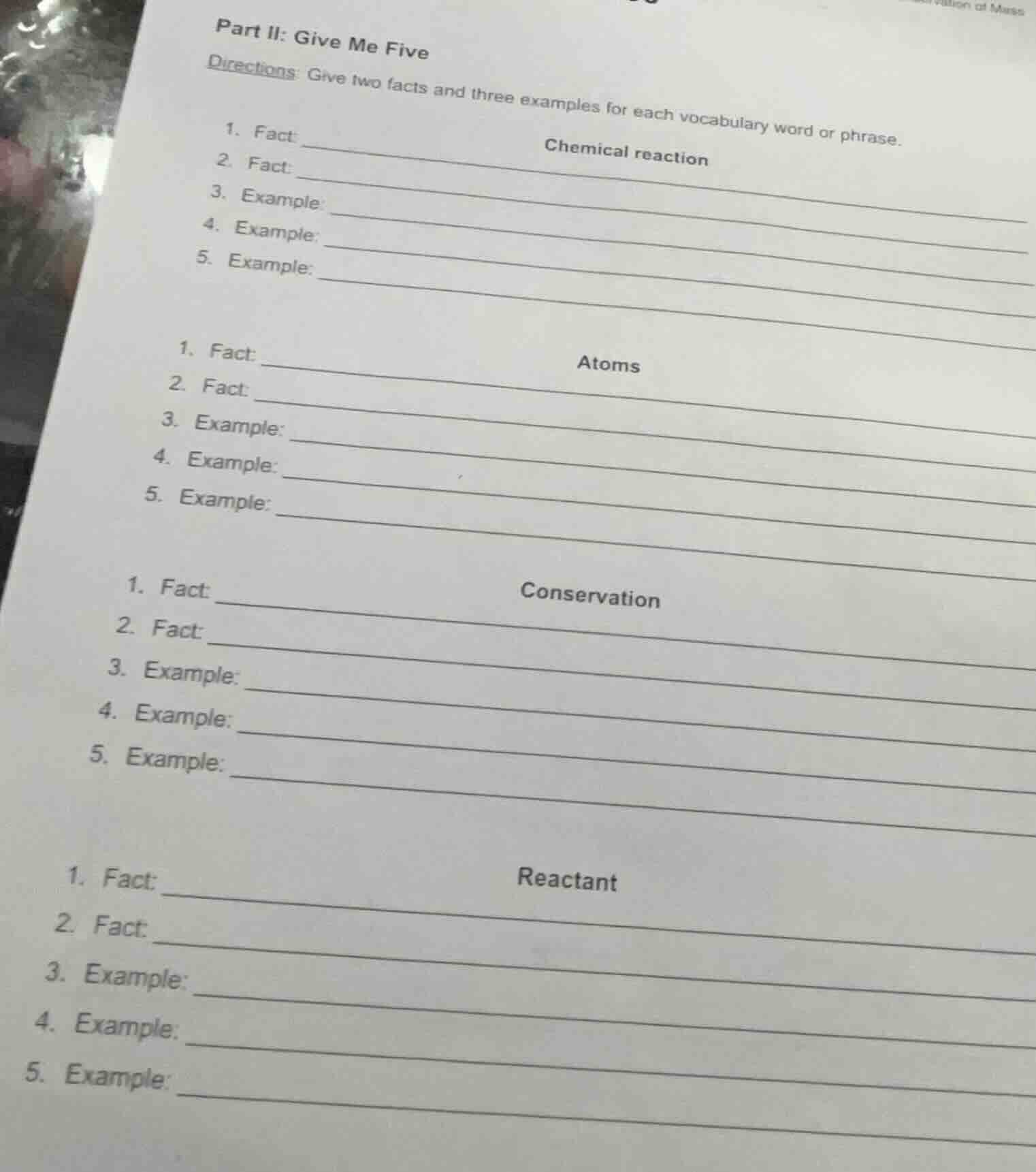
part ii: give me five
directions: give two facts and three examples for each vocabulary word or phrase.
chemical reaction
- fact:
- fact:
- example:
- example:
- example:
atoms
- fact:
- fact:
- example:
- example:
- example:
conservation
- fact:
- fact:
- example:
- example:
- example:
reactant
- fact:
- fact:
- example:
- example:
- example:
Chemical reaction
Facts are core properties of chemical reactions; examples are real-world instances of these reactions.
Atoms
Facts cover fundamental traits of atoms; examples are specific types or uses of atoms.
Conservation
Facts focus on the core principle of conservation in chemistry; examples are real applications of this principle.
Reactant
Facts describe the role/features of reactants; examples are specific substances acting as reactants.

Snap & solve any problem in the app
Get step-by-step solutions on Sovi AI
Photo-based solutions with guided steps
Explore more problems and detailed explanations
Chemical reaction
- Fact: Rearranges atomic bonds
- Fact: Produces new substances
- Example: Rusting of iron ($4\text{Fe} + 3\text{O}_2
ightarrow 2\text{Fe}_2\text{O}_3$)
- Example: Burning methane ($\text{CH}_4 + 2\text{O}_2
ightarrow \text{CO}_2 + 2\text{H}_2\text{O}$)
- Example: Baking soda + vinegar reaction
Atoms
- Fact: Basic unit of all matter
- Fact: Has a nucleus with protons/neutrons
- Example: Hydrogen atom (1 proton, 0 neutrons)
- Example: Carbon-12 atom (6 protons, 6 neutrons)
- Example: Oxygen atom (8 protons, 8 neutrons)
Conservation
- Fact: Mass is not created/destroyed
- Fact: Applies to closed chemical systems
- Example: Burning wood (mass of ash+gases = wood+oxygen)
- Example: Dissolving salt in water (total mass stays same)
- Example: Iron rusting (mass of rust = iron+oxygen)
Reactant
- Fact: Starts a chemical reaction
- Fact: Gets consumed during reaction
- Example: Hydrogen gas in water synthesis
- Example: Oxygen gas in combustion reactions
- Example: Vinegar in baking soda reaction