QUESTION IMAGE
Question
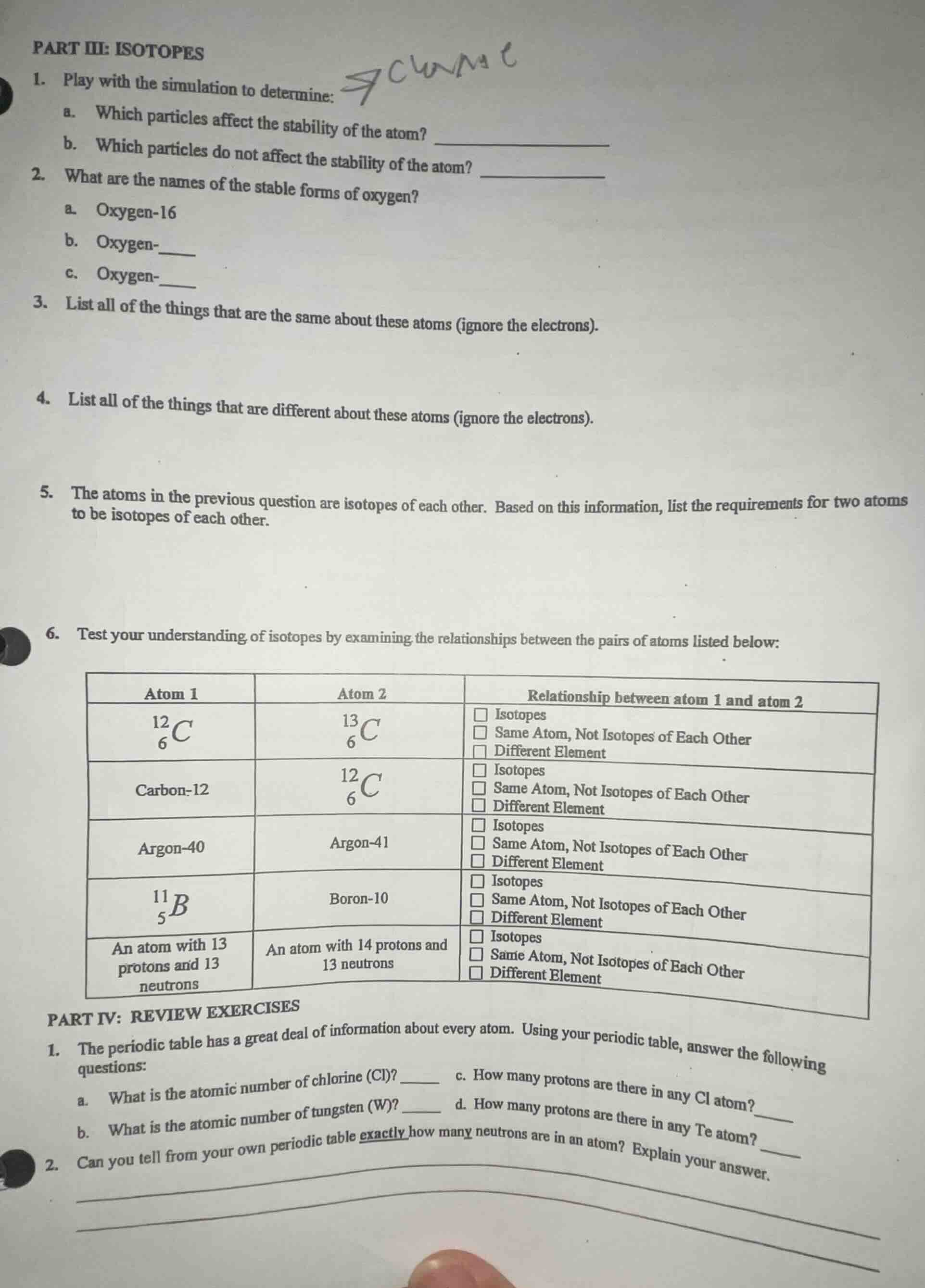
part iii: isotopes
- play with the simulation to determine:
a. which particles affect the stability of the atom?
b. which particles do not affect the stability of the atom?
- what are the names of the stable forms of oxygen?
a. oxygen - 16
b. oxygen -
c. oxygen -
- list all of the things that are the same about these atoms (ignore the electrons).
- list all of the things that are different about these atoms (ignore the electrons).
- the atoms in the previous question are isotopes of each other. based on this information, list the requirements for two atoms to be isotopes of each other.
- test your understanding of isotopes by examining the relationships between the pairs of atoms listed below:
| atom 1 | atom 2 | relationship between atom 1 and atom 2 |
|---|---|---|
| carbon - 12 | $ce{_{6}^{12}c}$ | $square$ isotopes $square$ same atom, not isotopes of each other $square$ different element |
| argon - 40 | argon - 41 | $square$ isotopes $square$ same atom, not isotopes of each other $square$ different element |
| $ce{_{5}^{11}b}$ | boron - 10 | $square$ isotopes $square$ same atom, not isotopes of each other $square$ different element |
| an atom with 13 protons and 13 neutrons | an atom with 14 protons and 13 neutrons | $square$ isotopes $square$ same atom, not isotopes of each other $square$ different element |
part iv: review exercises
- the periodic table has a great deal of information about every atom. using your periodic table, answer the following questions:
a. what is the atomic number of chlorine (cl)? c. how many protons are there in any cl atom?
b. what is the atomic number of tungsten (w)? d. how many protons are there in any te atom?
- can you tell from your own periodic table exactly how many neutrons are in an atom? explain your answer.
Brief Explanations
Part III: Isotopes
- a. Atomic stability depends on the balance of protons and neutrons in the nucleus, as imbalances cause radioactive decay.
b. Electrons orbit the nucleus and only affect chemical behavior, not nuclear stability.
- The three stable isotopes of oxygen are defined by their mass numbers, which are the sum of protons and neutrons.
- Isotopes are atoms of the same element, so they share the same number of protons (which defines the element) and thus the same atomic number.
- Isotopes differ in the number of neutrons in their nucleus, which changes their mass number.
- The definition of isotopes is based on being the same element (same proton count) with different neutron counts.
6.
- $\ce{^{12}_{6}C}$ and $\ce{^{13}_{6}C}$: Same atomic number (6, carbon), different mass numbers → isotopes.
- Carbon-12 and $\ce{^{12}_{6}C}$: Both represent the exact same atom with 6 protons and 6 neutrons.
- Argon-40 and Argon-41: Same element (argon), different mass numbers → isotopes.
- $\ce{^{11}_{5}B}$ and Boron-10: Same element (boron, atomic number 5), different mass numbers → isotopes.
- Atom with 13 protons/13 neutrons (aluminum) and atom with 14 protons/13 neutrons (silicon): Different atomic numbers → different elements.
Part IV: Review Exercises
- Atomic number = number of protons, which is a unique identifier for each element on the periodic table.
- Periodic tables only list the average atomic mass, not the mass of individual isotopes. Since elements can have multiple isotopes with different neutron counts, an exact neutron number cannot be determined.

Snap & solve any problem in the app
Get step-by-step solutions on Sovi AI
Photo-based solutions with guided steps
Explore more problems and detailed explanations
Part III: Isotopes
- a. Protons and neutrons
b. Electrons
- b. 17
c. 18
- - Same number of protons
- Same atomic number
- Same element identity
- - Different number of neutrons
- Different mass number
- - Must be atoms of the same element (same number of protons/atomic number)
- Must have different numbers of neutrons (different mass numbers)
6.
| Atom 1 | Atom 2 | Relationship between atom 1 and atom 2 |
|---|---|---|
| Carbon-12 | $\ce{^{12}_{6}C}$ | $\square$ Isotopes <br> $\square$ Same Atom, Not Isotopes of Each Other <br> $\square$ Different Element |
| Argon-40 | Argon-41 | $\square$ Isotopes <br> $\square$ Same Atom, Not Isotopes of Each Other <br> $\square$ Different Element |
| $\ce{^{11}_{5}B}$ | Boron-10 | $\square$ Isotopes <br> $\square$ Same Atom, Not Isotopes of Each Other <br> $\square$ Different Element |
| An atom with 13 protons and 13 neutrons | An atom with 14 protons and 13 neutrons | $\square$ Isotopes <br> $\square$ Same Atom, Not Isotopes of Each Other <br> $\square$ Different Element |
Part IV: Review Exercises
- a. 17
b. 74
c. 17
d. 52
- No, you cannot. Most elements have multiple isotopes with different numbers of neutrons, and the periodic table only lists the average atomic mass, not the mass of a specific isotope. To find the exact number of neutrons, you need the mass number of a specific isotope of the atom.