QUESTION IMAGE
Question
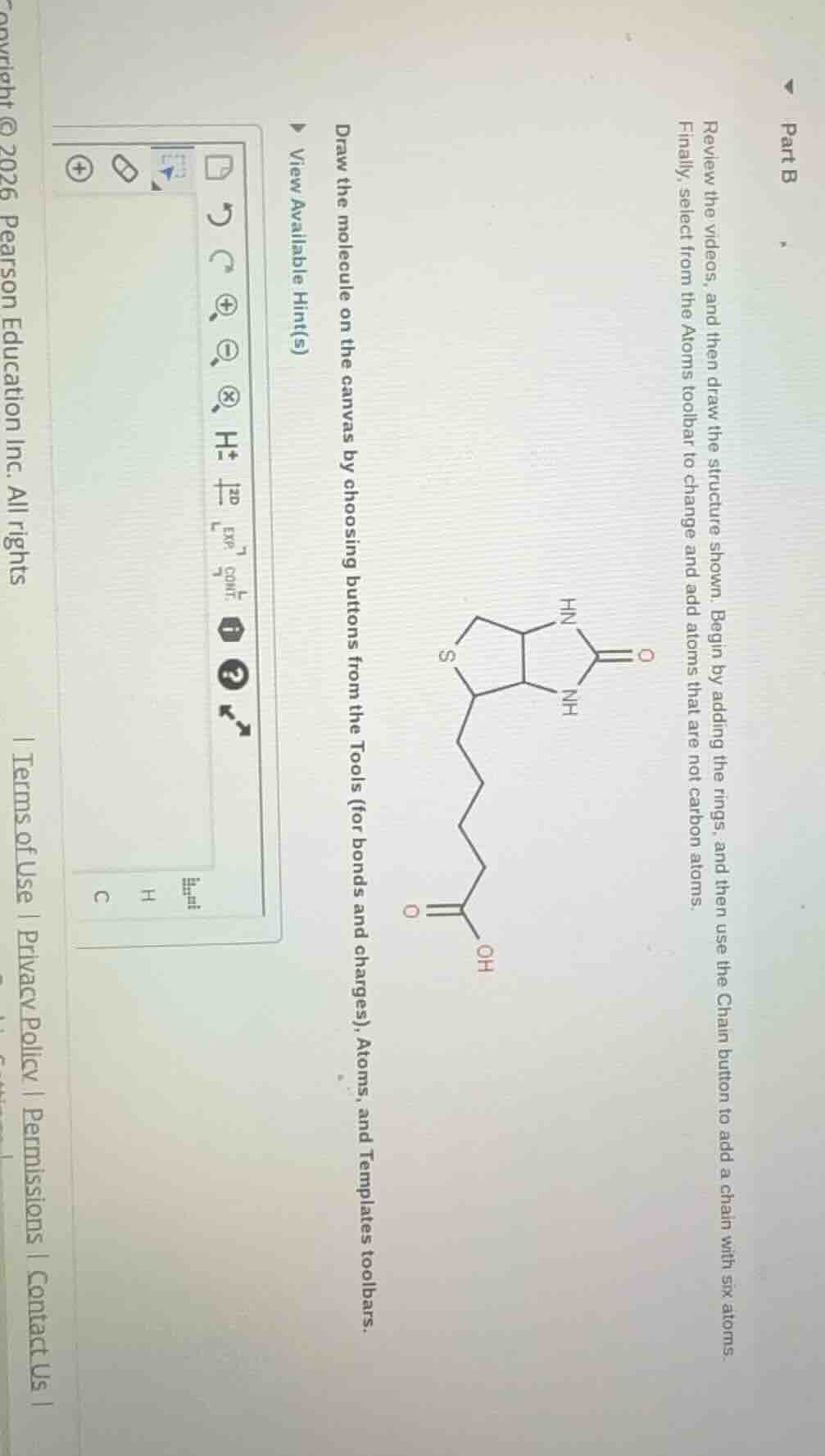
part b review the videos, and then draw the structure shown. begin by adding the rings, and then use the chain button to add a chain with six atoms. finally, select from the atoms toolbar to change and add atoms that are not carbon atoms. draw the molecule on the canvas by choosing buttons from the tools (for bonds and charges), atoms, and templates toolbars. view available hint(s)
This problem involves drawing a molecular structure, which is related to Chemistry (a subfield of Natural Science). The structure has rings (a 5 - membered ring with S, and a urea - like ring), a 6 - atom chain, and functional groups (carboxylic acid, amide, thiazolidine - like ring). To draw it:
- First, identify the rings: The 5 - membered ring with S (thiazolidine - like) and the adjacent 4 - membered amide - like ring (with HN, NH, and C = O). Draw these rings using the ring tools.
- Then, add the 6 - atom chain: Use the chain button to add a 6 - carbon chain (since the final group is a carboxylic acid ( - COOH), the chain should connect to the 5 - membered ring and end with - COOH.
- Add non - carbon atoms: The O in the carbonyl of the amide, the O in the carboxylic acid, the S in the 5 - membered ring, and the N atoms (HN, NH) are already partially shown, but ensure all are placed correctly. Use the Atoms toolbar to add any missing non - carbon atoms (like H atoms on N, C, etc., though the problem might focus on the main structure).

Snap & solve any problem in the app
Get step-by-step solutions on Sovi AI
Photo-based solutions with guided steps
Explore more problems and detailed explanations
The molecular structure should be drawn as follows (description): A 5 - membered ring containing a sulfur (S) atom, fused with a 4 - membered ring containing two nitrogen (N, labeled HN and NH) atoms and a carbonyl (C = O) group. Attached to the 5 - membered ring is a 6 - atom (carbon) chain ending with a carboxylic acid group ( - COOH, with a carbonyl (C = O) and a hydroxyl ( - OH) group). All atoms are connected with appropriate single or double bonds (double bond in the carbonyl groups, single bonds in the ring and chain, except for the double bond in C = O).
(Note: Since this is a drawing - based problem, the answer is a description of the correct structure. If using a drawing tool, follow the steps of adding rings, chain, and non - carbon atoms as described.)