QUESTION IMAGE
Question
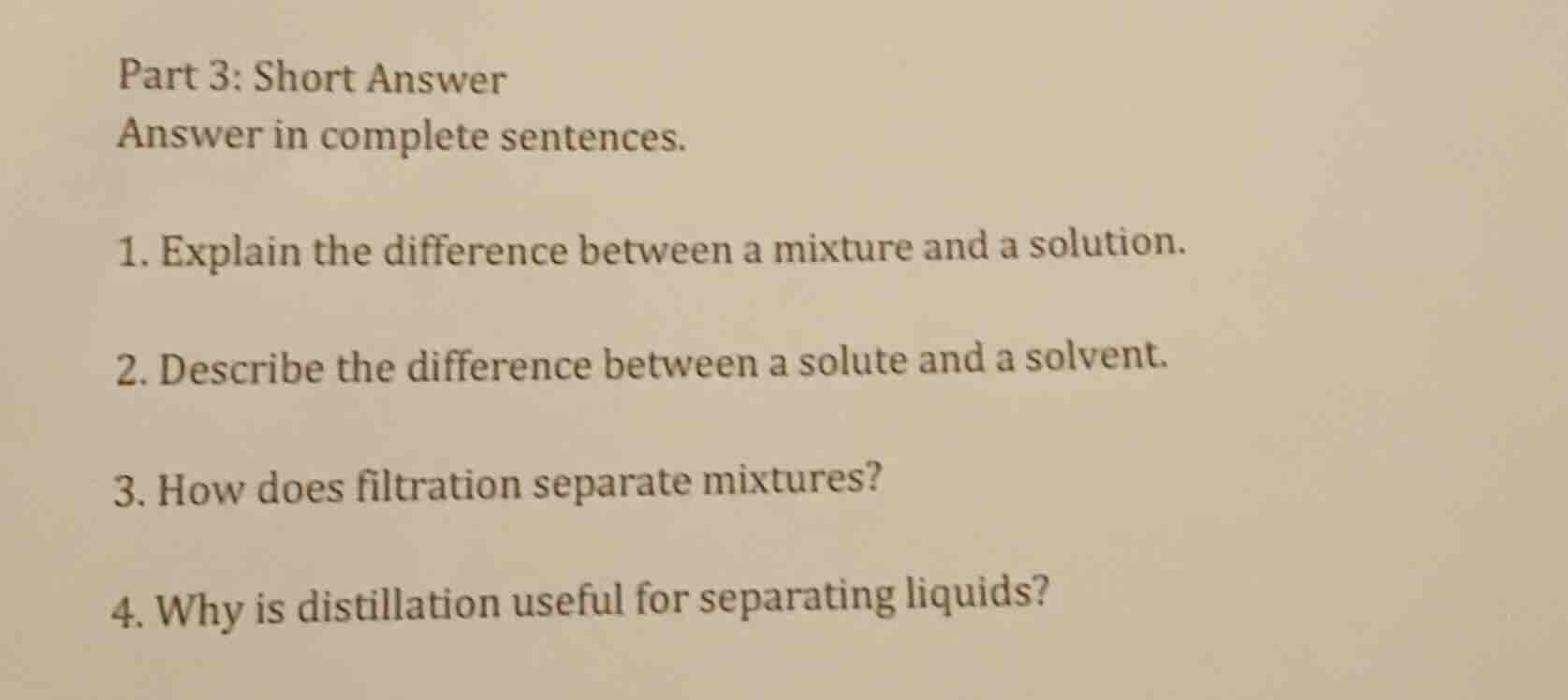
part 3: short answer
answer in complete sentences.
- explain the difference between a mixture and a solution.
- describe the difference between a solute and a solvent.
- how does filtration separate mixtures?
- why is distillation useful for separating liquids?
1. Explain the difference between a mixture and a solution.
A mixture is a combination of two or more substances where each substance retains its own properties and they can be physically separated (e.g., a mixture of sand and water, or iron filings and sulfur). A solution is a type of homogeneous mixture where one substance (the solute) is dissolved in another substance (the solvent) at the molecular or ionic level, resulting in a uniform composition throughout (e.g., salt dissolved in water, sugar dissolved in coffee). In a solution, the solute particles are so small that they do not settle out and the mixture appears uniform, while in a heterogeneous mixture (a type of mixture), the components are visibly distinct or can be separated by simple physical means like filtration.
In a solution, the solute is the substance that is dissolved. It is usually present in a smaller amount (e.g., salt in a salt - water solution, sugar in a sugar - water solution). The solvent is the substance that does the dissolving and is typically present in a larger amount. It provides the medium in which the solute dissolves (e.g., water in a salt - water or sugar - water solution, alcohol in a tincture). The solvent determines the physical state of the solution (if the solvent is liquid, the solution is usually liquid, etc.), and the solute's particles disperse within the solvent's particles.
Filtration is used to separate heterogeneous mixtures that consist of a solid and a liquid (or a solid and a gas, but more commonly solid - liquid). A filter medium (like filter paper) with pores of a certain size is used. The mixture is poured through the filter. The solid particles, which are larger than the pores of the filter, are trapped by the filter paper, while the liquid (or gas) molecules, which are smaller than the pores, pass through the filter. For example, in a mixture of sand and water, when we filter it, the sand (solid) is trapped on the filter paper and the water (liquid) passes through, thus separating the two components.

Snap & solve any problem in the app
Get step-by-step solutions on Sovi AI
Photo-based solutions with guided steps
Explore more problems and detailed explanations
A mixture is a combination of two or more substances where each retains its properties and can be physically separated (e.g., sand - water mixture), while a solution is a homogeneous mixture where a solute dissolves in a solvent at the molecular/ionic level (e.g., salt - water solution) with uniform composition and no visible separation of components.