QUESTION IMAGE
Question
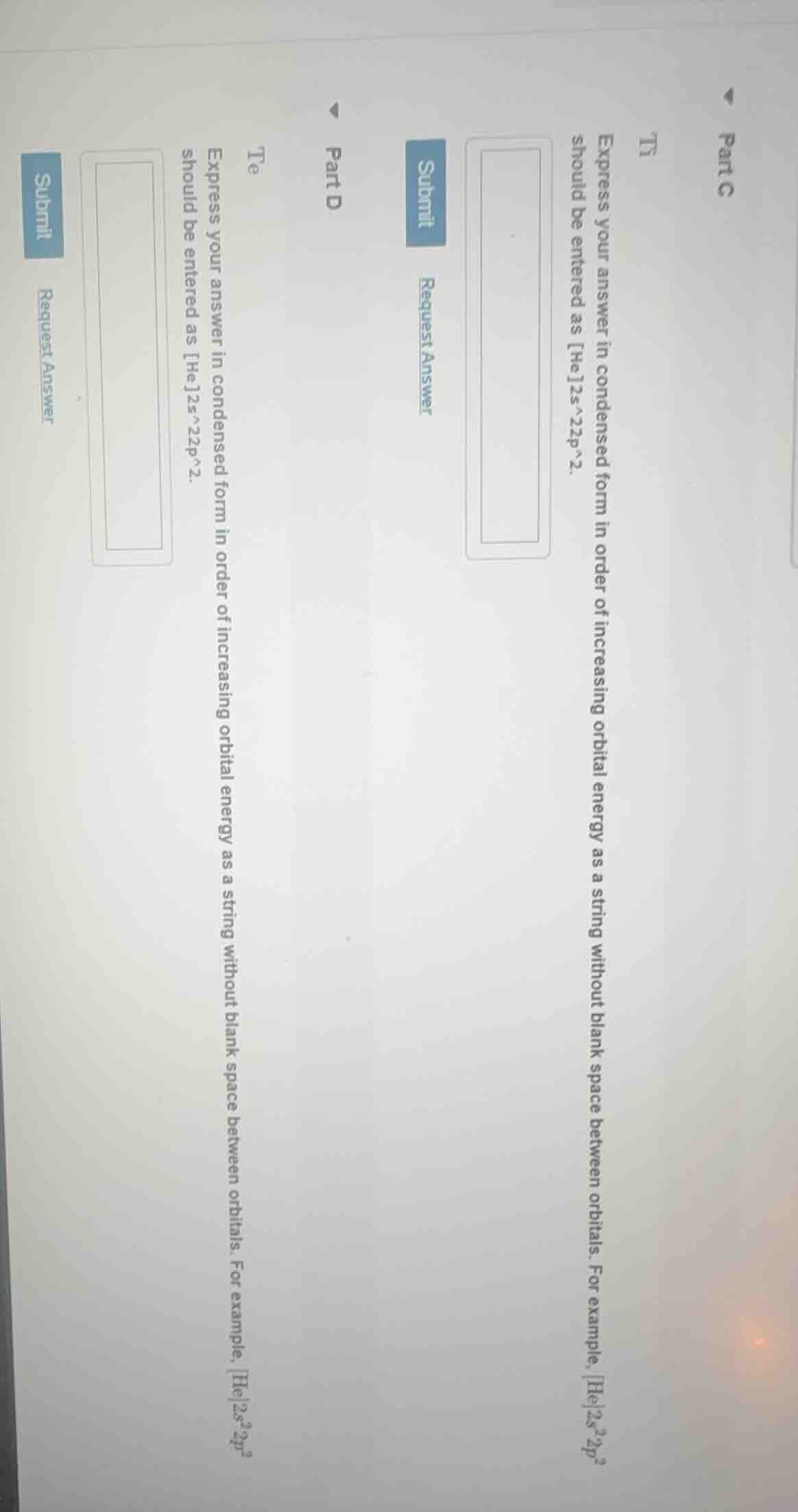
part c
ti
express your answer in condensed form in order of increasing orbital energy as a string without blank space between orbitals. for example, he2s^22p^2 should be entered as he2s^22p^2.
part d
te
express your answer in condensed form in order of increasing orbital energy as a string without blank space between orbitals. for example, he2s^22p^2 should be entered as he2s^22p^2.
Step1: Find Xe electron configuration
Xenon (Xe, atomic number 54) is the noble gas preceding Tellurium (Te, atomic number 52). The condensed form uses Xe as the core.
Step2: Add valence electrons for Te
Te has 52 electrons; Xe has 54, so Te has 2 fewer electrons than Xe. The valence orbitals fill as $5s^24d^{10}5p^4$.
Step3: Combine core and valence
Condensed form: $[Xe]5s^24d^{10}5p^4$
---
Step1: Find Kr electron configuration
Krypton (Kr, atomic number 36) is the noble gas preceding Titanium (Ti, atomic number 22). The condensed form uses Kr as the core.
Step2: Add valence electrons for Ti
Ti has 22 electrons; Kr has 36, so Ti has 14 fewer electrons than Kr. The valence orbitals fill as $4s^23d^2$.
Step3: Combine core and valence
Condensed form: $[Kr]4s^23d^2$

Snap & solve any problem in the app
Get step-by-step solutions on Sovi AI
Photo-based solutions with guided steps
Explore more problems and detailed explanations
Part C: $[Kr]4s^23d^2$
Part D: $[Xe]5s^24d^{10}5p^4$