QUESTION IMAGE
Question
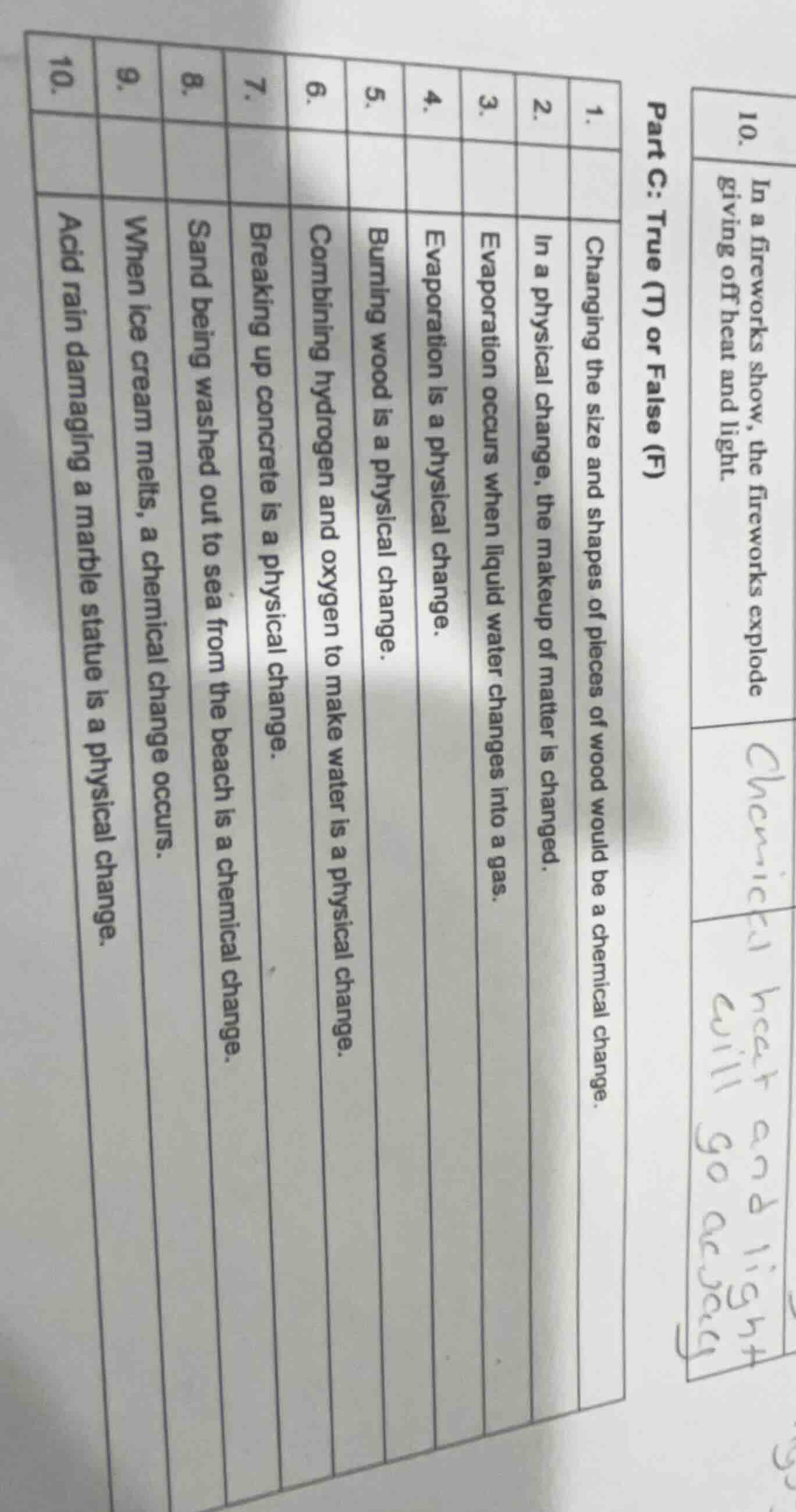
part c: true (t) or false (f)
- changing the size and shapes of pieces of wood would be a chemical change.
- in a physical change, the makeup of matter is changed.
- evaporation occurs when liquid water changes into a gas.
- evaporation is a physical change.
- burning wood is a physical change.
- combining hydrogen and oxygen to make water is a physical change.
- breaking up concrete is a physical change.
- sand being washed out to sea from the beach is a chemical change.
- when ice cream melts, a chemical change occurs.
- acid rain damaging a marble statue is a physical change.
- in a fireworks show, the fireworks explode giving off heat and light.
To solve these true - false questions, we analyze each one based on the definitions of physical and chemical changes. A physical change is a change in the form or appearance of a substance without changing its chemical composition. A chemical change involves a change in the chemical composition of a substance, often accompanied by the formation of new substances.
Question 1
- Explanation: Changing the size and shape of wood only alters its physical appearance. The chemical composition of the wood remains the same. So this is a physical change, not a chemical change.
- Answer: F
Question 2
- Explanation: In a physical change, the makeup (chemical composition) of matter does not change. Only the physical state or appearance changes.
- Answer: F
Question 3
- Explanation: Evaporation is the process where liquid water turns into water vapor (gas). The substance is still water, just in a different physical state. So it is a physical change and the statement is correct.
- Answer: T
Question 4
- Explanation: As explained in question 3, evaporation is a physical change (change of state of water).
- Answer: T
Question 5
- Explanation: Burning wood involves a reaction with oxygen. New substances like ash, carbon dioxide, etc., are formed. This is a chemical change, not a physical change.
- Answer: F
Question 6
- Explanation: Combining hydrogen and oxygen to make water is a chemical reaction ($2H_2 + O_2
ightarrow2H_2O$). New substance (water) is formed from hydrogen and oxygen. So it is a chemical change, not a physical change.
- Answer: F
Question 7
- Explanation: Breaking up concrete only changes its physical form (size of the pieces). The chemical composition of the concrete does not change. So it is a physical change.
- Answer: T
Question 8
- Explanation: Sand being washed out to sea from the beach is a process of moving sand (a physical transfer). The chemical composition of the sand does not change. So it is a physical change, not a chemical change.
- Answer: F
Question 9
- Explanation: When ice cream melts, it changes from solid to liquid state. The substance is still ice cream (the chemical composition does not change). So it is a physical change, not a chemical change.
- Answer: F
Question 10
- Explanation: Acid rain damaging a marble statue involves a chemical reaction (marble is mainly $CaCO_3$, and acid in rain reacts with $CaCO_3$). New substances are formed, so it is a chemical change, not a physical change.
- Answer: F
The answers for the questions (1 - 10) are: 1. F, 2. F, 3. T, 4. T, 5. F, 6. F, 7. T, 8. F, 9. F, 10. F

Snap & solve any problem in the app
Get step-by-step solutions on Sovi AI
Photo-based solutions with guided steps
Explore more problems and detailed explanations
To solve these true - false questions, we analyze each one based on the definitions of physical and chemical changes. A physical change is a change in the form or appearance of a substance without changing its chemical composition. A chemical change involves a change in the chemical composition of a substance, often accompanied by the formation of new substances.
Question 1
- Explanation: Changing the size and shape of wood only alters its physical appearance. The chemical composition of the wood remains the same. So this is a physical change, not a chemical change.
- Answer: F
Question 2
- Explanation: In a physical change, the makeup (chemical composition) of matter does not change. Only the physical state or appearance changes.
- Answer: F
Question 3
- Explanation: Evaporation is the process where liquid water turns into water vapor (gas). The substance is still water, just in a different physical state. So it is a physical change and the statement is correct.
- Answer: T
Question 4
- Explanation: As explained in question 3, evaporation is a physical change (change of state of water).
- Answer: T
Question 5
- Explanation: Burning wood involves a reaction with oxygen. New substances like ash, carbon dioxide, etc., are formed. This is a chemical change, not a physical change.
- Answer: F
Question 6
- Explanation: Combining hydrogen and oxygen to make water is a chemical reaction ($2H_2 + O_2
ightarrow2H_2O$). New substance (water) is formed from hydrogen and oxygen. So it is a chemical change, not a physical change.
- Answer: F
Question 7
- Explanation: Breaking up concrete only changes its physical form (size of the pieces). The chemical composition of the concrete does not change. So it is a physical change.
- Answer: T
Question 8
- Explanation: Sand being washed out to sea from the beach is a process of moving sand (a physical transfer). The chemical composition of the sand does not change. So it is a physical change, not a chemical change.
- Answer: F
Question 9
- Explanation: When ice cream melts, it changes from solid to liquid state. The substance is still ice cream (the chemical composition does not change). So it is a physical change, not a chemical change.
- Answer: F
Question 10
- Explanation: Acid rain damaging a marble statue involves a chemical reaction (marble is mainly $CaCO_3$, and acid in rain reacts with $CaCO_3$). New substances are formed, so it is a chemical change, not a physical change.
- Answer: F
The answers for the questions (1 - 10) are: 1. F, 2. F, 3. T, 4. T, 5. F, 6. F, 7. T, 8. F, 9. F, 10. F