QUESTION IMAGE
Question
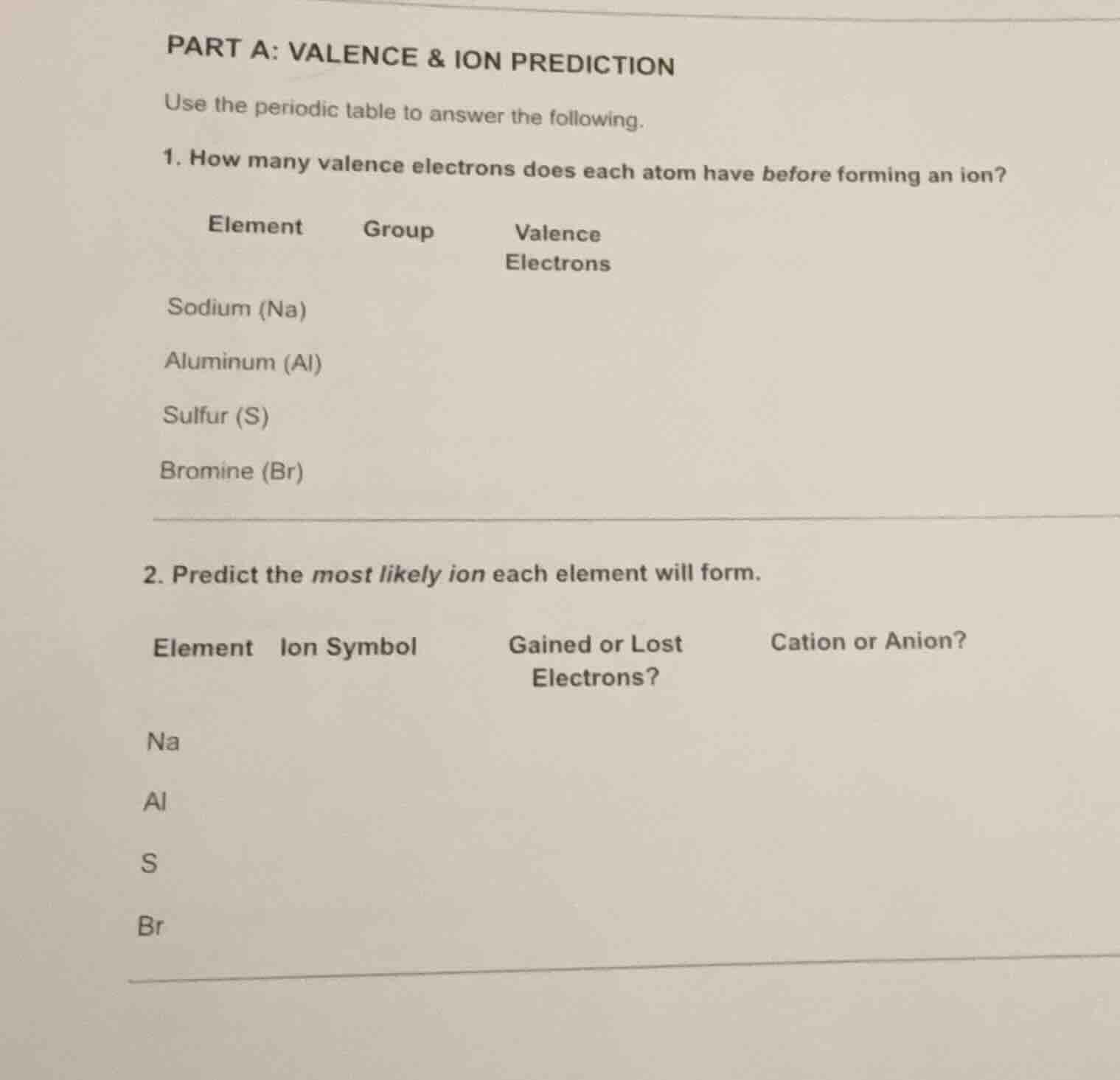
part a: valence & ion prediction
use the periodic table to answer the following.
- how many valence electrons does each atom have before forming an ion?
element group valence electrons
sodium (na)
aluminum (al)
sulfur (s)
bromine (br)
- predict the most likely ion each element will form.
element ion symbol gained or lost electrons? cation or anion?
na
al
s
br
Response
Question 1: Valence Electrons Calculation
Step 1: Sodium (Na)
- Explanation: Sodium is in Group 1 of the periodic table. For main - group elements, the number of valence electrons is equal to the group number. So, Group 1 elements have 1 valence electron.
- Expression: Group number = 1 ⇒ Valence electrons = 1
Step 2: Aluminum (Al)
- Explanation: Aluminum is in Group 13. For main - group elements, the number of valence electrons is equal to the group number minus 10 (for groups 13 - 18). So, 13 - 10 = 3 valence electrons.
- Expression: Group number = 13 ⇒ Valence electrons = 13 - 10 = 3
Step 3: Sulfur (S)
- Explanation: Sulfur is in Group 16. For main - group elements, the number of valence electrons is equal to 18 - group number (for groups 15 - 18, another way: group number - 10 for 13 - 18). So, 16 - 10 = 6 valence electrons (or 18 - 16 = 2, no, wait, for non - metals in groups 15 - 18, the number of valence electrons is 8 - (18 - group number). Wait, correct rule: for main - group elements (groups 1, 2, 13 - 18), the number of valence electrons is equal to the group number for groups 1 and 2, and for groups 13 - 18, it is group number - 10. So group 16: 16 - 10 = 6.
- Expression: Group number = 16 ⇒ Valence electrons = 16 - 10 = 6
Step 4: Bromine (Br)
- Explanation: Bromine is in Group 17. Using the rule for main - group elements (groups 13 - 18: group number - 10), 17 - 10 = 7 valence electrons.
- Expression: Group number = 17 ⇒ Valence electrons = 17 - 10 = 7
So the completed table for question 1 is:
| Element | Group | Valence Electrons |
|---|---|---|
| Aluminum (Al) | 13 | 3 |
| Sulfur (S) | 16 | 6 |
| Bromine (Br) | 17 | 7 |
Question 2: Ion Prediction
Step 1: Sodium (Na)
- Ion Symbol: Sodium has 1 valence electron. It is a metal, so it will lose its 1 valence electron to achieve a stable electron configuration (like a noble gas). When it loses 1 electron, it forms a cation with a + 1 charge. So the ion symbol is $\text{Na}^+$.
- Gained or Lost Electrons?: Lost (because it is a metal and wants to achieve a stable octet by losing the outermost electron)
- Cation or Anion?: Cation (because it loses electrons, resulting in a positive charge)
Step 2: Aluminum (Al)
- Ion Symbol: Aluminum has 3 valence electrons. It is a metal, so it will lose 3 valence electrons to achieve a stable electron configuration. When it loses 3 electrons, it forms a cation with a + 3 charge. So the ion symbol is $\text{Al}^{3+}$.
- Gained or Lost Electrons?: Lost (metal, loses electrons to get stable)
- Cation or Anion?: Cation (positive charge due to electron loss)
Step 3: Sulfur (S)
- Ion Symbol: Sulfur has 6 valence electrons. It is a non - metal, so it will gain 2 electrons to achieve a stable octet (8 valence electrons). When it gains 2 electrons, it forms an anion with a - 2 charge. So the ion symbol is $\text{S}^{2 - }$.
- Gained or Lost Electrons?: Gained (non - metal, gains electrons to get stable octet)
- Cation or Anion?: Anion (negative charge due to electron gain)
Step 4: Bromine (Br)
- Ion Symbol: Bromine has 7 valence electrons. It is a non - metal, so it will gain 1 electron to achieve a stable octet. When it gains 1 electron, it forms an anion with a - 1 charge. So the ion symbol is $\text{Br}^-$.
- Gained or Lost Electrons?: Gained (non - metal, gains electron f…

Snap & solve any problem in the app
Get step-by-step solutions on Sovi AI
Photo-based solutions with guided steps
Explore more problems and detailed explanations
Question 1: Valence Electrons Calculation
Step 1: Sodium (Na)
- Explanation: Sodium is in Group 1 of the periodic table. For main - group elements, the number of valence electrons is equal to the group number. So, Group 1 elements have 1 valence electron.
- Expression: Group number = 1 ⇒ Valence electrons = 1
Step 2: Aluminum (Al)
- Explanation: Aluminum is in Group 13. For main - group elements, the number of valence electrons is equal to the group number minus 10 (for groups 13 - 18). So, 13 - 10 = 3 valence electrons.
- Expression: Group number = 13 ⇒ Valence electrons = 13 - 10 = 3
Step 3: Sulfur (S)
- Explanation: Sulfur is in Group 16. For main - group elements, the number of valence electrons is equal to 18 - group number (for groups 15 - 18, another way: group number - 10 for 13 - 18). So, 16 - 10 = 6 valence electrons (or 18 - 16 = 2, no, wait, for non - metals in groups 15 - 18, the number of valence electrons is 8 - (18 - group number). Wait, correct rule: for main - group elements (groups 1, 2, 13 - 18), the number of valence electrons is equal to the group number for groups 1 and 2, and for groups 13 - 18, it is group number - 10. So group 16: 16 - 10 = 6.
- Expression: Group number = 16 ⇒ Valence electrons = 16 - 10 = 6
Step 4: Bromine (Br)
- Explanation: Bromine is in Group 17. Using the rule for main - group elements (groups 13 - 18: group number - 10), 17 - 10 = 7 valence electrons.
- Expression: Group number = 17 ⇒ Valence electrons = 17 - 10 = 7
So the completed table for question 1 is:
| Element | Group | Valence Electrons |
|---|---|---|
| Aluminum (Al) | 13 | 3 |
| Sulfur (S) | 16 | 6 |
| Bromine (Br) | 17 | 7 |
Question 2: Ion Prediction
Step 1: Sodium (Na)
- Ion Symbol: Sodium has 1 valence electron. It is a metal, so it will lose its 1 valence electron to achieve a stable electron configuration (like a noble gas). When it loses 1 electron, it forms a cation with a + 1 charge. So the ion symbol is $\text{Na}^+$.
- Gained or Lost Electrons?: Lost (because it is a metal and wants to achieve a stable octet by losing the outermost electron)
- Cation or Anion?: Cation (because it loses electrons, resulting in a positive charge)
Step 2: Aluminum (Al)
- Ion Symbol: Aluminum has 3 valence electrons. It is a metal, so it will lose 3 valence electrons to achieve a stable electron configuration. When it loses 3 electrons, it forms a cation with a + 3 charge. So the ion symbol is $\text{Al}^{3+}$.
- Gained or Lost Electrons?: Lost (metal, loses electrons to get stable)
- Cation or Anion?: Cation (positive charge due to electron loss)
Step 3: Sulfur (S)
- Ion Symbol: Sulfur has 6 valence electrons. It is a non - metal, so it will gain 2 electrons to achieve a stable octet (8 valence electrons). When it gains 2 electrons, it forms an anion with a - 2 charge. So the ion symbol is $\text{S}^{2 - }$.
- Gained or Lost Electrons?: Gained (non - metal, gains electrons to get stable octet)
- Cation or Anion?: Anion (negative charge due to electron gain)
Step 4: Bromine (Br)
- Ion Symbol: Bromine has 7 valence electrons. It is a non - metal, so it will gain 1 electron to achieve a stable octet. When it gains 1 electron, it forms an anion with a - 1 charge. So the ion symbol is $\text{Br}^-$.
- Gained or Lost Electrons?: Gained (non - metal, gains electron for stable octet)
- Cation or Anion?: Anion (negative charge due to electron gain)
The completed table for question 2 is:
| Element | Ion Symbol | Gained or Lost Electrons? | Cation or Anion? |
|---|---|---|---|
| Al | $\text{Al}^{3+}$ | Lost | Cation |
| S | $\text{S}^{2 - }$ | Gained | Anion |
| Br | $\text{Br}^-$ | Gained | Anion |
Final Answers
Question 1 Table:
| Element | Group | Valence Electrons |
|---|---|---|
| Aluminum (Al) | 13 | 3 |
| Sulfur (S) | 16 | 6 |
| Bromine (Br) | 17 | 7 |
Question 2 Table:
| Element | Ion Symbol | Gained or Lost Electrons? | Cation or Anion? |
|---|---|---|---|
| Al | $\text{Al}^{3+}$ | Lost | Cation |
| S | $\text{S}^{2 - }$ | Gained | Anion |
| Br | $\text{Br}^-$ | Gained | Anion |