QUESTION IMAGE
Question
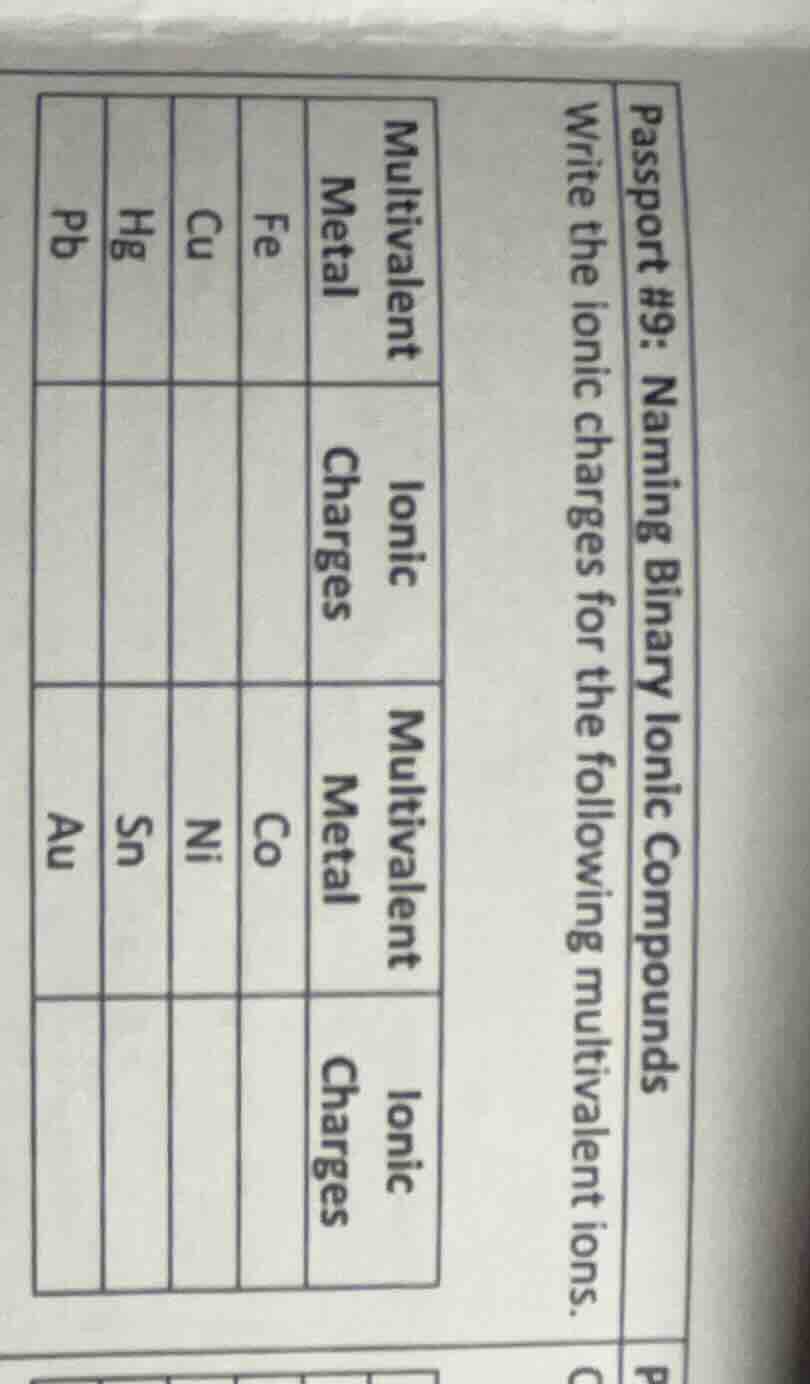
passport #9: naming binary ionic compounds
write the ionic charges for the following multivalent ions.
multivalent metal\tionic charges\tmultivalent metal\tionic charges
fe\t\tco\t
cu\t\tni\t
hg\t\tsn\t
pb\t\tau\t
Step1: Recall ionic charges of multivalent metals
- Iron (Fe): commonly \( +2 \) (ferrous) and \( +3 \) (ferric)
- Copper (Cu): \( +1 \) (cuprous) and \( +2 \) (cupric)
- Mercury (Hg): \( +1 \) (mercurous, as \( \text{Hg}_2^{2+} \)) and \( +2 \) (mercuric)
- Lead (Pb): \( +2 \) and \( +4 \)
- Cobalt (Co): \( +2 \) and \( +3 \)
- Nickel (Ni): \( +2 \) (common), sometimes \( +3 \)
- Tin (Sn): \( +2 \) (stannous) and \( +4 \) (stannic)
- Gold (Au): \( +1 \) (aurous) and \( +3 \) (auric)
Step2: Fill the table with ionic charges
| Multivalent Metal | Ionic Charges | Multivalent Metal | Ionic Charges |
|---|---|---|---|
| Cu | \( +1, +2 \) | Ni | \( +2 \) (or \( +2, +3 \)) |
| Hg | \( +1 \) (as \( \text{Hg}_2^{2+} \)), \( +2 \) | Sn | \( +2, +4 \) |
| Pb | \( +2, +4 \) | Au | \( +1, +3 \) |

Snap & solve any problem in the app
Get step-by-step solutions on Sovi AI
Photo-based solutions with guided steps
Explore more problems and detailed explanations
The ionic charges for the multivalent metals are filled in the table as shown above. For example:
- Fe: \( +2, +3 \)
- Cu: \( +1, +2 \)
- Hg: \( +1 \) (as \( \text{Hg}_2^{2+} \)), \( +2 \)
- Pb: \( +2, +4 \)
- Co: \( +2, +3 \)
- Ni: \( +2 \) (or \( +2, +3 \))
- Sn: \( +2, +4 \)
- Au: \( +1, +3 \)