QUESTION IMAGE
Question
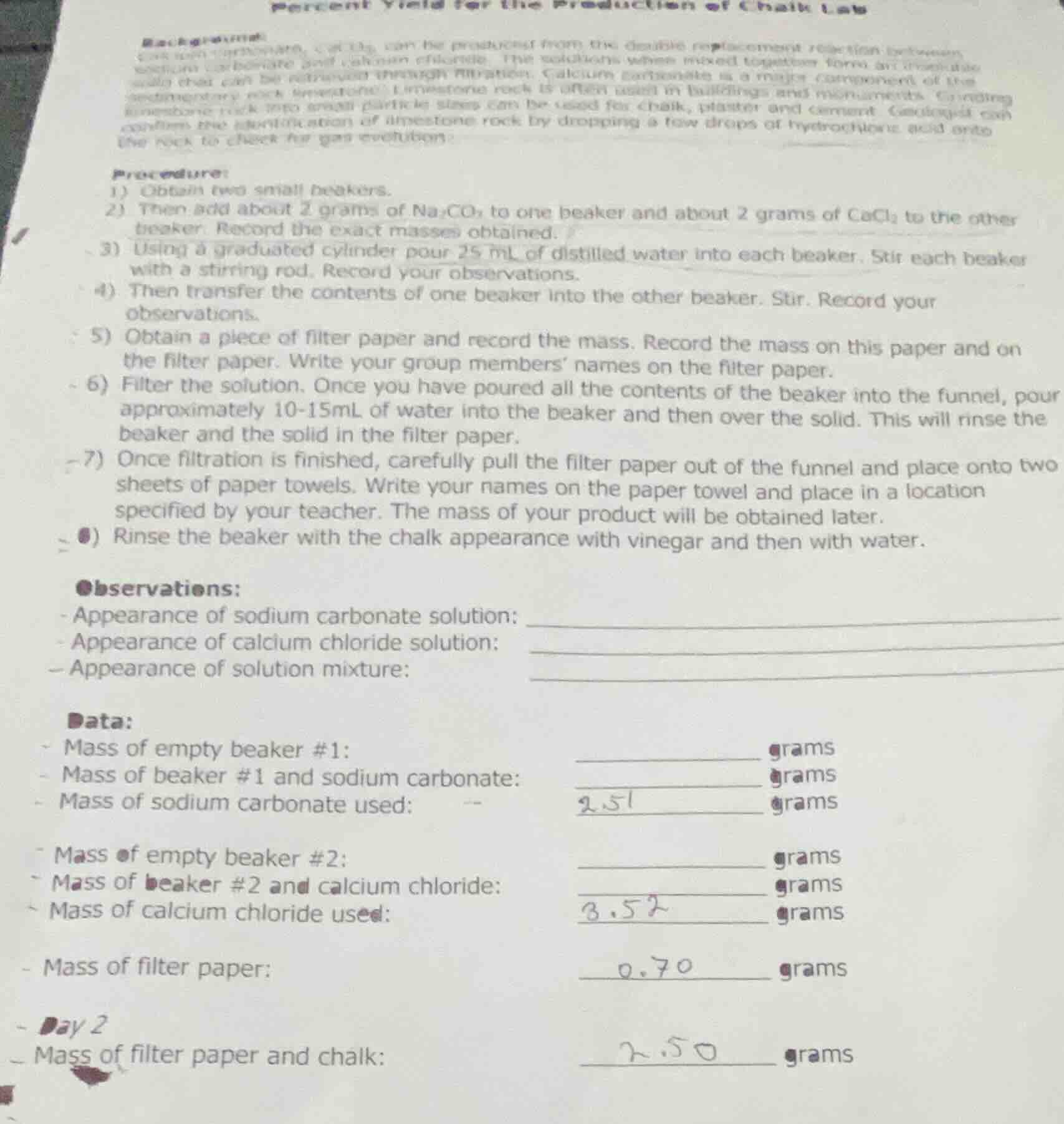
percent yield for the production of chalk labbackground:calcium carbonate, caco₃, can be produced from the double replacement reaction between sodium carbonate and calcium chloride. the solutions when mixed together form an insoluble solid that can be retrieved through filtration. calcium carbonate is a major component of the sedimentary rock limestone. limestone rock is often used in buildings and monuments. grinding limestone rock into small particle sizes can be used for chalk, plaster and cement. geologists can confirm the identification of limestone rock by dropping a few drops of hydrochloric acid onto the rock to check for gas evolution.procedure:1) obtain two small beakers.2) then add about 2 grams of na₂co₃ to one beaker and about 2 grams of cacl₂ to the other beaker. record the exact masses obtained.3) using a graduated cylinder pour 25 ml of distilled water into each beaker. stir each beaker with a stirring rod. record your observations.4) then transfer the contents of one beaker into the other beaker. stir. record your observations.5) obtain a piece of filter paper and record the mass. record the mass on this paper and on the filter paper. write your group members names on the filter paper.6) filter the solution. once you have poured all the contents of the beaker into the funnel, pour approximately 10-15ml of water into the beaker and then over the solid. this will rinse the beaker and the solid in the filter paper.7) once filtration is finished, carefully pull the filter paper out of the funnel and place onto two sheets of paper towels. write your names on the paper towel and place in a location specified by your teacher. the mass of your product will be obtained later.8) rinse the beaker with the chalk appearance with vinegar and then with water.observations:- appearance of sodium carbonate solution: - appearance of calcium chloride solution: - appearance of solution mixture: data:- mass of empty beaker #1: grams- mass of beaker #1 and sodium carbonate: grams- mass of sodium carbonate used: 2.51 grams- mass of empty beaker #2: grams- mass of beaker #2 and calcium chloride: grams- mass of calcium chloride used: 3.52 grams- mass of filter paper: 0.70 grams- day 2- mass of filter paper and chalk: 2.50 grams
Step1: Calculate actual mass of chalk
Subtract filter paper mass from combined mass.
$\text{Actual mass of chalk} = 2.50\ \text{g} - 0.70\ \text{g} = 1.80\ \text{g}$
Step2: Write balanced reaction
State the chemical reaction equation.
Step3: Find molar masses
Calculate molar masses of reactants/product.
Molar mass of $\text{Na}_2\text{CO}_3 = 2(23) + 12 + 3(16) = 106\ \text{g/mol}$
Molar mass of $\text{CaCl}_2 = 40 + 2(35.5) = 111\ \text{g/mol}$
Molar mass of $\text{CaCO}_3 = 40 + 12 + 3(16) = 100\ \text{g/mol}$
Step4: Calculate moles of reactants
Divide mass by molar mass for each reactant.
Moles of $\text{Na}_2\text{CO}_3 = \frac{2.51\ \text{g}}{106\ \text{g/mol}} \approx 0.0237\ \text{mol}$
Moles of $\text{CaCl}_2 = \frac{3.52\ \text{g}}{111\ \text{g/mol}} \approx 0.0317\ \text{mol}$
Step5: Identify limiting reactant
Compare mole ratio (1:1 reaction).
$\text{Na}_2\text{CO}_3$ has fewer moles, so it is limiting.
Step6: Calculate theoretical yield
Use moles of limiting reactant.
$\text{Theoretical yield} = 0.0237\ \text{mol} \times 100\ \text{g/mol} = 2.37\ \text{g}$
Step7: Calculate percent yield
Divide actual by theoretical, multiply by 100.
$\text{Percent yield} = \frac{1.80\ \text{g}}{2.37\ \text{g}} \times 100 \approx 75.95\%$

Snap & solve any problem in the app
Get step-by-step solutions on Sovi AI
Photo-based solutions with guided steps
Explore more problems and detailed explanations
Percent yield of chalk (calcium carbonate): $\approx 76.0\%$
Actual mass of chalk: $1.80\ \text{g}$
Theoretical yield of chalk: $2.37\ \text{g}$
Filled Observations (expected):
- Appearance of sodium carbonate solution: Clear, colorless liquid
- Appearance of calcium chloride solution: Clear, colorless liquid
- Appearance of solution mixture: White, cloudy precipitate (suspension) forms