QUESTION IMAGE
Question
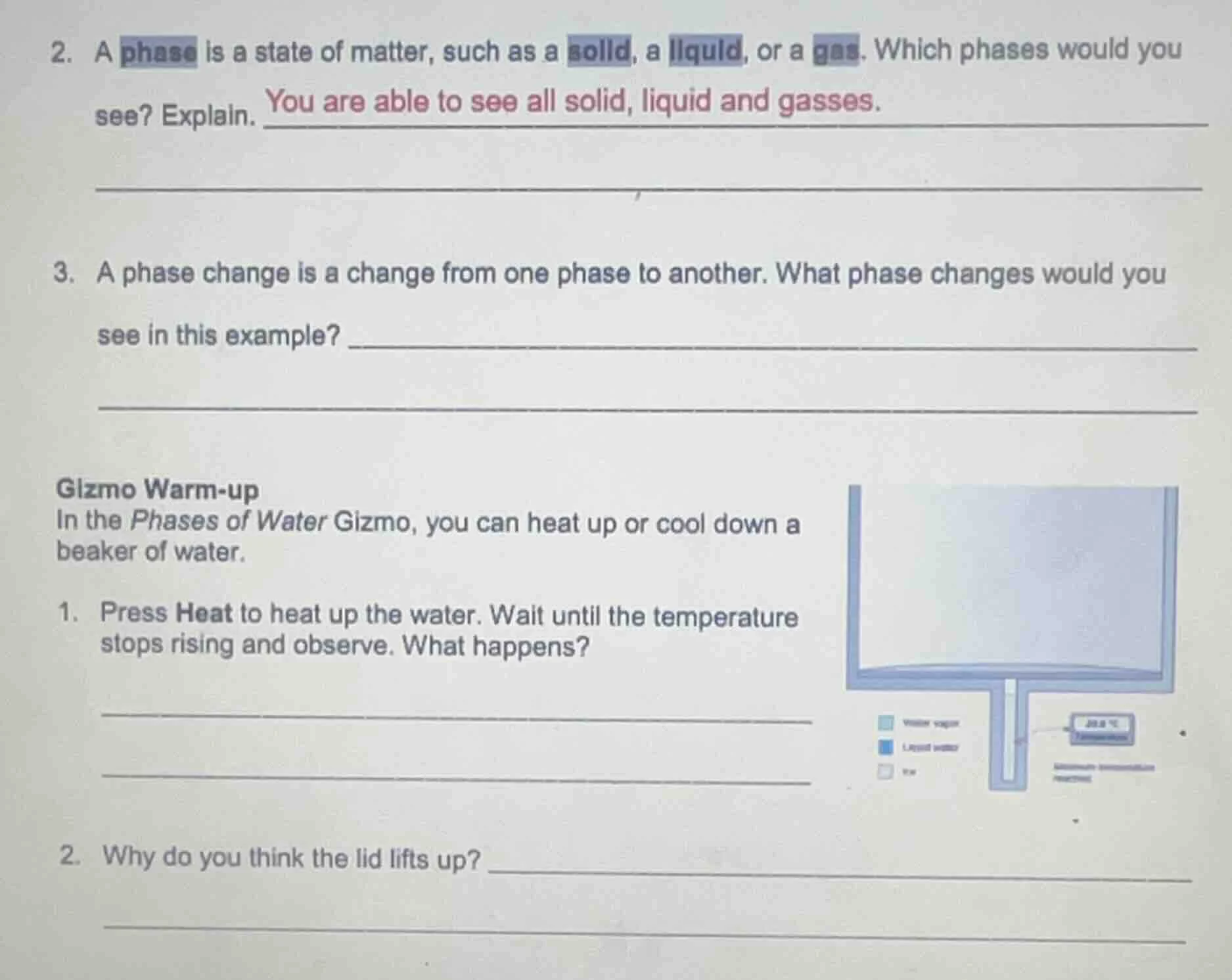
- a phase is a state of matter, such as a solid, a liquid, or a gas. which phases would you see? explain. you are able to see all solid, liquid and gasses.
- a phase change is a change from one phase to another. what phase changes would you see in this example?
gizmo warm - up
in the phases of water gizmo, you can heat up or cool down a beaker of water.
- press heat to heat up the water. wait until the temperature stops rising and observe. what happens?
- why do you think the lid lifts up?
For Question 2 (Phase Change):
This refers to water's phase changes: solid (ice) to liquid (melting), liquid to gas (vaporization/boiling), gas to liquid (condensation), and liquid to solid (freezing) when heating/cooling.
For Gizmo Warm-up Question 1:
When heating water until temperature stops rising, the water boils, turning from liquid water into water vapor (gas), and bubbles form as it vaporizes.
For Gizmo Warm-up Question 2:
As liquid water turns into water vapor, the gas molecules move rapidly and build up pressure inside the sealed beaker. This pressure pushes upward on the lid, causing it to lift.
For Question 3 (Phases Visible Correction):
Note: Water vapor (gas phase of water) is invisible to the naked eye; what is seen as "steam" is condensed liquid water droplets. So visible phases are solid (ice) and liquid (liquid water, condensed droplets), while the gaseous water vapor itself cannot be seen.

Snap & solve any problem in the app
Get step-by-step solutions on Sovi AI
Photo-based solutions with guided steps
Explore more problems and detailed explanations
- (Corrected): You can see solid (ice) and liquid (liquid water, condensed water droplets); water vapor (gas) is invisible.
- Melting (solid to liquid), vaporization/boiling (liquid to gas), condensation (gas to liquid), freezing (liquid to solid)
Gizmo Warm-up 1: The water boils, forming bubbles, and liquid water turns into water vapor (gas).
Gizmo Warm-up 2: The lid lifts because water vapor builds up pressure inside the beaker as liquid water boils into gas.