QUESTION IMAGE
Question
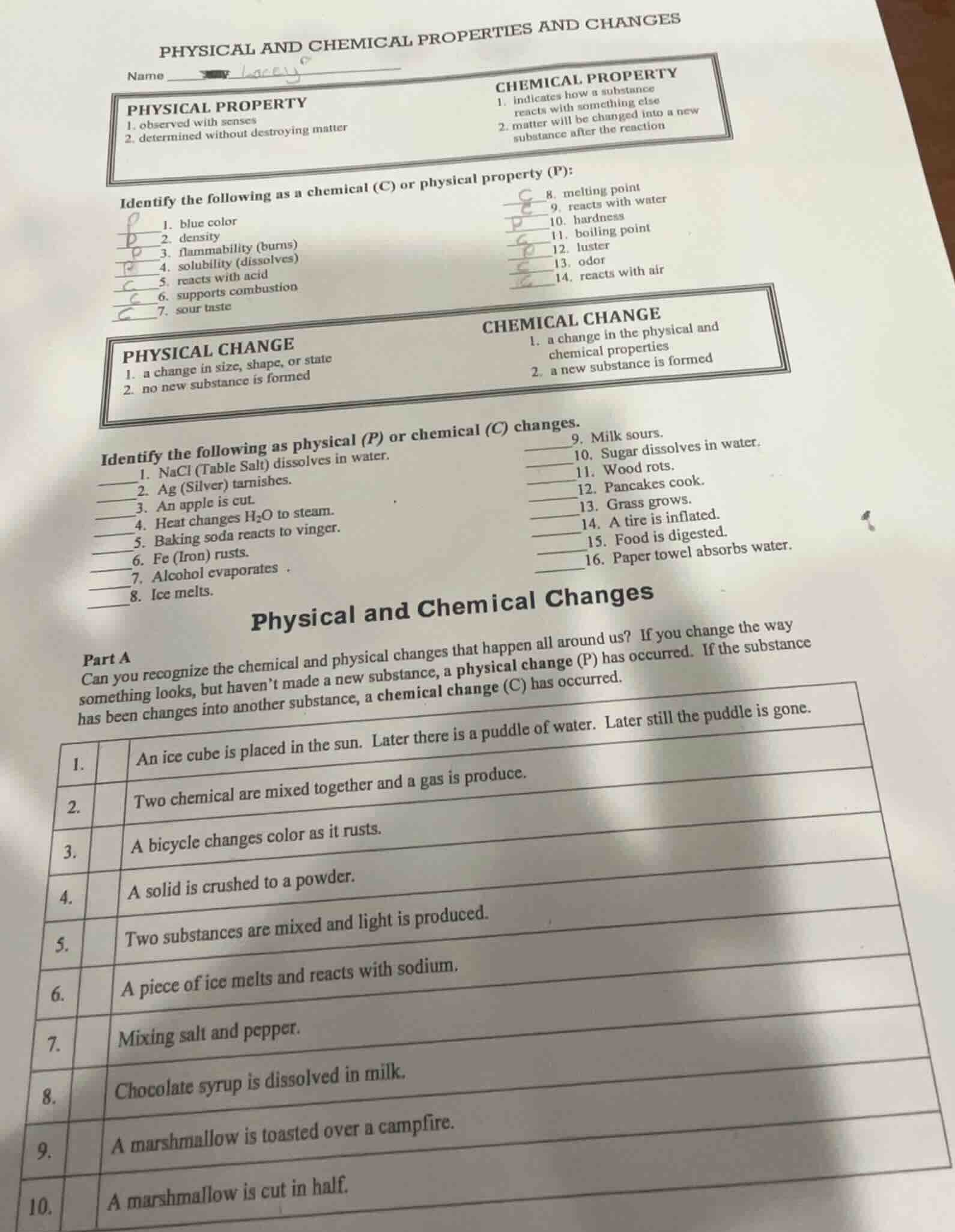
physical and chemical properties and changes
name
physical property
- observed with senses
- determined without destroying matter
chemical property
- indicates how a substance reacts with something else
- matter will be changed into a new substance after the reaction
identify the following as a chemical (c) or physical property (p):
- blue color
- density
- flammability (burns)
- solubility (dissolves)
- reacts with acid
- supports combustion
- sour taste
- melting point
- reacts with water
- hardness
- boiling point
- luster
- odor
- reacts with air
physical change
- a change in size, shape, or state
- no new substance is formed
chemical change
- a change in the physical and chemical properties
- a new substance is formed
identify the following as physical (p) or chemical (c) changes.
- nacl (table salt) dissolves in water.
- ag (silver) tarnishes.
- an apple is cut.
- heat changes h₂o to steam.
- baking soda reacts to vinger.
- fe (iron) rusts.
- alcohol evaporates.
- ice melts.
- milk sours.
- sugar dissolves in water.
- wood rots.
- pancakes cook.
- grass grows.
- a tire is inflated.
- food is digested.
- paper towel absorbs water.
physical and chemical changes
part a
can you recognize the chemical and physical changes that happen all around us? if you change the way something looks, but havent made a new substance, a physical change (p) has occurred. if the substance has been changes into another substance, a chemical change (c) has occurred.
- an ice cube is placed in the sun. later there is a puddle of water. later still the puddle is gone.
- two chemical are mixed together and a gas is produce.
- a bicycle changes color as it rusts.
- a solid is crushed to a powder.
- two substances are mixed and light is produced.
- a piece of ice melts and reacts with sodium.
- mixing salt and pepper.
- chocolate syrup is dissolved in milk.
- a marshmallow is toasted over a campfire.
- a marshmallow is cut in half.
Response
Part A (Identifying Physical (P) or Chemical (C) Changes)
1. An ice cube is placed in the sun...
- Explanation: Ice melts to water (state change) and water evaporates (state change). No new substance is formed.
- Classification: Physical Change (P)
2. Two chemicals are mixed... and a gas is produced.
- Explanation: A gas (new substance) is formed from the reaction of two chemicals.
- Classification: Chemical Change (C)
3. A bicycle changes color as it rusts.
- Explanation: Rust (a new substance, iron oxide) forms on the bicycle.
- Classification: Chemical Change (C)
4. A solid is crushed to a powder.
- Explanation: Only the size/shape changes (powder vs. solid). No new substance is formed.
- Classification: Physical Change (P)
5. Two substances are mixed and light is produced.
- Explanation: Light production often indicates a chemical reaction (e.g., combustion or energy-releasing reactions). A new substance is likely formed.
- Classification: Chemical Change (C)
6. A piece of ice melts and reacts with sodium.
- Explanation: Ice melts (physical change), but then water reacts with sodium (forming sodium hydroxide and hydrogen gas—new substances). The reaction is chemical.
- Classification: Chemical Change (C) (the reaction with sodium is the key chemical change)
7. Mixing salt and pepper.
- Explanation: Salt and pepper are just combined (no reaction, no new substance). This is a mixture.
- Classification: Physical Change (P)
8. Chocolate syrup is dissolved in milk.
- Explanation: Dissolving is a physical process (no new substance; syrup and milk retain their chemical identities).
- Classification: Physical Change (P)
9. A marshmallow is toasted over a campfire.
- Explanation: Toasting causes charring (carbonization) and chemical reactions (new substances like CO₂, ash, and caramelized sugars form).
- Classification: Chemical Change (C)
10. A marshmallow is cut in half.
- Explanation: Only the size/shape changes (halved). No new substance is formed.
- Classification: Physical Change (P)
Final Answers (Part A)
- P
- C
- C
- P
- C
- C
- P
- P
- C
- P
Additional Sections (Properties and Changes)
Physical/Chemical Properties (Top Section)
- Blue color: P (observed with senses, no destruction of matter).
- Density: P (measured without destroying matter).
- Flammability: C (describes how a substance reacts/burns, forming new substances).
- Solubility: P (dissolving is a physical process, no new substance).
- Reacts with acid: C (reaction forms new substances).
- Supports combustion: C (describes reaction with oxygen, forming new substances).
- Sour taste: P (observed with senses, no destruction of matter).
- Melting point: P (measured without destroying matter).
- Reacts with water: C (reaction forms new substances).
- Hardness: P (measured without destroying matter).
- Boiling point: P (measured without destroying matter).
- Luster: P (observed with senses, no destruction of matter).
- Odor: P (observed with senses, no destruction of matter).
- Reacts with air: C (reaction forms new substances, e.g., oxidation).
Physical/Chemical Changes (Middle Section)
- NaCl dissolves in water: P (dissolving, no new substance).
- Ag tarnishes: C (tarnish = silver sulfide, new substance).
- An apple is cut: P (size/shape change, no new substance).
- Heat changes H₂O to steam: P (state change, no new substance).
- Baking sod…

Snap & solve any problem in the app
Get step-by-step solutions on Sovi AI
Photo-based solutions with guided steps
Explore more problems and detailed explanations
Part A (Identifying Physical (P) or Chemical (C) Changes)
1. An ice cube is placed in the sun...
- Explanation: Ice melts to water (state change) and water evaporates (state change). No new substance is formed.
- Classification: Physical Change (P)
2. Two chemicals are mixed... and a gas is produced.
- Explanation: A gas (new substance) is formed from the reaction of two chemicals.
- Classification: Chemical Change (C)
3. A bicycle changes color as it rusts.
- Explanation: Rust (a new substance, iron oxide) forms on the bicycle.
- Classification: Chemical Change (C)
4. A solid is crushed to a powder.
- Explanation: Only the size/shape changes (powder vs. solid). No new substance is formed.
- Classification: Physical Change (P)
5. Two substances are mixed and light is produced.
- Explanation: Light production often indicates a chemical reaction (e.g., combustion or energy-releasing reactions). A new substance is likely formed.
- Classification: Chemical Change (C)
6. A piece of ice melts and reacts with sodium.
- Explanation: Ice melts (physical change), but then water reacts with sodium (forming sodium hydroxide and hydrogen gas—new substances). The reaction is chemical.
- Classification: Chemical Change (C) (the reaction with sodium is the key chemical change)
7. Mixing salt and pepper.
- Explanation: Salt and pepper are just combined (no reaction, no new substance). This is a mixture.
- Classification: Physical Change (P)
8. Chocolate syrup is dissolved in milk.
- Explanation: Dissolving is a physical process (no new substance; syrup and milk retain their chemical identities).
- Classification: Physical Change (P)
9. A marshmallow is toasted over a campfire.
- Explanation: Toasting causes charring (carbonization) and chemical reactions (new substances like CO₂, ash, and caramelized sugars form).
- Classification: Chemical Change (C)
10. A marshmallow is cut in half.
- Explanation: Only the size/shape changes (halved). No new substance is formed.
- Classification: Physical Change (P)
Final Answers (Part A)
- P
- C
- C
- P
- C
- C
- P
- P
- C
- P
Additional Sections (Properties and Changes)
Physical/Chemical Properties (Top Section)
- Blue color: P (observed with senses, no destruction of matter).
- Density: P (measured without destroying matter).
- Flammability: C (describes how a substance reacts/burns, forming new substances).
- Solubility: P (dissolving is a physical process, no new substance).
- Reacts with acid: C (reaction forms new substances).
- Supports combustion: C (describes reaction with oxygen, forming new substances).
- Sour taste: P (observed with senses, no destruction of matter).
- Melting point: P (measured without destroying matter).
- Reacts with water: C (reaction forms new substances).
- Hardness: P (measured without destroying matter).
- Boiling point: P (measured without destroying matter).
- Luster: P (observed with senses, no destruction of matter).
- Odor: P (observed with senses, no destruction of matter).
- Reacts with air: C (reaction forms new substances, e.g., oxidation).
Physical/Chemical Changes (Middle Section)
- NaCl dissolves in water: P (dissolving, no new substance).
- Ag tarnishes: C (tarnish = silver sulfide, new substance).
- An apple is cut: P (size/shape change, no new substance).
- Heat changes H₂O to steam: P (state change, no new substance).
- Baking soda + vinegar: C (gas (CO₂) and new substances form).
- Fe rusts: C (rust = iron oxide, new substance).
- Alcohol evaporates: P (state change, no new substance).
- Ice melts: P (state change, no new substance).
- Milk sours: C (lactic acid forms, new substance).
- Sugar dissolves in water: P (dissolving, no new substance).
- Wood rots: C (decomposition, new substances form).
- Pancakes cook: C (chemical reactions, new substances form).
- Grass grows: C (photosynthesis and growth involve new substances).
- A tire is inflated: P (air added, no new substance).
- Food is digested: C (breakdown into new substances, e.g., nutrients).
- Paper towel absorbs water: P (absorption, no new substance).
Final Answers (Middle Section)
- P
- C
- P
- P
- C
- C
- P
- P
- C
- P
- C
- C
- C
- P
- C
- P