QUESTION IMAGE
Question
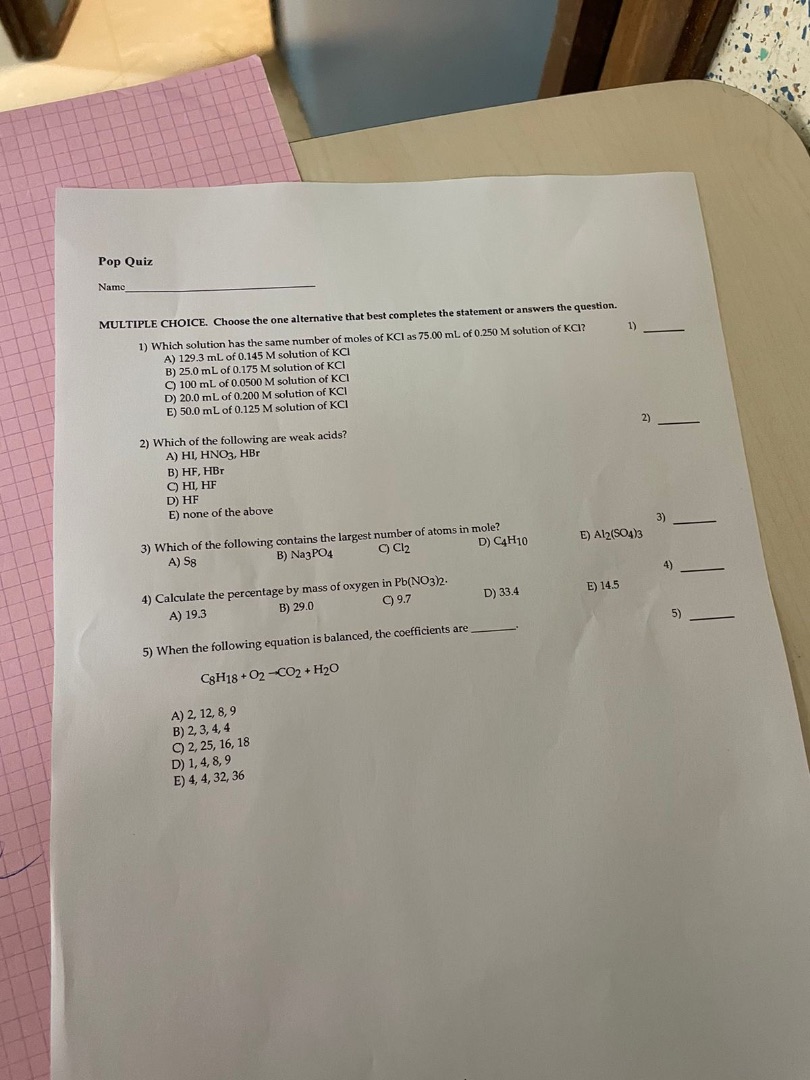
pop quiz
name_____________________
multiple choice. choose the one alternative that best completes the statement or answers the question.
- which solution has the same number of moles of kcl as 75.00 ml of 0.250 m solution of kcl?
a) 129.3 ml of 0.145 m solution of kcl
b) 25.0 ml of 0.175 m solution of kcl
c) 100 ml of 0.0500 m solution of kcl
d) 20.0 ml of 0.0200 m solution of kcl
e) 50.0 ml of 0.125 m solution of kcl
- ______
- which of the following are weak acids?
a) hi, hno₃, hbr
b) hf, hbr
c) hi, hf
d) hf
e) none of the above
- ______
- which of the following contains the largest number of atoms in mole?
a) s₈
b) na₃po₄
c) cl₂
d) c₄h₁₀
e) al₂(so₄)₃
- ______
- calculate the percentage by mass of oxygen in pb(no₃)₂.
a) 19.3
b) 29.0
c) 9.7
d) 33.4
e) 14.5
- ______
- when the following equation is balanced, the coefficients are ______.
c₈h₁₈ + o₂ → co₂ + h₂o
a) 2, 12, 8, 9
b) 2, 3, 4, 4
c) 2, 25, 16, 18
d) 1, 4, 8, 9
e) 4, 4, 32, 36
- ______
Question 1
Step1: Calculate moles of KCl in given solution
Moles = Molarity × Volume (in L). For 75.00 mL (0.075 L) of 0.250 M KCl: $n = 0.250 \times 0.075 = 0.01875$ mol.
Step2: Check each option
- Option A: 129.3 mL (0.1293 L) of 0.145 M: $n = 0.145 \times 0.1293 \approx 0.01875$ mol.
- Option B: 25.0 mL (0.025 L) of 0.175 M: $n = 0.175 \times 0.025 = 0.004375$ mol.
- Option C: 100 mL (0.1 L) of 0.0500 M: $n = 0.0500 \times 0.1 = 0.005$ mol.
- Option D: 20.0 mL (0.02 L) of 0.0200 M: $n = 0.0200 \times 0.02 = 0.0004$ mol.
- Option E: 50.0 mL (0.05 L) of 0.125 M: $n = 0.125 \times 0.05 = 0.00625$ mol.
HI and HBr are strong acids, $HNO_3$ is strong. HF is a weak acid. Only HF is weak here, but option D says none of the above? Wait, no: option D is "none of the above"? Wait, no, let's recheck. Options: A) HI, $HNO_3$, HBr (all strong). B) HF, HBr (HBr strong, HF weak). C) HI, HF (HI strong, HF weak). D) HF (wait, no, the options: D is "HF"? Wait, no, the options as given: 2) Which of the following are weak acids? A) HI, $HNO_3$, HBr; B) HF, HBr; C) HI, HF; D) HF; E) none of the above. Wait, HF is a weak acid. But the options: D is HF? Wait, maybe the user's options: let's see, the original options: A) HI, HNO3, HBr; B) HF, HBr; C) HI, HF; D) HF; E) none of the above. Wait, HF is weak. But maybe the question has a typo? Wait, no, HI is strong, HBr strong, $HNO_3$ strong. HF is weak. So option D: HF. But let's confirm. Weak acids: HF is weak, others in options are strong. So the correct answer is D? Wait, no, the options: D is "HF"? Wait, the user's options: 2) A) HI, HNO3, HBr; B) HF, HBr; C) HI, HF; D) HF; E) none of the above. So HF is a weak acid, so D? But maybe the intended answer is D? Wait, no, maybe I misread. Wait, the options: D is "HF" (single), but maybe the question expects multiple? No, the question says "which of the following are weak acids" (plural? Or maybe not). Wait, HF is weak, others in options are strong. So the correct answer is D? Wait, no, the options: D is "HF", E is "none of the above". Wait, maybe the question has a mistake, but according to acid strength: HF is weak, HI, HBr, $HNO_3$ are strong. So among the options, only HF is weak, so if D is "HF", then D. But let's check again.
Step1: Calculate number of atoms per mole for each compound.
- A) $S_8$: 1 mole has 8 moles of S atoms (since 1 molecule has 8 S atoms).
- B) $Na_3PO_4$: 1 mole has 3 Na + 1 P + 4 O = 8 atoms? Wait, no: number of atoms per mole: 1 mole of $Na_3PO_4$ has 3 Na, 1 P, 4 O: total 3+1+4=8 atoms? Wait, no, 3+1+4=8? 3+1=4, +4=8? Yes. Wait, no: 3 Na, 1 P, 4 O: 3+1+4=8 atoms per molecule, so per mole, 8 moles of atoms? Wait, no, 1 mole of $Na_3PO_4$ has 3 moles Na, 1 mole P, 4 moles O: total 3+1+4=8 moles of atoms.
- C) $Cl_2$: 1 mole has 2 moles of Cl atoms.
- D) $C_4H_{10}$: 4 C + 10 H = 14 atoms per molecule, so 14 moles of atoms per mole.
- E) $Al_2(SO_4)_3$: 2 Al + 3 S + 12 O = 2+3+12=17 atoms per molecule, so 17 moles of atoms per mole. Wait, wait, let's recalculate:
- A) $S_8$: 1 mole of $S_8$ has 8 moles of S atoms (since each molecule has 8 S).
- B) $Na_3PO_4$: 3 Na, 1 P, 4 O: 3+1+4=8 moles of atoms per mole.
- C) $Cl_2$: 2 moles of Cl atoms per mole.
- D) $C_4H_{10}$: 4 C + 10 H = 14 moles of atoms per mole.
- E) $Al_2(SO_4)_3$: 2 Al, 3 S, 12 O (since 3*4=12 O). So 2+3+12=17 moles of atoms per mole. Wait, that's more than D. Wait, did I miscalculate D? $C_4H_{10}$: 4 C and 10 H: 4+10=14. E: 2 Al, 3 S, 12 O: 2+3=5, +12=17. So E has 17, which is more than D's 14, A's 8, B's 8, C's 2. Wait, but the options: A) $S_8$, B) $Na_3PO_4$, C) $Cl_2$, D) $C_4H_{10}$, E) $Al_2(SO_4)_3$. So E has 17 atoms per mole, which is the largest. Wait, but let's check again:
- $Al_2(SO_4)_3$: formula is $Al_2(SO_4)_3$, so 2 Al, 3 S, and 3*4=12 O. So total atoms: 2+3+12=17. Yes. So E has 17 moles of atoms per mole, which is the largest. Wait, but the options: is E the answer? Wait, maybe I made a mistake. Let's check D: $C_4H_{10}$: 4 C (4 moles) + 10 H (10 moles) = 14 moles of atoms. E: 2 Al (2) + 3 S (3) + 12 O (12) = 17. So E is larger. So the answer is E.
Question 4

Snap & solve any problem in the app
Get step-by-step solutions on Sovi AI
Photo-based solutions with guided steps
Explore more problems and detailed explanations
A. 129.3 mL of 0.145 M solution of KCl