QUESTION IMAGE
Question
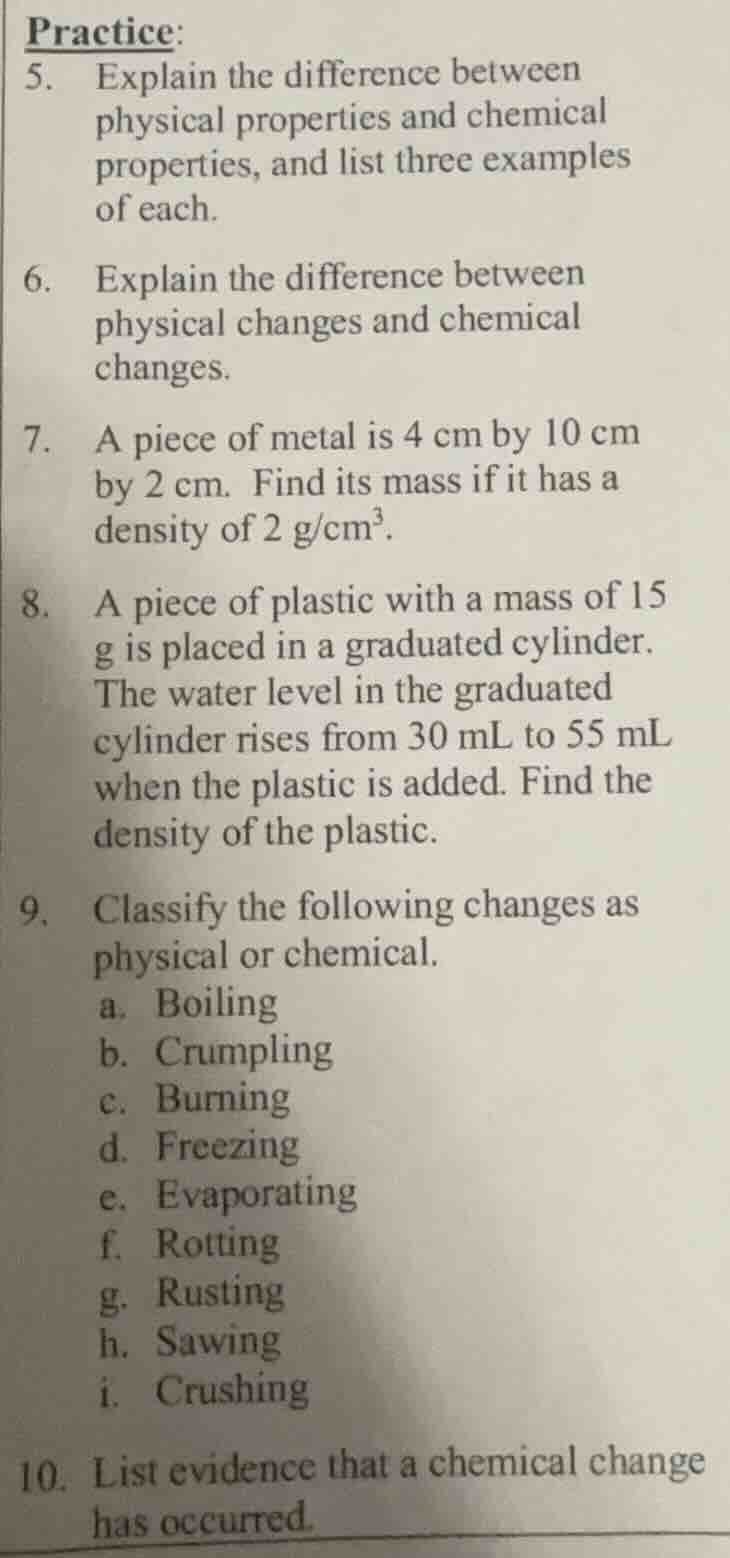
practice:
- explain the difference between physical properties and chemical properties, and list three examples of each.
- explain the difference between physical changes and chemical changes.
- a piece of metal is 4 cm by 10 cm by 2 cm. find its mass if it has a density of 2 g/cm³.
- a piece of plastic with a mass of 15 g is placed in a graduated cylinder. the water level in the graduated cylinder rises from 30 ml to 55 ml when the plastic is added. find the density of the plastic.
- classify the following changes as physical or chemical.
a. boiling
b. crumpling
c. burning
d. freezing
e. evaporating
f. rotting
g. rusting
h. sawing
i. crushing
- list evidence that a chemical change has occurred.
Question 5
Physical properties describe observable/measurable traits of a substance without altering its chemical identity. Chemical properties describe how a substance reacts to form new substances.
Physical changes alter a substance's form but not its chemical makeup. Chemical changes create new substances with different properties.
Step1: Calculate metal volume
$$V = l \times w \times h = 4\ \text{cm} \times 10\ \text{cm} \times 2\ \text{cm} = 80\ \text{cm}^3$$
Step2: Solve for mass using density
Density formula: $
ho = \frac{m}{V}$, rearranged to $m =
ho \times V$
$$m = 2\ \text{g/cm}^3 \times 80\ \text{cm}^3$$

Snap & solve any problem in the app
Get step-by-step solutions on Sovi AI
Photo-based solutions with guided steps
Explore more problems and detailed explanations
- Physical Properties: Characteristics observable without changing the substance's chemical composition.
Examples: Density ($\frac{\text{mass}}{\text{volume}}$), color, melting point.
- Chemical Properties: Characteristics describing a substance's ability to form new substances.
Examples: Flammability, reactivity with acid, oxidation resistance.
---