QUESTION IMAGE
Question
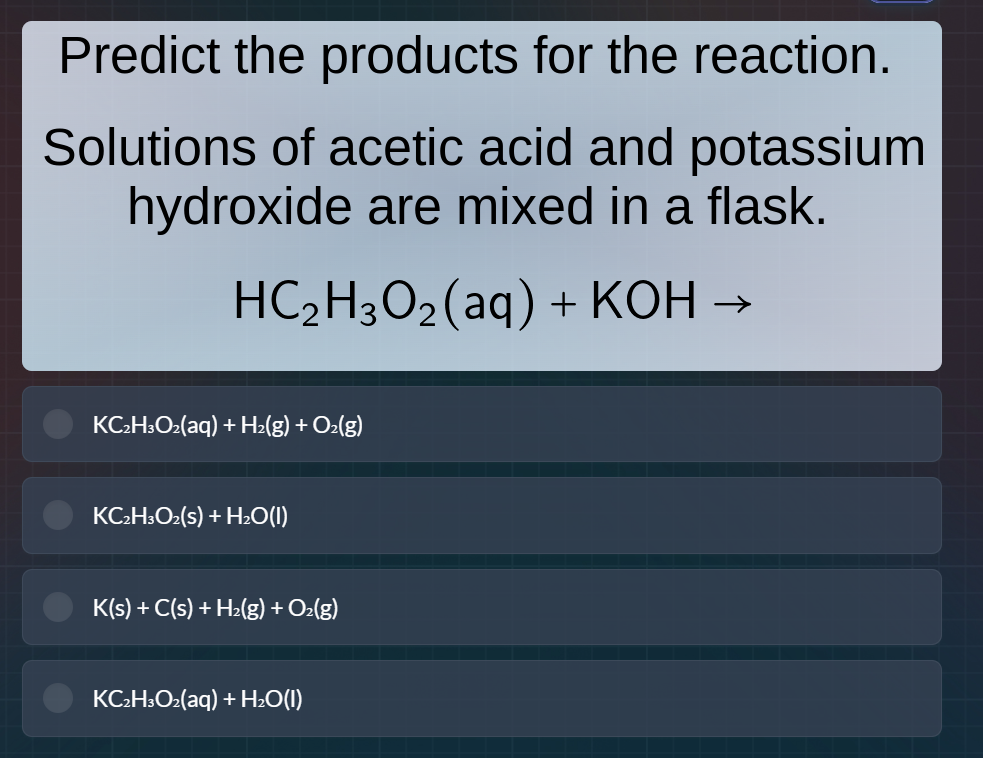
predict the products for the reaction. solutions of acetic acid and potassium hydroxide are mixed in a flask. hc₂h₃o₂(aq) + koh → kc₂h₃o₂(aq) + h₂(g) + o₂(g) kc₂h₃o₂(s) + h₂o(l) k(s) + c(s) + h₂(g) + o₂(g) kc₂h₃o₂(aq) + h₂o(l)
Step1: Identify Reaction Type
Acetic acid ($\ce{HC2H3O2}$) is a weak acid, and potassium hydroxide ($\ce{KOH}$) is a strong base. This is an acid - base neutralization reaction. In an acid - base neutralization reaction, an acid and a base react to form a salt and water.
Step2: Determine Products
The general form of an acid - base neutralization reaction is: Acid + Base $
ightarrow$ Salt + Water.
For the reaction between acetic acid ($\ce{HC2H3O2}$) and potassium hydroxide ($\ce{KOH}$):
- The acid donates a proton ($\ce{H+}$) and the base donates a hydroxide ion ($\ce{OH-}$). The $\ce{H+}$ from the acid and $\ce{OH-}$ from the base combine to form water ($\ce{H2O}$).
- The remaining ions, $\ce{C2H3O2-}$ (acetate ion) from the acid and $\ce{K+}$ (potassium ion) from the base, combine to form the salt potassium acetate ($\ce{KC2H3O2}$). Since potassium acetate is soluble in water (because potassium salts are generally soluble), it will be in the aqueous state ($\ce{aq}$), and water is in the liquid state ($\ce{l}$).
So the reaction is $\ce{HC2H3O2(aq) + KOH(aq)
ightarrow KC2H3O2(aq) + H2O(l)}$

Snap & solve any problem in the app
Get step-by-step solutions on Sovi AI
Photo-based solutions with guided steps
Explore more problems and detailed explanations
$\ce{KC2H3O2(aq) + H2O(l)}$ (the option: $\ce{KC2H3O2(aq) + H2O(l)}$)