QUESTION IMAGE
Question
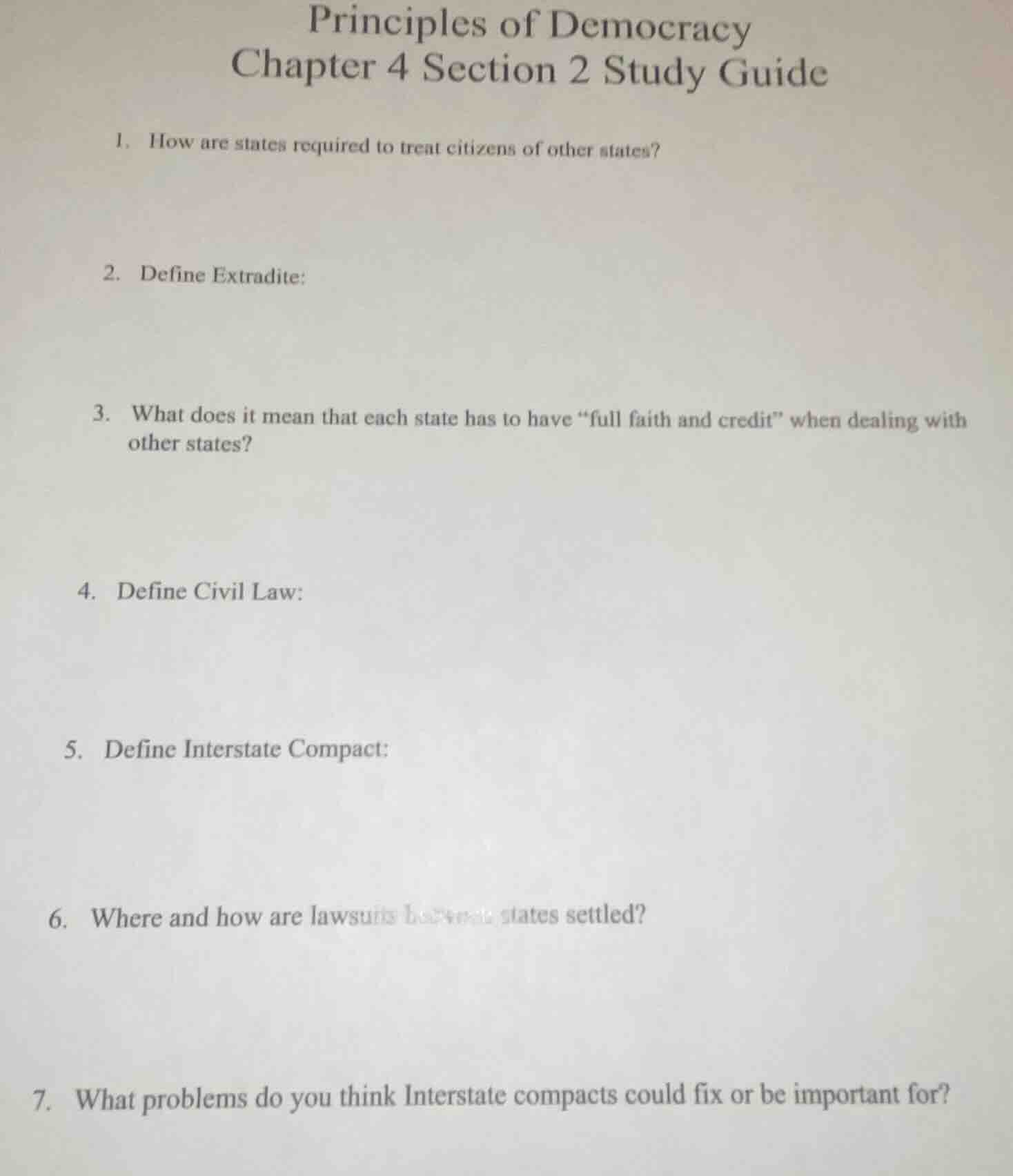
principles of democracy
chapter 4 section 2 study guide
- how are states required to treat citizens of other states?
- define extradite:
- what does it mean that each state has to have \full faith and credit\ when dealing with
other states?
- define civil law:
- define interstate compact:
- where and how are lawsuits between states settled?
- what problems do you think interstate compacts could fix or be important for?
Question 1
States must treat citizens of other states equally under the Privileges and Immunities Clause. This means they can't discriminate against out - of - state citizens in basic rights like employment, property rights, etc., unless there's a valid state interest.
Extradite means to send a person accused or convicted of a crime from one state (or country) to the state (or country) where the crime was committed so that they can face trial or serve their sentence.
The “full faith and credit” clause means that each state must recognize the public acts, records, and judicial proceedings of other states. For example, a marriage license issued in one state is recognized in another, and a court judgment from one state is enforceable in another.

Snap & solve any problem in the app
Get step-by-step solutions on Sovi AI
Photo-based solutions with guided steps
Explore more problems and detailed explanations
States are required to treat citizens of other states equally (under the Privileges and Immunities Clause), meaning they cannot discriminate against out - of - state citizens in fundamental rights (e.g., employment, property rights) unless a valid state interest justifies it.