QUESTION IMAGE
Question
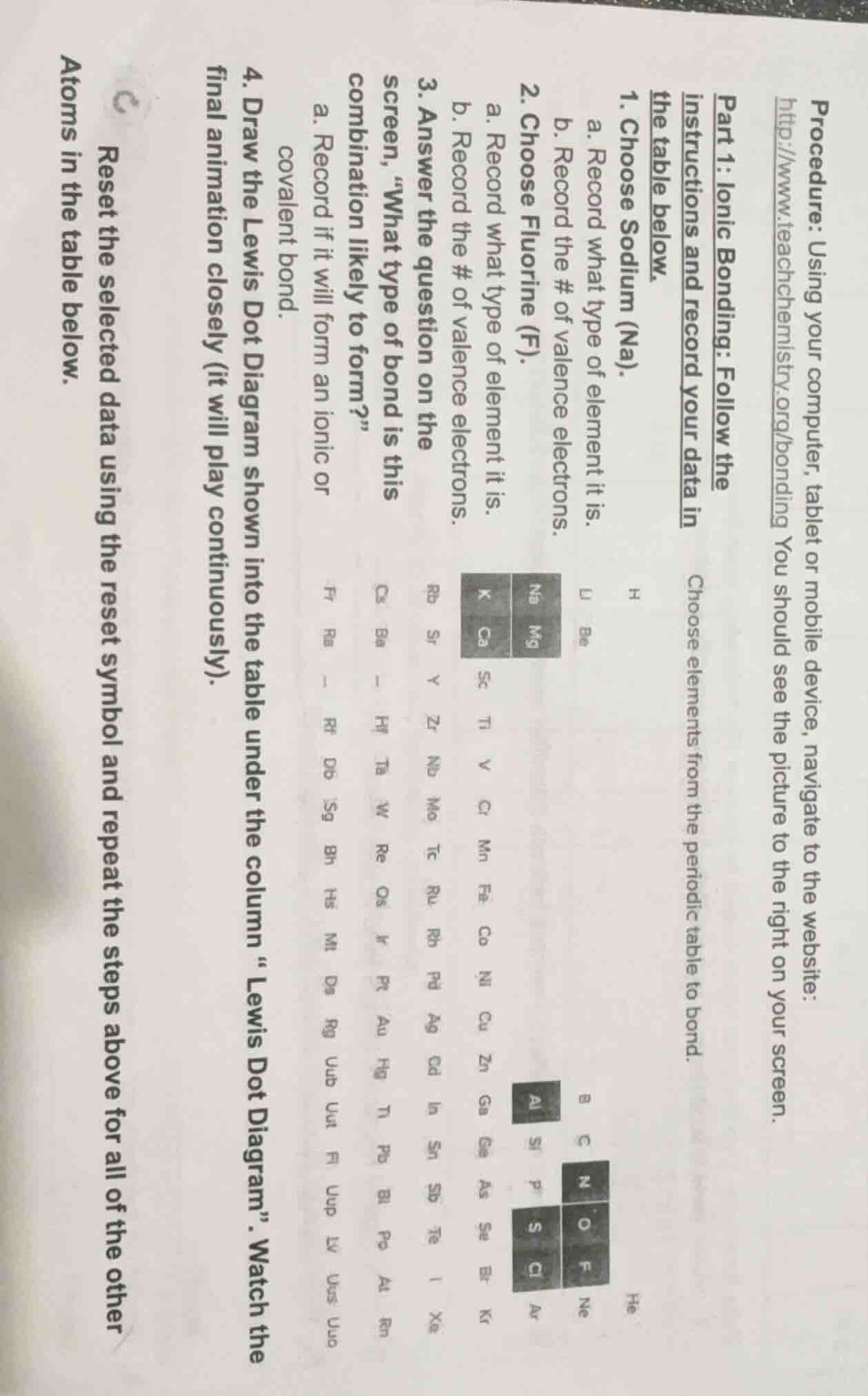
procedure: using your computer, tablet or mobile device, navigate to the website: http://www.teachchemistry.org/bonding you should see the picture to the right on your screen.
part 1: ionic bonding: follow the instructions and record your data in the table below.
- choose sodium (na).
a. record what type of element it is.
b. record the # of valence electrons.
- choose fluorine (f).
a. record what type of element it is.
b. record the # of valence electrons.
- answer the question on the screen, “what type of bond is this combination likely to form?”
a. record if it will form an ionic or covalent bond.
- draw the lewis dot diagram shown into the table under the column “lewis dot diagram”. watch the final animation closely (it will play continuously).
reset the selected data using the reset symbol and repeat the steps above for all of the other atoms in the table below.
This is a chemistry lab activity focused on ionic bonding between sodium (Na) and fluorine (F). Below is the completed data based on standard chemical properties:
- For Sodium (Na): It is an alkali metal (group 1 metal) with 1 valence electron.
- For Fluorine (F): It is a halogen (nonmetal) with 7 valence electrons.
- Sodium (a metal) and fluorine (a nonmetal) will form an ionic bond, as metals transfer electrons to nonmetals to form ionic compounds.
- Lewis Dot Diagrams: Na has one dot (valence electron) around its symbol, F has seven dots around its symbol. When bonded, Na loses its single electron to F, resulting in Na⁺ (no dots) and F⁻ (eight dots, surrounded by brackets with a - charge).

Snap & solve any problem in the app
Get step-by-step solutions on Sovi AI
Photo-based solutions with guided steps
Explore more problems and detailed explanations
- Sodium (Na)
a. Alkali Metal (Group 1 Metal)
b. 1
- Fluorine (F)
a. Halogen (Group 17 Nonmetal)
b. 7
- Ionic bond
- Lewis Dot Diagrams:
- Na: $\ce{Na \cdot}$
[LLM SSE On Failure]