QUESTION IMAGE
Question
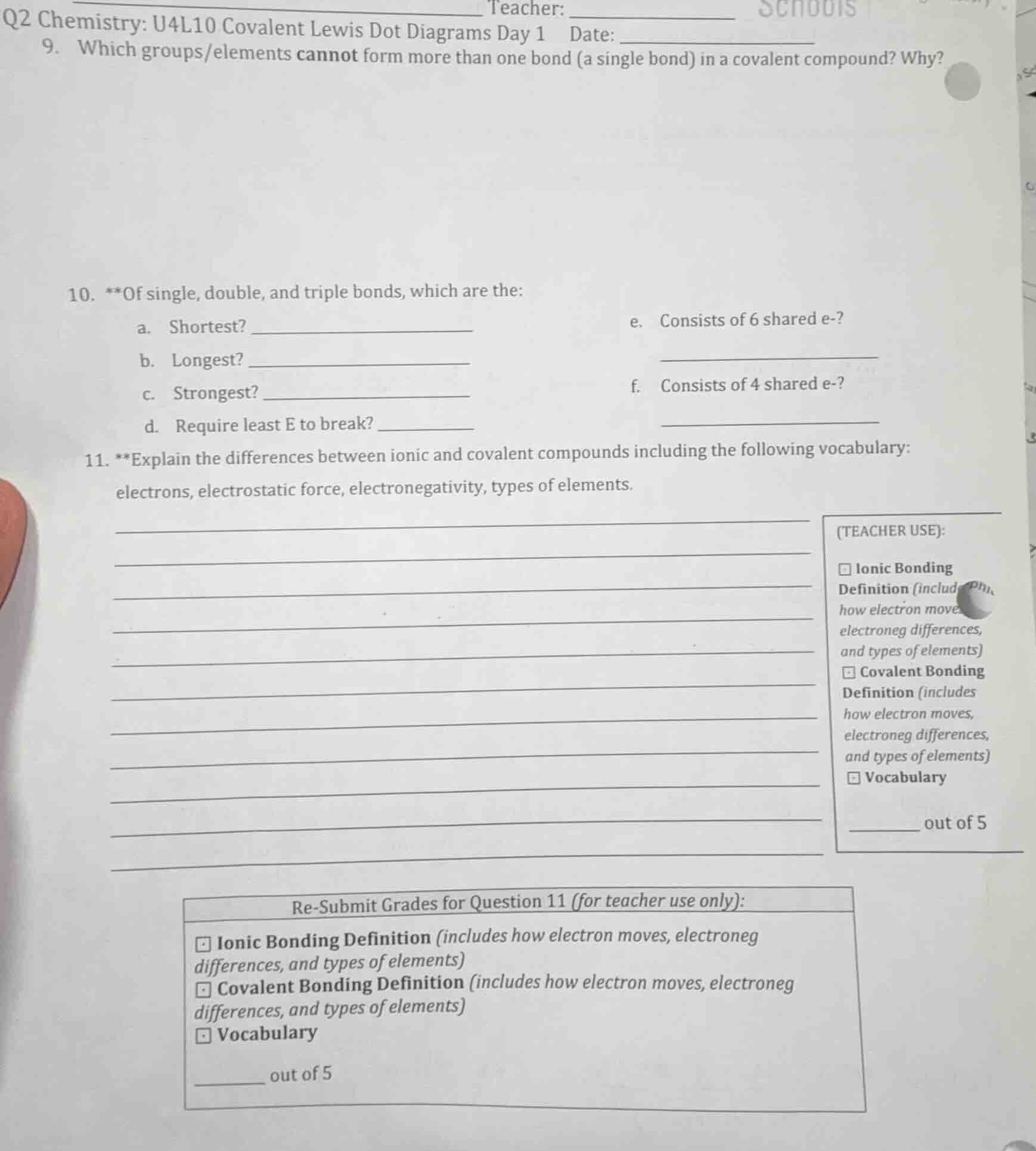
q2 chemistry: u4l10 covalent lewis dot diagrams day 1 date:
- which groups/elements cannot form more than one bond (a single bond) in a covalent compound? why?
- **of single, double, and triple bonds, which are the:
a. shortest?
b. longest?
c. strongest?
d. require least e to break?
e. consists of 6 shared e-?
f. consists of 4 shared e-?
- **explain the differences between ionic and covalent compounds including the following vocabulary:
electrons, electrostatic force, electronegativity, types of elements.
(teacher use):
☑ ionic bonding
definition (includ how electron move electroneg differences,
and types of elements)
☑ covalent bonding
definition (includes
how electron moves,
electroneg differences,
and types of elements)
☑ vocabulary
out of 5
re-submit grades for question 11 (for teacher use only):
☑ ionic bonding definition (includes how electron moves, electroneg
differences, and types of elements)
☑ covalent bonding definition (includes how electron moves, electroneg
differences, and types of elements)
☑ vocabulary
out of 5
Question 9
Elements in Group 17 (halogens, like F, Cl, Br, I) and Group 1 (alkali metals, but in covalent compounds, H is key here) – specifically, hydrogen (H) and halogens (Group 17) usually form single bonds. Hydrogen has 1 valence electron, needs 1 more to fill its shell (duet rule). Halogens have 7 valence electrons, need 1 more to fill their octet. So they can only form one bond (share one electron pair) to achieve stability.
Triple bonds have the most shared electron pairs (3 pairs), so the nuclei of bonded atoms are pulled closer together, making the bond length shortest.
Single bonds have only 1 pair of shared electrons, so the attraction between nuclei is the weakest, leading to the longest bond length.

Snap & solve any problem in the app
Get step-by-step solutions on Sovi AI
Photo-based solutions with guided steps
Explore more problems and detailed explanations
Group 1 (Hydrogen) and Group 17 (Halogens, e.g., F, Cl, Br, I) cannot form more than one bond (single bond) in covalent compounds. Because H needs 1 electron to complete its duet, and halogens need 1 electron to complete their octet, so they only share one pair of electrons (form one bond).