QUESTION IMAGE
Question
question 4 of 10
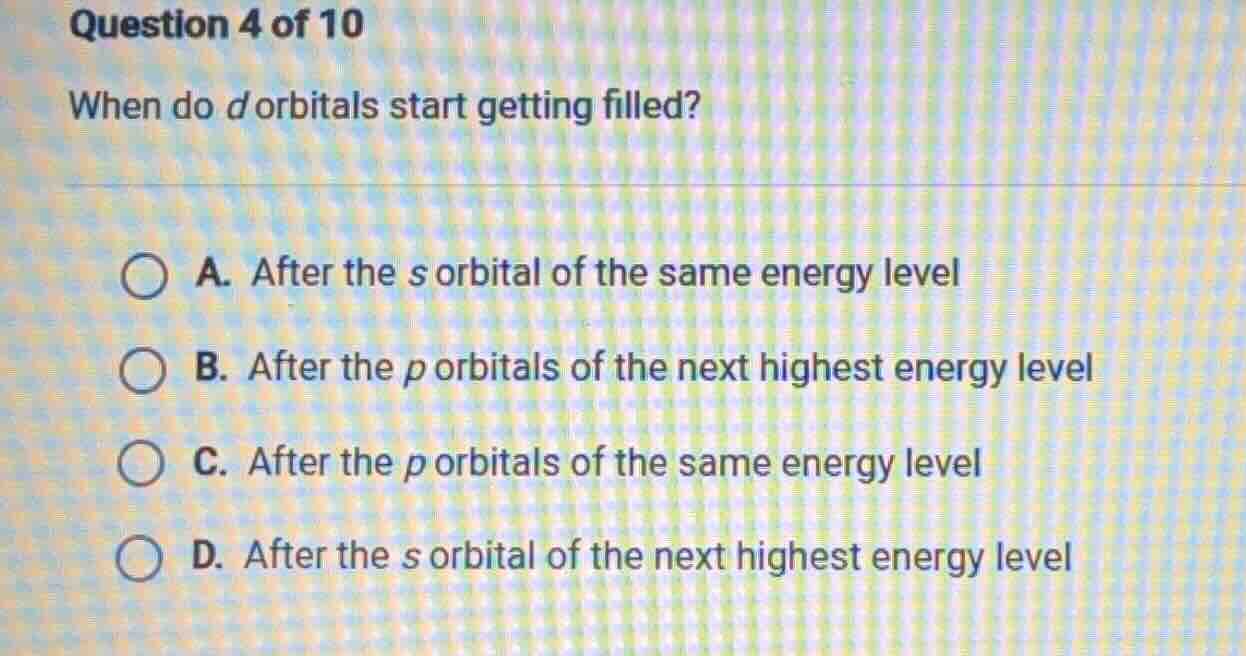
when do d orbitals start getting filled?
a. after the s orbital of the same energy level
b. after the p orbitals of the next highest energy level
c. after the p orbitals of the same energy level
d. after the s orbital of the next highest energy level
To determine when d orbitals start filling, we recall the electron - filling order based on energy levels and orbital types. The electron - filling order follows the pattern of energy levels and orbital sub - shells. The general order of filling orbitals is based on the Aufbau principle. For a given principal quantum number \(n\), the order of filling is \(ns\), then \((n - 1)d\), and then \(np\). Wait, no, let's correct that. The correct order is that for the \(n\)th energy level, the \(s\) orbital ( \(ns\)) is filled first. Then, before the \(p\) orbitals of the \(n\)th energy level (\(np\)) are filled, the \(d\) orbitals of the \((n - 1)\)th energy level \(((n - 1)d)\) start to be filled? No, actually, the correct sequence is based on the energy of the orbitals. The energy of an orbital is determined by the sum of the principal quantum number (\(n\)) and the azimuthal quantum number (\(l\)) (the \(n + l\) rule). For \(s\) orbitals, \(l = 0\), for \(p\) orbitals, \(l=1\), and for \(d\) orbitals, \(l = 2\).
Let's take an example. For the 4th energy level (\(n = 4\)):
- The \(4s\) orbital has \(n + l=4 + 0=4\).
- The \(3d\) orbital has \(n + l=3+2 = 5\).
- The \(4p\) orbital has \(n + l=4 + 1=5\) (wait, no, the \(n + l\) values: for \(4s\): \(4 + 0 = 4\); for \(3d\): \(3+2 = 5\); for \(4p\): \(4 + 1=5\); for \(5s\): \(5+0 = 5\), etc. But the filling order is based on increasing \(n + l\) values, and when \(n + l\) is the same, the orbital with the lower \(n\) is filled first? No, actually, when \(n + l\) is the same, the orbital with the smaller \(n\) is filled first? Wait, no, the correct filling order is: \(1s\), \(2s\), \(2p\), \(3s\), \(3p\), \(4s\), \(3d\), \(4p\), \(5s\), \(4d\), \(5p\), \(6s\), \(4f\), \(5d\), \(6p\), etc.
So, the \(d\) orbitals (e.g., \(3d\)) start to be filled after the \(s\) orbital of the next highest energy level (e.g., \(4s\))? Wait, no. Let's think again. The \(4s\) orbital is filled before the \(3d\) orbital. So the \(d\) orbitals of the \((n - 1)\)th energy level (e.g., \(3d\) when \(n = 4\)) start to be filled after the \(s\) orbital of the \(n\)th energy level (e.g., \(4s\))? Wait, no, the \(4s\) is at a lower energy than \(3d\) initially? Wait, actually, the \(4s\) orbital has a lower energy than the \(3d\) orbital for atoms with low atomic numbers. So electrons fill the \(4s\) orbital before the \(3d\) orbital. Then, after the \(4s\) is filled, the \(3d\) starts to be filled. Then, after the \(3d\) is filled, the \(4p\) starts to be filled.
So, in general, the \(d\) orbitals of the \((n - 1)\)th energy level start to be filled after the \(s\) orbital of the \(n\)th energy level (the next highest energy level in terms of the principal quantum number \(n\))? Wait, the \(n\) for the \(s\) orbital that is filled before the \(d\) orbital is one unit higher than the \(n\) of the \(d\) orbital. For example, \(4s\) ( \(n = 4\)) is filled before \(3d\) ( \(n=3\)). So the \(d\) orbitals (e.g., \(3d\)) start to be filled after the \(s\) orbital of the next highest energy level ( \(4s\) in this case).
Now let's analyze the options:
- Option A: "After the s orbital of the same energy level" - If we take the \(3d\) orbital, the \(s\) orbital of the same energy level would be \(3s\). But \(3d\) is filled after \(4s\), not \(3s\), so this is incorrect.
- Option B: "After the p orbitals of the next highest energy level" - The \(p\) orbitals of the next highest energy level would be at a higher energy than the \(d\) orbitals that are being filled. For example, for \(3d\), the next highest energy level is \…

Snap & solve any problem in the app
Get step-by-step solutions on Sovi AI
Photo-based solutions with guided steps
Explore more problems and detailed explanations
D. After the s orbital of the next highest energy level