QUESTION IMAGE
Question
question 4 of 10
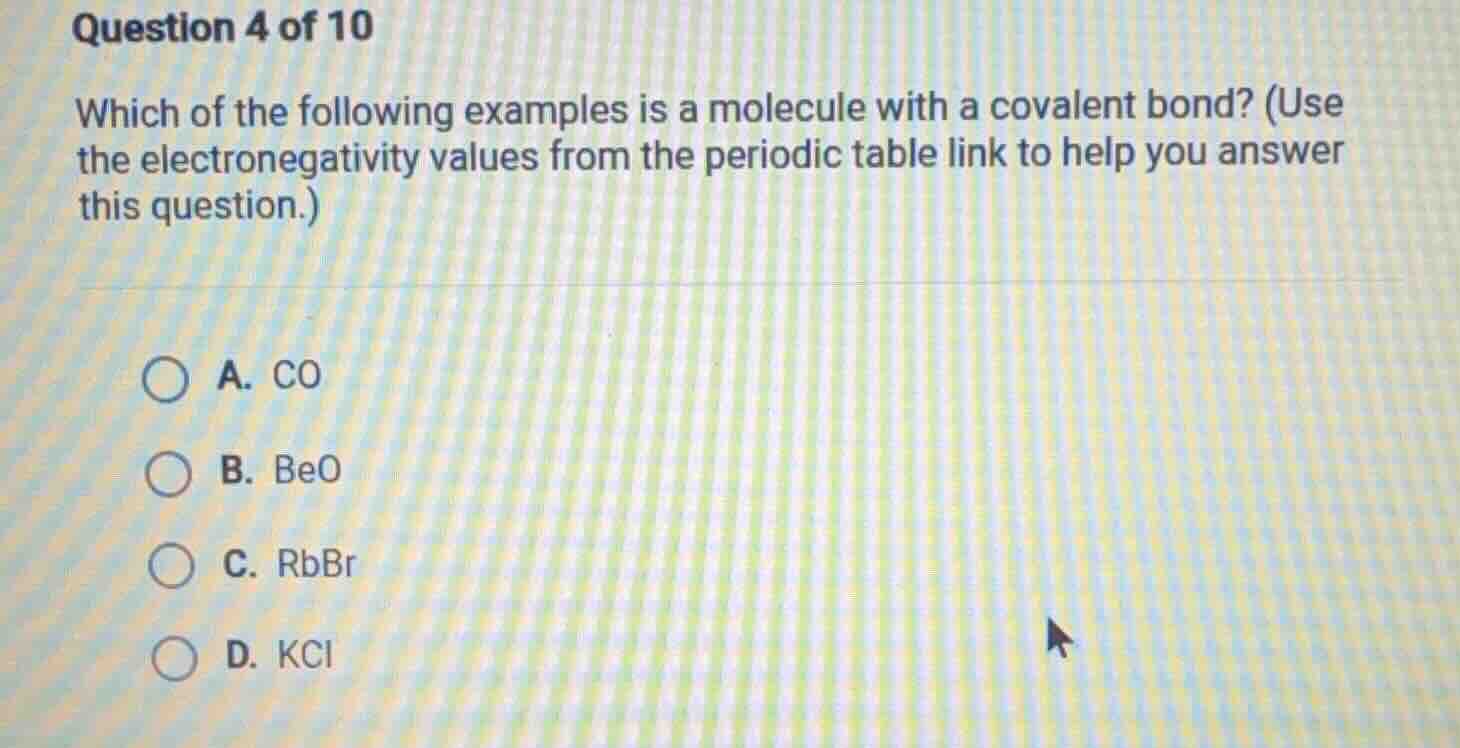
which of the following examples is a molecule with a covalent bond? (use
the electronegativity values from the periodic table link to help you answer
this question.)
a. co
b. beo
c. rbbr
d. kcl
Brief Explanations
To determine a covalent bond, we check the electronegativity difference (ΔEN) between atoms. Covalent bonds typically form between non - metals (ΔEN < 1.7, often < 2.0 for polar covalent; pure covalent when ΔEN = 0).
- For option A (CO): Carbon (C) and Oxygen (O) are both non - metals. The electronegativity of C is ~2.5 and O is ~3.5, so ΔEN = 3.5 - 2.5 = 1.0, which is within the range for covalent (polar covalent) bonding.
- For option B (BeO): Beryllium (Be) is a metal and Oxygen (O) is a non - metal. This is an ionic bond (metal - non - metal combination).
- For option C (RbBr): Rubidium (Rb) is a metal and Bromine (Br) is a non - metal, forming an ionic bond.
- For option D (KCl): Potassium (K) is a metal and Chlorine (Cl) is a non - metal, forming an ionic bond.
So, only CO has a covalent bond.

Snap & solve any problem in the app
Get step-by-step solutions on Sovi AI
Photo-based solutions with guided steps
Explore more problems and detailed explanations
A. CO