QUESTION IMAGE
Question
question 11 of 12
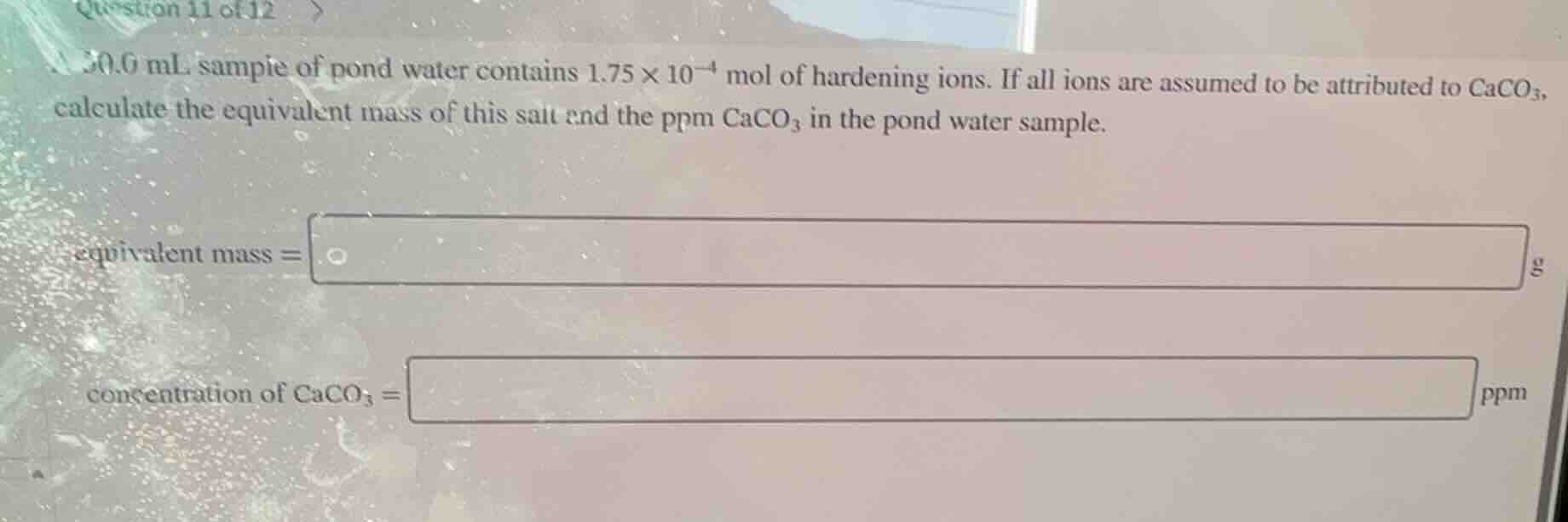
a 30.0 ml sample of pond water contains $1.75 \times 10^{-4}$ mol of hardening ions. if all ions are assumed to be attributed to $\ce{caco3}$, calculate the equivalent mass of this salt and the ppm $\ce{caco3}$ in the pond water sample.
equivalent mass = \boxed{\space} g
concentration of $\ce{caco3}$ = \boxed{\space} ppm
Step1: Calculate molar mass of $\text{CaCO}_3$
Molar mass = $40.08 + 12.01 + 3\times16.00 = 100.09\ \text{g/mol}$
Step2: Find equivalent mass of $\text{CaCO}_3$
For $\text{CaCO}_3$, n-factor (charge per formula unit for hardness) = 2.
$\text{Equivalent mass} = \frac{\text{Molar mass}}{\text{n-factor}} = \frac{100.09}{2} = 50.045\ \text{g/eq}$
Step3: Calculate mass of $\text{CaCO}_3$
Mass = moles $\times$ molar mass = $1.75\times10^{-4}\ \text{mol} \times 100.09\ \text{g/mol} = 0.01751575\ \text{g}$
Step4: Convert sample volume to kg (ppm = mg/kg)
Assume density of water = 1 g/mL, so 50.0 mL = 50.0 g = $0.050\ \text{kg}$; mass of $\text{CaCO}_3$ = $17.51575\ \text{mg}$
Step5: Calculate ppm of $\text{CaCO}_3$
$\text{ppm} = \frac{\text{mass of solute (mg)}}{\text{mass of solvent (kg)}} = \frac{17.51575}{0.050} = 350.315$

Snap & solve any problem in the app
Get step-by-step solutions on Sovi AI
Photo-based solutions with guided steps
Explore more problems and detailed explanations
equivalent mass = 50.0 g (or 50.05 g)
concentration of $\text{CaCO}_3$ = 350 ppm (or 350.3 ppm)