QUESTION IMAGE
Question
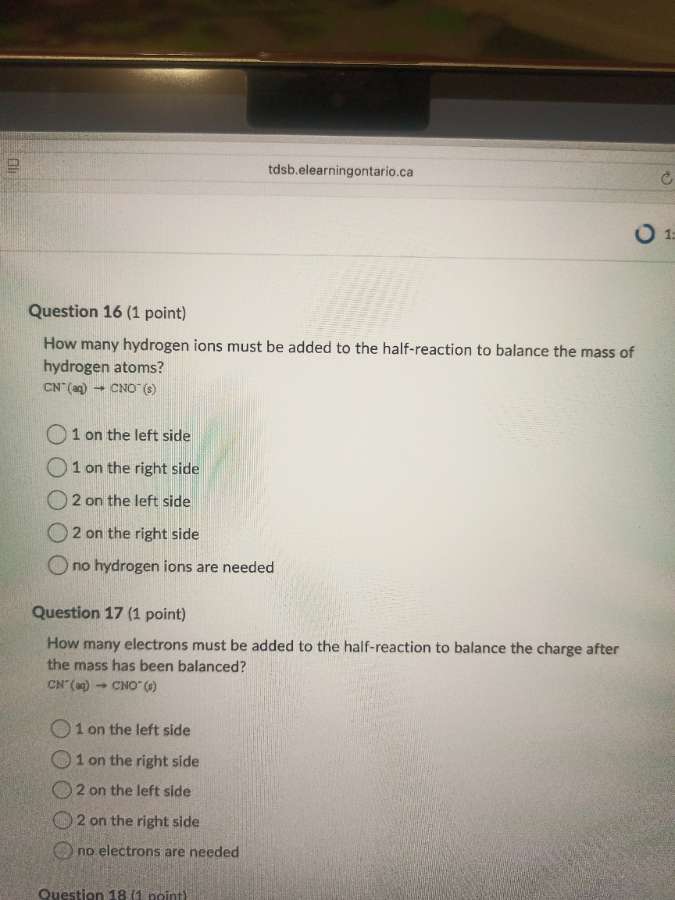
question 16 (1 point)
how many hydrogen ions must be added to the half - reaction to balance the mass of
hydrogen atoms?
cn⁻(aq) → cno⁻(s)
1 on the left side
1 on the right side
2 on the left side
2 on the right side
no hydrogen ions are needed
question 17 (1 point)
how many electrons must be added to the half - reaction to balance the charge after
the mass has been balanced?
cn⁻(aq) → cno⁻(s)
1 on the left side
1 on the right side
2 on the left side
2 on the right side
no electrons are needed
question 18 (1 point)
Question 16
Step1: Analyze reactant and product
Reactant: $\ce{CN^- (aq)}$ (contains C, N, no H)
Product: $\ce{CNO^- (s)}$ (contains C, N, O, no H)
Step2: Check H atoms
Both sides have 0 H atoms. So no H⁺ needed.
Step1: Balance mass (already balanced for H, C, N, O)
Reaction: $\ce{CN^- (aq) -> CNO^- (s)}$
Step2: Balance charge
Left charge: -1
Right charge: -1
Wait, no—wait, let's recheck. Wait, maybe I missed oxidation state? Wait, CN⁻ to CNO⁻: C goes from +2 to +4 (loses 2 e⁻? No, wait, no—wait, let's balance the reaction properly. Wait, first, balance O: add H₂O? Wait, no, the original reaction is CN⁻(aq) → CNO⁻(s). Wait, maybe the O comes from water? Wait, no, the problem says "after mass has been balanced"—maybe the mass balance here is just C, N, and O? Wait, CN⁻ has C, N; CNO⁻ has C, N, O. So to balance O, we need to add H₂O? Wait, no, the problem might have a typo, but assuming mass is balanced (maybe O is balanced by some means). Wait, no, let's check charge. Left: CN⁻ is -1. Right: CNO⁻ is -1. Wait, that can't be. Wait, maybe the oxidation: CN⁻ to CNO⁻: N is -3 in CN⁻, in CNO⁻, N is -3? Wait, no, C in CN⁻ is +2, in CNO⁻ is +4 (since O is -2, N is -3: +4 + (-3) + (-2) = -1, which matches CNO⁻ charge). So C is oxidized (loses 2 e⁻). Wait, but the charge on left is -1, right is -1. Wait, that's a problem. Wait, maybe the reaction is in basic or acidic? Wait, no, the problem says "after mass has been balanced"—maybe the mass balance includes adding H⁺ or H₂O. Wait, maybe I made a mistake. Wait, let's do it properly:
- Balance C, N: CN⁻ → CNO⁻
- Balance O: add H₂O to left? No, CNO⁻ has O, so add H₂O to left: CN⁻ + H₂O → CNO⁻
- Balance H: add H⁺ to right: CN⁻ + H₂O → CNO⁻ + 2 H⁺
Now, charge:
Left: -1 (CN⁻) + 0 (H₂O) = -1
Right: -1 (CNO⁻) + 2(+1) (H⁺) = +1
So to balance charge, we need to add 2 e⁻ to right (since left is -1, right is +1; difference is +2, so add 2 e⁻ to right to make right charge -1: -1 + 2(+1) - 2 = -1). Wait, no: left charge -1, right charge (CNO⁻: -1) + (2 H⁺: +2) = +1. So to balance, we need to add 2 e⁻ to the right (reduction) or left (oxidation)? Wait, C is oxidized (loses e⁻), so electrons are on the right. Wait, the problem says "how many electrons must be added to the half-reaction to balance the charge". So left charge: -1 (CN⁻) + 0 (H₂O) = -1. Right charge: -1 (CNO⁻) + 2(+1) (H⁺) = +1. So the difference is +2 (right is more positive). So to balance, we need to add 2 e⁻ to the right (so that right charge is +1 - 2 = -1, same as left). Wait, but the options are 1 or 2 on left/right. Wait, maybe the mass balance was done without H₂O? Maybe the problem is simpler. Wait, the original reaction: CN⁻ → CNO⁻. Charge left: -1, right: -1. But that's only if O is balanced. Wait, maybe the problem assumes that mass is balanced (C, N) and O is already balanced (maybe from the environment). But that's not correct. Wait, the problem says "after the mass has been balanced"—so maybe in the mass balance, we only consider C and N, and O is already there. Then charge: left -1, right -1. But that would mean no electrons needed. But that contradicts oxidation. Wait, maybe the problem has an error, but looking at the options, "no electrons are needed" is an option. Wait, no—wait, let's recalculate. CN⁻: charge -1. CNO⁻: charge -1. So charge is balanced. So no electrons needed? But that can't be, because C is oxidized. Wait, maybe the O is balanced by adding O₂? No, the problem is about half-reaction. Wait, maybe the mass balance is just C and N, and O is already present. So charge is -1 on both sides. So no electrons needed.
Wait, but that's confusing. Alternatively, maybe the reaction is in basic solution. Let's try basic:
CN⁻ + H₂O → CNO⁻ + 2 H⁺ + 2 e⁻ (acidic)
In basic, add 2 OH⁻:
CN⁻ + H₂O + 2 OH⁻ → CNO⁻ + 2 H₂O + 2 e⁻
Sim…
Step1: Balance mass (add H₂O and H⁺)
$\ce{CN^- + H2O -> CNO^- + 2 H^+}$
Step2: Balance charge
Left charge: -1
Right charge: -1 + 2(+1) = +1
Need to add 2 e⁻ to right (charge becomes +1 + 2(-1) = -1, matching left)

Snap & solve any problem in the app
Get step-by-step solutions on Sovi AI
Photo-based solutions with guided steps
Explore more problems and detailed explanations
no hydrogen ions are needed