QUESTION IMAGE
Question
question 18 (1 point)
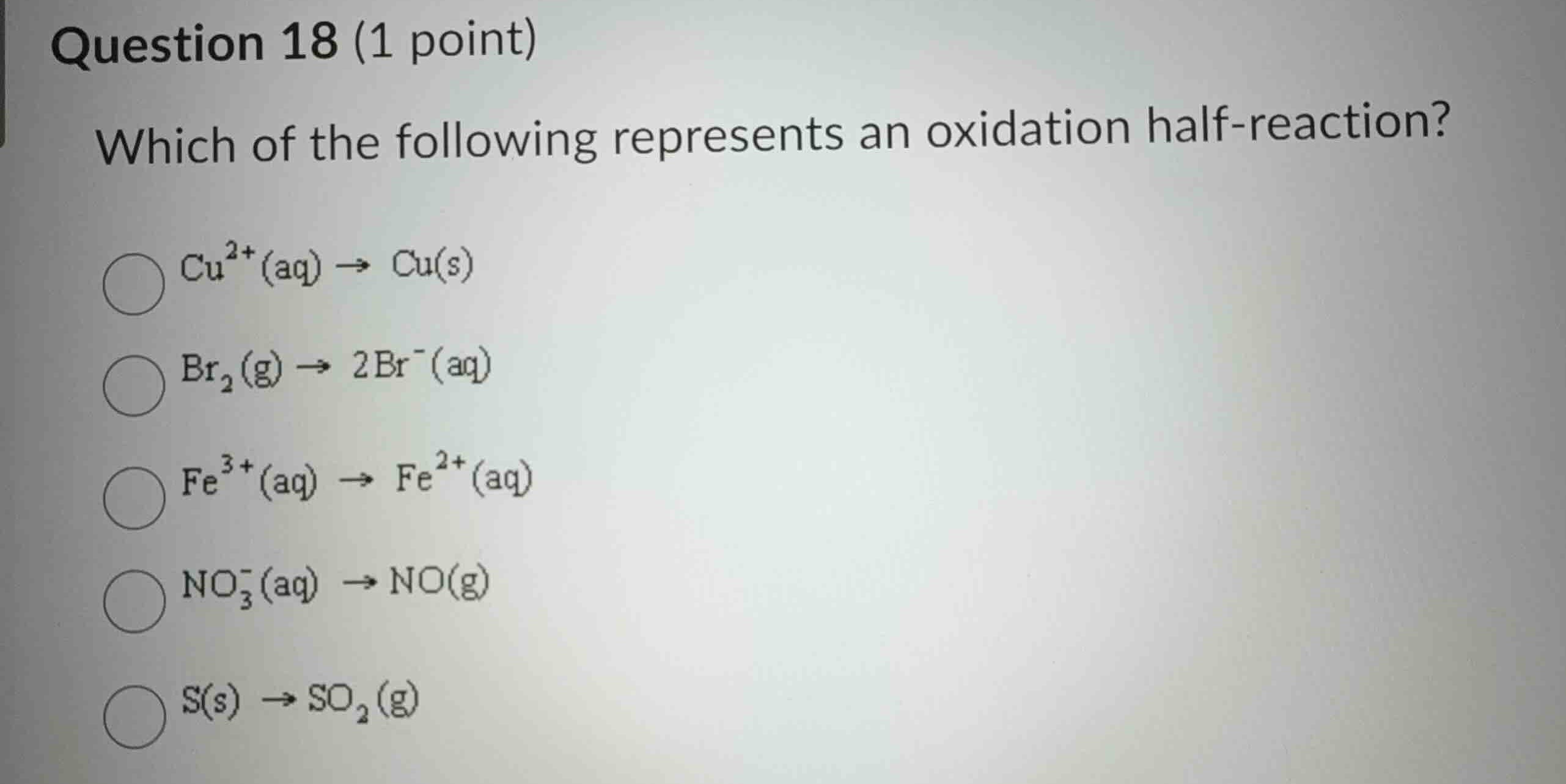
which of the following represents an oxidation half - reaction?
\\(\ce{cu^{2+}(aq) -> cu(s)}
\\(\ce{br_{2}(g) -> 2br^{-}(aq)}
\\(\ce{fe^{3+}(aq) -> fe^{2+}(aq)}
\\(\ce{no^{-}_{3}(aq) -> no(g)}
\\(\ce{s(s) -> so_{2}(g)}
Brief Explanations
To determine the oxidation half - reaction, we use the concept of oxidation (increase in oxidation state, loss of electrons).
- For \(\ce{Cu^{2+}(aq)\to Cu(s)}\): The oxidation state of Cu changes from +2 to 0. This is a decrease, so it is a reduction.
- For \(\ce{Br_{2}(g)\to 2Br^{-}(aq)}\): The oxidation state of Br changes from 0 to - 1. This is a decrease, so it is a reduction.
- For \(\ce{Fe^{3+}(aq)\to Fe^{2+}(aq)}\): The oxidation state of Fe changes from +3 to +2. This is a decrease, so it is a reduction.
- For \(\ce{NO^{-}_{3}(aq)\to NO(g)}\): The oxidation state of N in \(\ce{NO^{-}_{3}}\) is +5 (let x be the oxidation state of N: \(x + 3\times(-2)+(- 1)=0\Rightarrow x = + 5\)) and in NO it is +2. This is a decrease, so it is a reduction.
- For \(\ce{S(s)\to SO_{2}(g)}\): The oxidation state of S in S(s) is 0 and in \(\ce{SO_{2}}\) (let x be the oxidation state of S: \(x+2\times(-2) = 0\Rightarrow x= + 4\)). The oxidation state of S increases from 0 to +4, so this is an oxidation half - reaction.

Snap & solve any problem in the app
Get step-by-step solutions on Sovi AI
Photo-based solutions with guided steps
Explore more problems and detailed explanations
\(\boldsymbol{\ce{S(s) \to SO_{2}(g)}}\) (the option with this reaction)