QUESTION IMAGE
Question
question 20
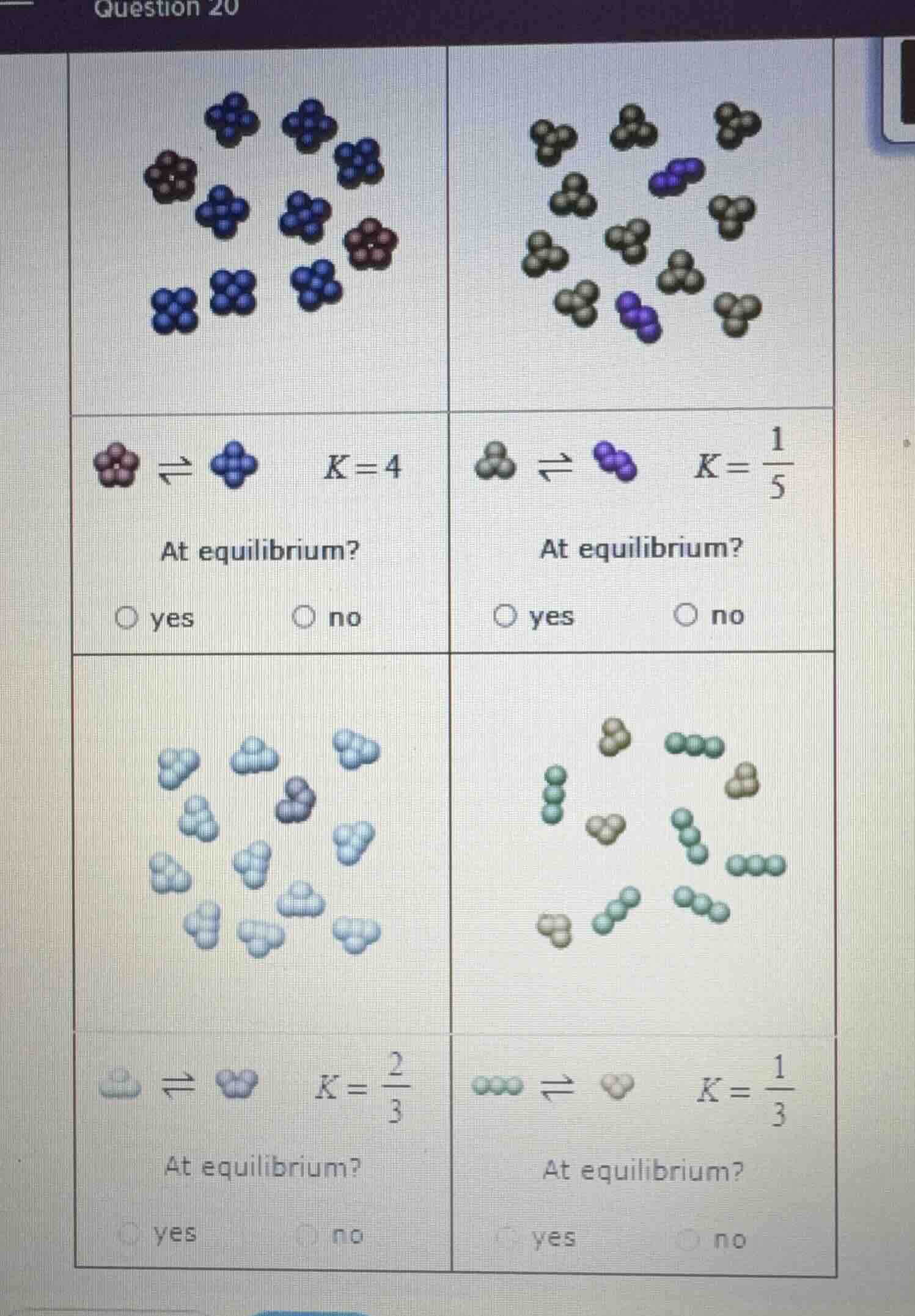
for the first reaction:
(\boldsymbol{\text{maroon molecule}}
ightleftharpoons \boldsymbol{\text{blue molecule}}) (k = 4)
at equilibrium?
(circ) yes (circ) no
for the second reaction:
(\boldsymbol{\text{gray molecule}}
ightleftharpoons \boldsymbol{\text{purple molecule}}) (k=\frac{1}{5})
at equilibrium?
(circ) yes (circ) no
for the third reaction:
(\boldsymbol{\text{light blue molecule}}
ightleftharpoons \boldsymbol{\text{lavender molecule}}) (k = \frac{2}{3})
at equilibrium?
(circ) yes (circ) no
for the fourth reaction:
(\boldsymbol{\text{teal molecule (3 - atom)}}
ightleftharpoons \boldsymbol{\text{beige molecule (3 - atom)}}) (k=\frac{1}{3})
at equilibrium?
(circ) yes (circ) no
First Equilibrium (Brown ⇌ Blue, \( K = 4 \))
Step 1: Count Moles
Count brown (reactant) and blue (product) molecules. Brown: 2, Blue: 8.
Step 2: Calculate Reaction Quotient (\( Q \))
For reaction \( \text{Brown}
ightleftharpoons \text{Blue} \), \( Q = \frac{[\text{Blue}]}{[\text{Brown}]} = \frac{8}{2} = 4 \).
Step 3: Compare \( Q \) and \( K \)
\( Q = 4 = K \), so at equilibrium.
Step 1: Count Moles
Gray: 8, Purple: 2.
Step 2: Calculate \( Q \)
\( Q = \frac{[\text{Purple}]}{[\text{Gray}]} = \frac{2}{8} = \frac{1}{4} \).
Step 3: Compare \( Q \) and \( K \)
\( Q = \frac{1}{4}
eq \frac{1}{5} = K \), so not at equilibrium.
Step 1: Count Moles
Light Blue: 9, Purple: 1.
Step 2: Calculate \( Q \)
\( Q = \frac{[\text{Purple}]}{[\text{Light Blue}]} = \frac{1}{9} \approx 0.11 \). \( \frac{2}{3} \approx 0.67 \), \( Q
eq K \), so not at equilibrium. (Wait, correction: Wait, the reaction is Light Blue ⇌ Purple? Wait, the diagram: light blue (let's say A) and purple (B). Wait, maybe I misread. Wait, the third reaction: the left has light blue (A) and purple (B). Wait, count again: light blue (A) molecules: let's see, the light blue ones: 9? Wait no, the third box: light blue (A) and purple (B). Wait, the formula: \( K = \frac{[\text{B}]}{[\text{A}]} = \frac{2}{3} \). Wait, maybe I miscounted. Wait, the third grid: light blue (A) and purple (B). Let's count A (light blue): 9? No, looking at the third row left: the molecules: light blue (A) and purple (B). Wait, the purple one is 1, light blue is 9? Wait no, maybe the reaction is A ⇌ B, so \( K = \frac{[B]}{[A]} = \frac{2}{3} \). Wait, if B is 1, A is 9, \( Q = 1/9 \approx 0.11 \), \( K = 2/3 \approx 0.67 \), so \( Q
eq K \), so no. Wait, but maybe I miscounted. Wait, the third row left: the purple (B) is 1, light blue (A) is 9? Wait, no, let's count again. The third row left: the molecules: how many light blue (A) and purple (B). Let's see: the purple one is 1, light blue: let's count the light blue (A) molecules: each light blue is a cluster. Let's count: 9 light blue, 1 purple. So \( Q = 1/9 \approx 0.11 \), \( K = 2/3 \approx 0.67 \), so \( Q
eq K \), so not at equilibrium. So answer: no. Wait, but maybe the reaction is reversed? Wait, the reaction is A ⇌ B, \( K = 2/3 \). So \( K = [B]/[A] = 2/3 \). So if [B] = 1, [A] = 9, \( Q = 1/9
eq 2/3 \), so no.
Fourth Equilibrium (Green ⇌ Beige, \( K = \frac{1}{3} \))

Snap & solve any problem in the app
Get step-by-step solutions on Sovi AI
Photo-based solutions with guided steps
Explore more problems and detailed explanations
yes