QUESTION IMAGE
Question
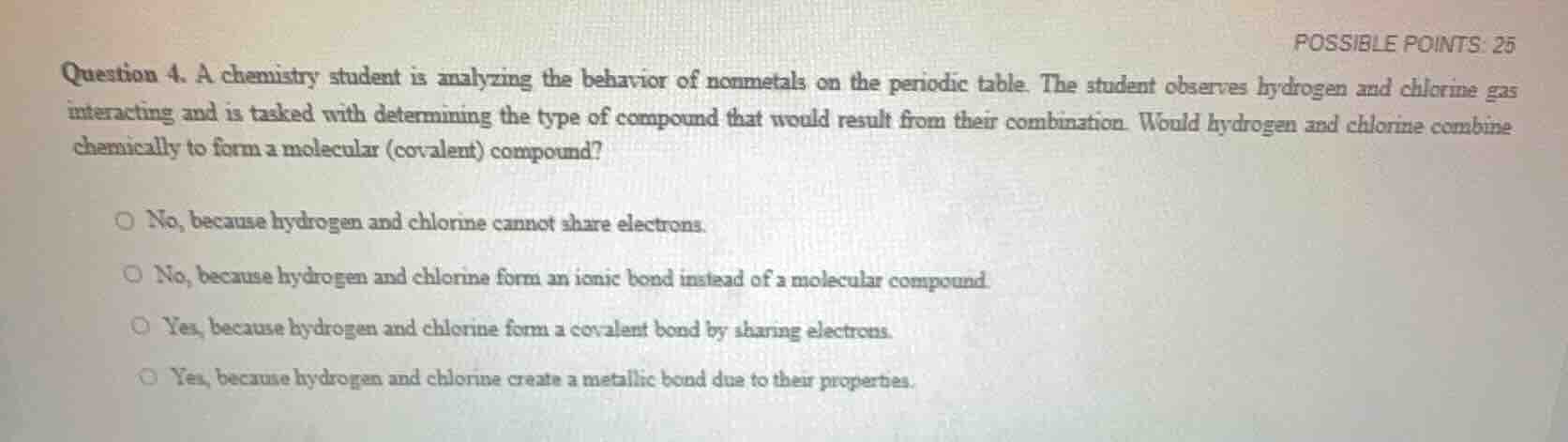
question 4. a chemistry student is analyzing the behavior of nonmetals on the periodic table. the student observes hydrogen and chlorine gas interacting and is tasked with determining the type of compound that would result from their combination. would hydrogen and chlorine combine chemically to form a molecular (covalent) compound?
no, because hydrogen and chlorine cannot share electrons.
no, because hydrogen and chlorine form an ionic bond instead of a molecular compound.
yes, because hydrogen and chlorine form a covalent bond by sharing electrons.
yes, because hydrogen and chlorine create a metallic bond due to their properties.
To determine the correct answer, we analyze the bonding between hydrogen and chlorine:
- Option 1: Incorrect. Hydrogen and chlorine can share electrons (e.g., in HCl, they form a covalent bond).
- Option 2: Incorrect. Ionic bonds form between metals and nonmetals, but hydrogen is a nonmetal (and chlorine is also a nonmetal). They form a covalent, not ionic, bond.
- Option 3: Correct. Both hydrogen and chlorine are nonmetals. Nonmetals share electrons to form covalent (molecular) compounds. In HCl, they share electrons to form a covalent bond.
- Option 4: Incorrect. Metallic bonds form between metals, but neither hydrogen nor chlorine are metals.

Snap & solve any problem in the app
Get step-by-step solutions on Sovi AI
Photo-based solutions with guided steps
Explore more problems and detailed explanations
C. Yes, because hydrogen and chlorine form a covalent bond by sharing electrons.