QUESTION IMAGE
Question
question 5
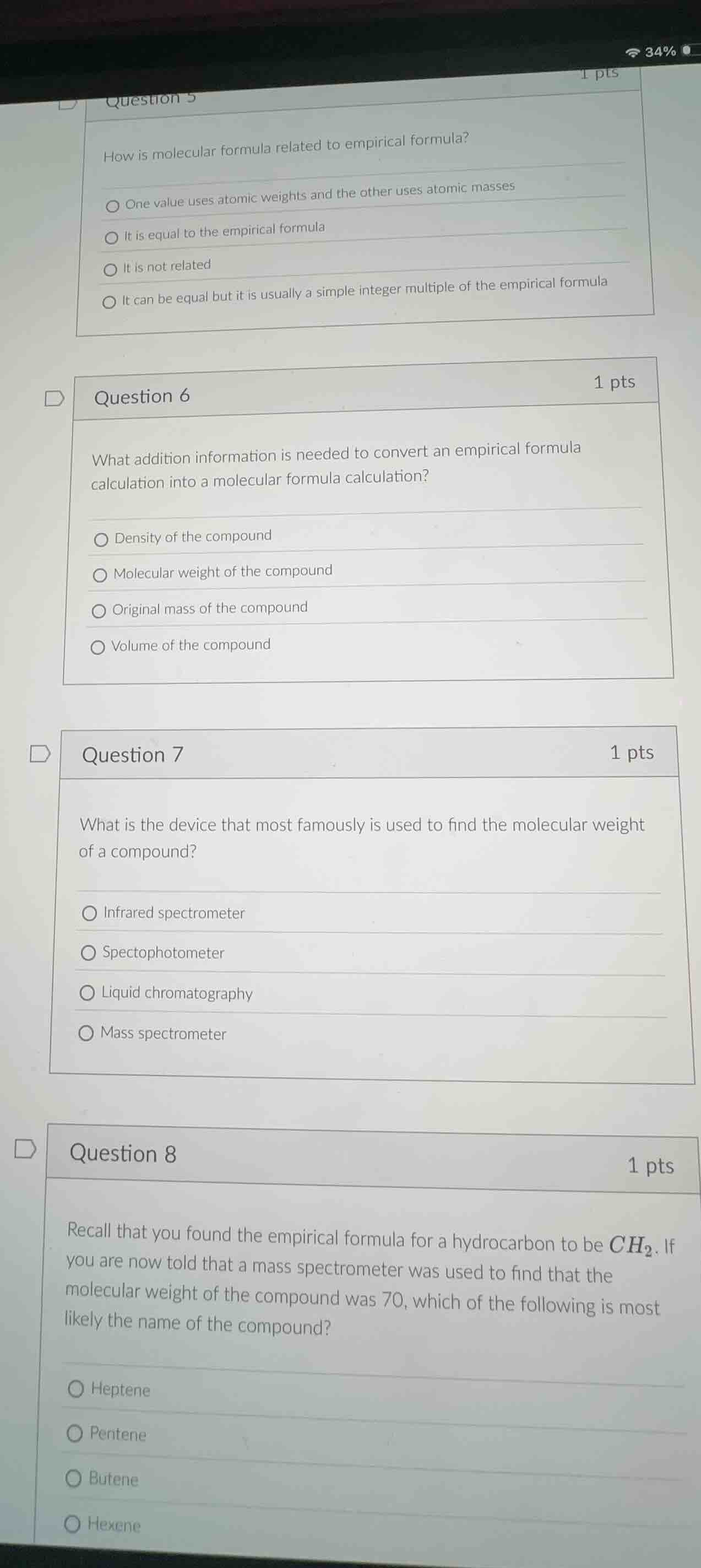
how is molecular formula related to empirical formula?
one value uses atomic weights and the other uses atomic masses
it is equal to the empirical formula
it is not related
it can be equal but it is usually a simple integer multiple of the empirical formula
question 6
1 pts
what addition information is needed to convert an empirical formula calculation into a molecular formula calculation?
density of the compound
molecular weight of the compound
original mass of the compound
volume of the compound
question 7
1 pts
what is the device that most famously is used to find the molecular weight of a compound?
infrared spectrometer
spectophotometer
liquid chromatography
mass spectrometer
question 8
1 pts
recall that you found the empirical formula for a hydrocarbon to be ch₂. if you are now told that a mass spectrometer was used to find that the molecular weight of the compound was 70, which of the following is most likely the name of the compound?
heptene
pentene
butene
hexene
Question 5
The molecular formula represents the actual number of atoms of each element in a molecule, while the empirical formula represents the simplest whole - number ratio of atoms of each element in a compound. For example, the empirical formula of glucose ($C_6H_{12}O_6$) is $CH_2O$. The molecular formula can be equal to the empirical formula (like for $H_2O$, both molecular and empirical formula are the same) or it can be a simple integer multiple of the empirical formula (like for glucose, the molecular formula is 6 times the empirical formula $CH_2O$). The option "One value uses atomic weights and the other uses atomic masses" is incorrect as both use atomic masses (or weights, which are closely related). The option "It is equal to the empirical formula" is not always true. The option "It is not related" is wrong as they are related. So the correct relationship is that the molecular formula can be equal but is usually a simple integer multiple of the empirical formula.
To convert an empirical formula to a molecular formula, we use the formula: Molecular formula = (Empirical formula)$_n$, where $n=\frac{\text{Molecular weight}}{\text{Empirical formula weight}}$. So we need the molecular weight of the compound to find the value of $n$. Density, original mass, and volume of the compound are not used in this conversion.
- An infrared spectrometer is used to identify functional groups in a compound by measuring the absorption of infrared radiation.
- A spectrophotometer is used to measure the concentration of a solution by measuring the amount of light absorbed by the solution.
- Liquid chromatography is used for separation of components in a mixture.
- A mass spectrometer is used to determine the molecular weight of a compound by ionizing the compound and measuring the mass - to - charge ratio of the ions. So the device most famously used to find the molecular weight of a compound is a mass spectrometer.

Snap & solve any problem in the app
Get step-by-step solutions on Sovi AI
Photo-based solutions with guided steps
Explore more problems and detailed explanations
It can be equal but it is usually a simple integer multiple of the empirical formula