QUESTION IMAGE
Question
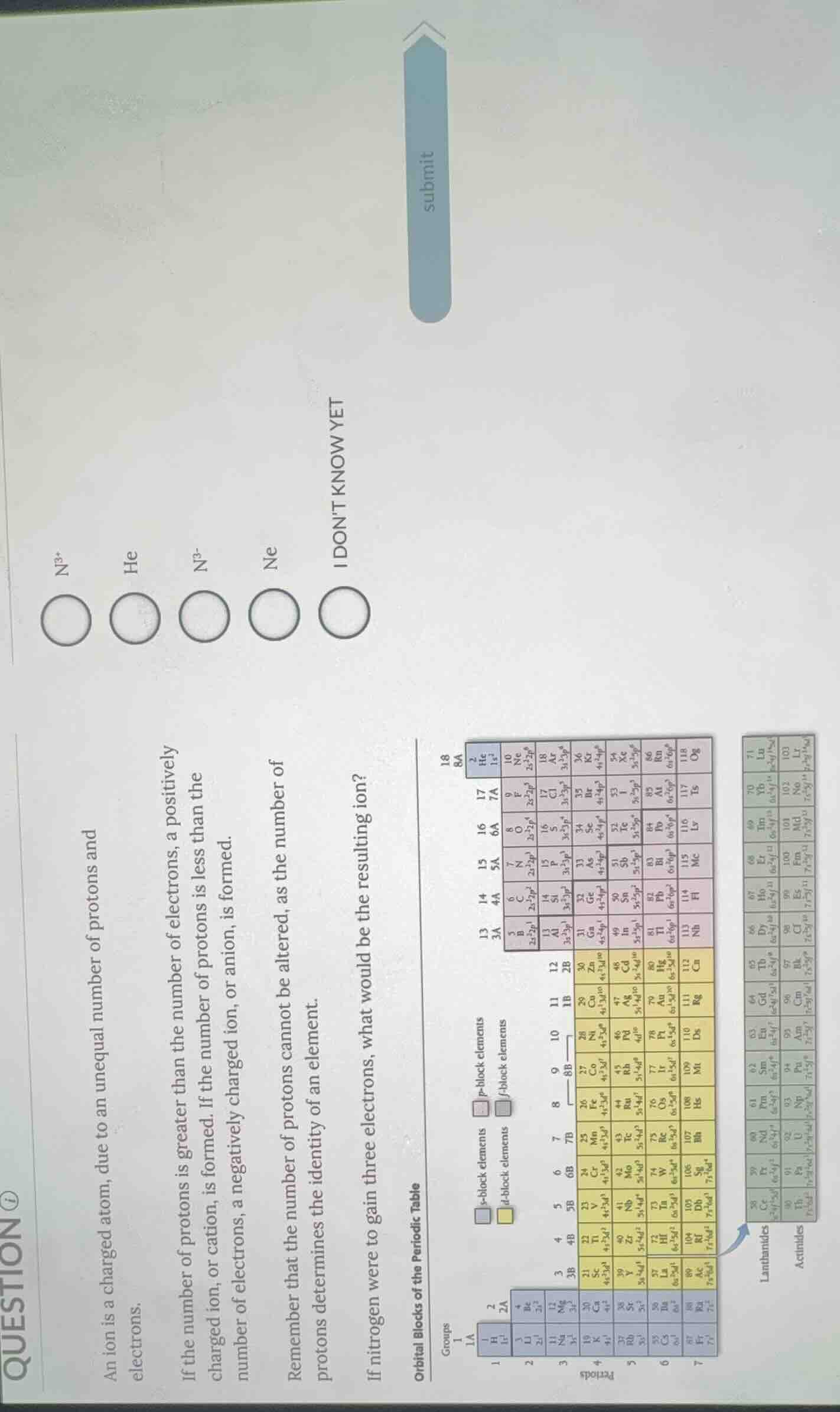
question an ion is a charged atom, due to an unequal number of protons and electrons. if the number of protons is greater than the number of electrons, a positively charged ion, or cation, is formed. if the number of protons is less than the number of electrons, a negatively charged ion, or anion, is formed. remember that the number of protons cannot be altered, as the number of protons determines the identity of an element. if nitrogen were to gain three electrons, what would be the resulting ion? n³⁺ he n³⁻ ne i dont know yet orbitals of the periodic table groups 1 2 3 4 5 6 7 1a h 1 2a 2 3b 4b 5b 6b 7b 8 9 10 11b 12b 13 14 15 16 17 18 3a 4a 5a 6a 7a 8a s - block elements p - block elements d - block elements f - block elements 1 h 2 he 3 li 4 be 5 b 6 c 7 n 8 o 9 f 10 ne 11 na 12 mg 13 al 14 si 15 p 16 s 17 cl 18 ar 19 k 20 ca 21 sc 22 ti 23 v 24 cr 25 mn 26 fe 27 co 28 ni 29 cu 30 zn 31 ga 32 ge 33 as 34 se 35 br 36 kr 37 rb 38 sr 39 y 40 zr 41 nb 42 mo 43 tc 44 ru 45 rh 46 pd 47 ag 48 cd 49 in 50 sn 51 sb 52 te 53 i 54 xe 55 cs 56 ba 57 la 72 hf 73 ta 74 w 75 re 76 os 77 ir 78 pt 79 au 80 hg 81 tl 82 pb 83 bi 84 po 85 at 86 rn 87 fr 88 ra 89 ac 104 rf 105 db 106 sg 107 bh 108 hs 109 mt 110 ds 111 rg 112 cn 113 nh 114 fl 115 mc 116 lv 117 ts 118 og lanthanides 58 ce 59 pr 60 nd 61 pm 62 sm 63 eu 64 gd 65 tb 66 dy 67 ho 68 er 69 tm 70 yb 71 lu actinides 90 th 91 pa 92 u 93 np 94 pu 95 am 96 cm 97 bk 98 cf 99 es 100 fm 101 md 102 no 103 lr submit
Step1: Determine nitrogen's electron configuration
Nitrogen (N) has an atomic number of 7, so it has 7 electrons. Its electron configuration is $1s^2 2s^2 2p^3$.
Step2: Analyze electron gain
If nitrogen gains 3 electrons, the number of electrons becomes $7 + 3 = 10$.
Step3: Determine the ion
An atom with 7 protons (nitrogen's atomic number) and 10 electrons has a charge of $7 - 10 = -3$. So the ion is $N^{3-}$.

Snap & solve any problem in the app
Get step-by-step solutions on Sovi AI
Photo-based solutions with guided steps
Explore more problems and detailed explanations
$N^{3-}$