QUESTION IMAGE
Question
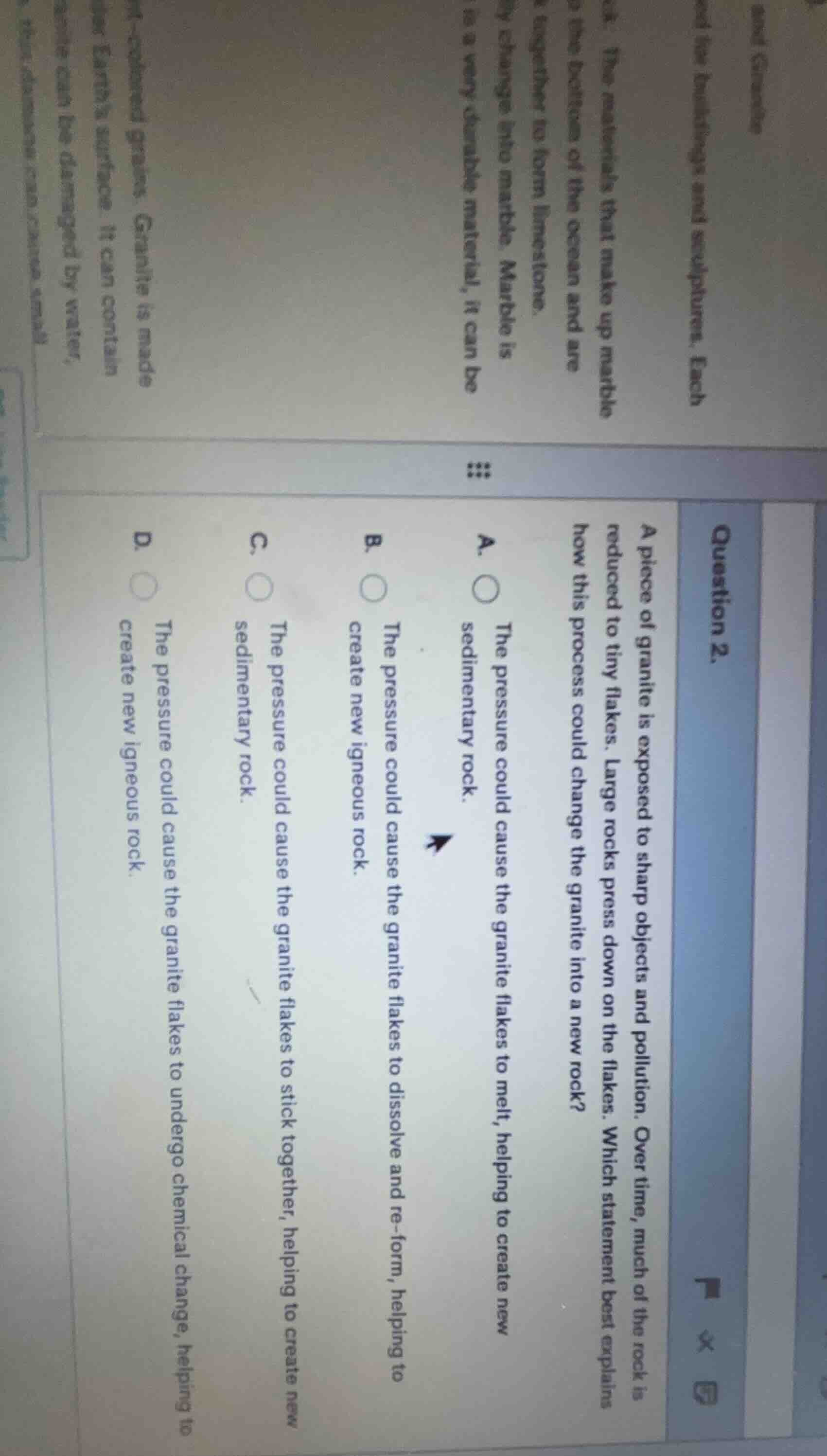
question 2. a piece of granite is exposed to sharp objects and pollution. over time, much of the rock is reduced to tiny flakes. large rocks press down on the flakes. which statement best explains how this process could change the granite into a new rock? a. the pressure could cause the granite flakes to melt, helping to create new sedimentary rock. b. the pressure could cause the granite flakes to dissolve and re - form, helping to create new igneous rock. c. the pressure could cause the granite flakes to stick together, helping to create new sedimentary rock. d. the pressure could cause the granite flakes to undergo chemical change, helping to create new igneous rock.
Granite flakes are sediment particles. When large rocks press down on these flakes (compaction), the particles stick together to form a sedimentary rock. Melting (option A) forms igneous rock, dissolution/re-formation (option B) is not this process, and chemical change for igneous rock (option D) does not fit this scenario.

Snap & solve any problem in the app
Get step-by-step solutions on Sovi AI
Photo-based solutions with guided steps
Explore more problems and detailed explanations
C. The pressure could cause the granite flakes to stick together, helping to create new sedimentary rock.