QUESTION IMAGE
Question
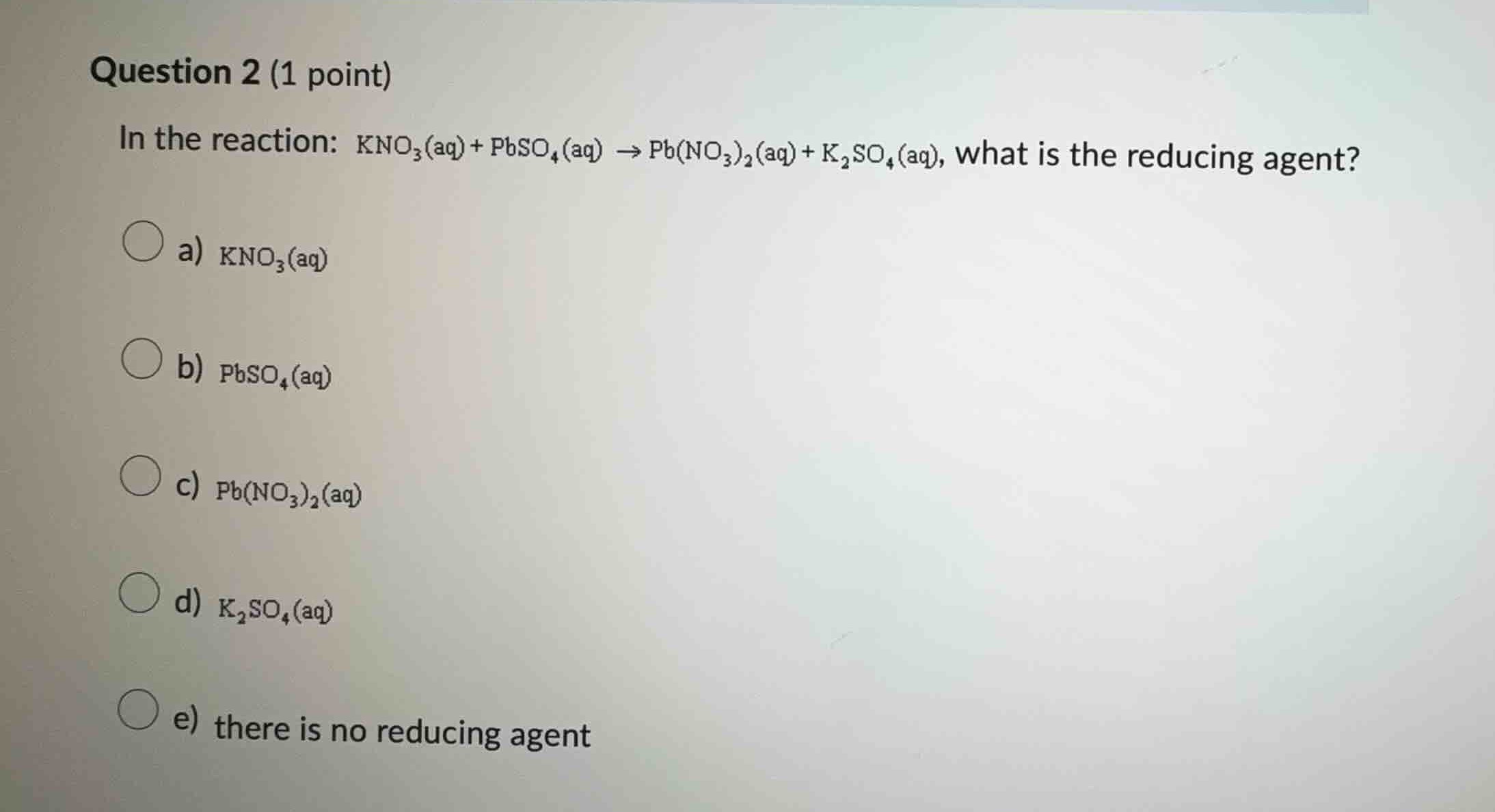
question 2 (1 point)
in the reaction: $\ce{kno_{3}(aq) + pbso_{4}(aq) \
ightarrow pb(no_{3})_{2}(aq) + k_{2}so_{4}(aq)}$, what is the reducing agent?
a) $\ce{kno_{3}(aq)}$
b) $\ce{pbso_{4}(aq)}$
c) $\ce{pb(no_{3})_{2}(aq)}$
d) $\ce{k_{2}so_{4}(aq)}$
e) there is no reducing agent
To determine the reducing agent, we first check the oxidation states of all elements. In the reaction \( \text{KNO}_3(\text{aq}) + \text{PbSO}_4(\text{aq})
ightarrow \text{Pb(NO}_3\text{)}_2(\text{aq}) + \text{K}_2\text{SO}_4(\text{aq}) \), this is a double - displacement reaction (ions are exchanged between compounds), not a redox reaction. In a redox reaction, there is a change in oxidation states of elements (one element is oxidized and another is reduced). Since there is no change in oxidation states here, there is no reducing agent (a reducing agent is oxidized, i.e., its oxidation state increases, and causes another substance to be reduced).

Snap & solve any problem in the app
Get step-by-step solutions on Sovi AI
Photo-based solutions with guided steps
Explore more problems and detailed explanations
e) there is no reducing agent