QUESTION IMAGE
Question
question 4 (2 points) saved
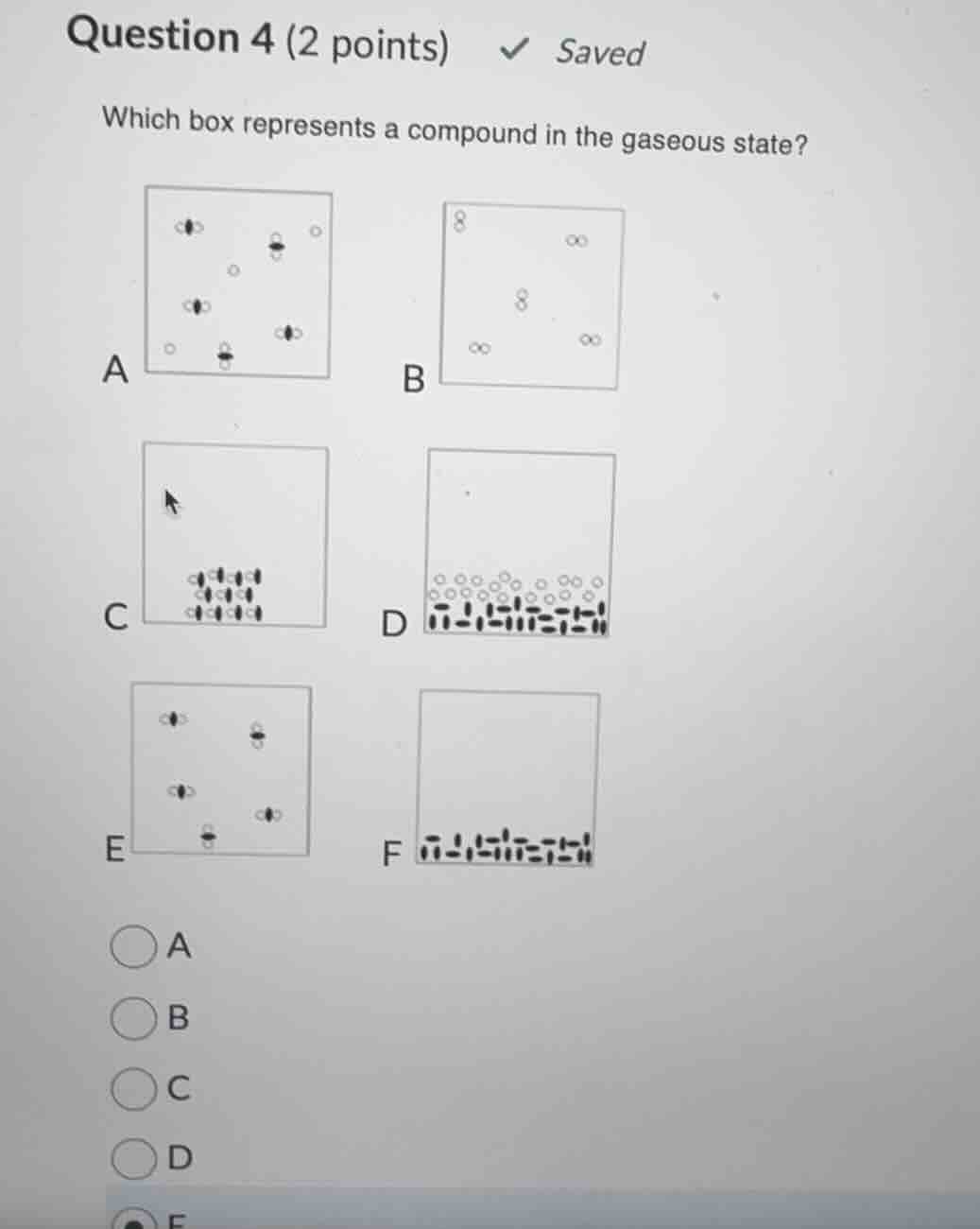
which box represents a compound in the gaseous state?
a diagram of particles b diagram of particles
c diagram of particles d diagram of particles
e diagram of particles f diagram of particles
a
b
c
d
e
Brief Explanations
- First, recall the definitions: A compound is a substance made of two or more different elements chemically bonded. Gaseous state has particles far apart, moving freely.
- Analyze each option:
- Option A: Contains different types of particles (some single atoms, some molecules), so it's a mixture, not a pure compound.
- Option B: Particles are diatomic molecules of the same element (element, not compound).
- Option C: Particles are molecules (same type, compound) and are far apart, moving freely (gaseous state: particles have large space between them, no fixed shape/volume).
- Option D: Particles are in two states (liquid and solid? Or mixture), not gaseous.
- Option E: Wait, original options—wait, E: particles are molecules (compound?) but let's recheck. Wait, C: the box C has particles (molecules) spread out, no fixed arrangement, far apart (gaseous). Wait, maybe I misread. Wait, the correct one: A compound has molecules with different atoms. Let's check the diagrams:
- In box E: Wait, no, let's re-express. Wait, the key is: compound (molecules with different elements) and gaseous (particles far apart, not close like liquid/solid).
- Box E: Wait, the user's diagram: E has molecules (each molecule has two different atoms, so compound) and particles are spread out (gaseous state: particles are far apart, moving freely, no fixed position). Wait, maybe I made a mistake earlier. Wait, let's re-express:
- A: mixture (different particles: single atoms and molecules).
- B: element (diatomic molecules, same element).
- C: compound (molecules with different atoms) and gaseous (particles far apart).
- D: mixture (two types of particles, one like liquid, one like solid? No, D has two layers: maybe liquid and solid, not gaseous.
- E: Wait, E's molecules: each molecule has two different atoms (compound) and particles are spread out (gaseous). Wait, maybe the correct answer is E? Wait, no, let's check again. Wait, the original question's options: the user's selected option was E? Wait, no, the user's image: the options are A, B, C, D, E, F. Wait, maybe I misread. Let's re-express the states:
- Gaseous state: particles are far apart, move freely, no fixed volume/shape.
- Liquid: particles close, take shape of container.
- Solid: particles close, fixed shape.
- Compound: molecules consist of two or more different elements.
- So:
- A: mixture (molecules and single atoms).
- B: element (diatomic, same element).
- C: compound (molecules with different atoms) and gaseous (particles far apart). Wait, C's box: particles are at the bottom? No, wait the diagram: C has a few molecules at the bottom? No, maybe I misread. Wait, the user's diagram: C's box has a mouse pointer and some molecules at the bottom? No, maybe the correct one is E. Wait, E's box: molecules (each with two different atoms, compound) and particles are spread out (gaseous). Yes, E: compound (molecules with different elements) and gaseous (particles far apart, moving freely). So the correct answer is E.

Snap & solve any problem in the app
Get step-by-step solutions on Sovi AI
Photo-based solutions with guided steps
Explore more problems and detailed explanations
E. (The box E represents a compound in the gaseous state as it contains molecules of a compound (different atoms bonded) with particles spread out, indicating the gaseous state.)