QUESTION IMAGE
Question
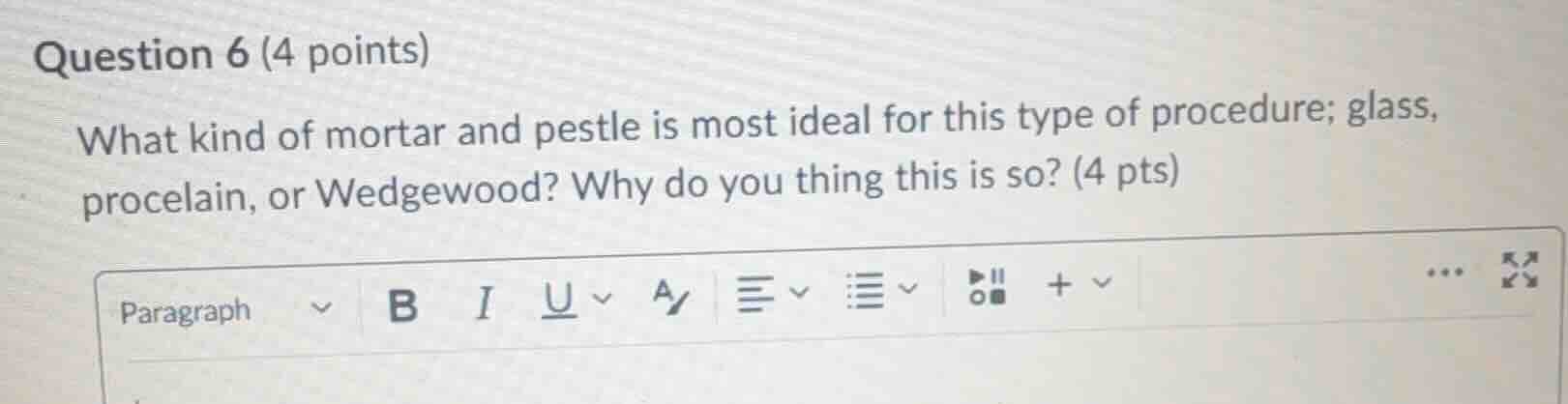
question 6 (4 points)
what kind of mortar and pestle is most ideal for this type of procedure; glass, porcelain, or wedgewood? why do you thing this is so? (4 pts)
To determine the ideal mortar and pestle (glass, porcelain, or Wedgewood), we analyze their properties:
- Wedgewood (or agate) mortar and pestle is often ideal for grinding solids in lab procedures.
- Why?
- It is extremely hard and non - reactive, so it doesn’t contaminate samples (unlike glass, which can be scratched or react with some chemicals, or porcelain, which is slightly less hard).
- Its hardness allows efficient grinding of solids without abrasion of the mortar/pestle itself, preserving sample purity and the tool’s integrity. Glass is less hard and more prone to scratching (releasing silica), while porcelain is slightly softer than Wedgewood and may wear or contaminate more easily.

Snap & solve any problem in the app
Get step-by-step solutions on Sovi AI
Photo-based solutions with guided steps
Explore more problems and detailed explanations
The most ideal mortar and pestle for many laboratory grinding procedures is Wedgewood (often agate - based Wedgewood - type). It is ideal because it is extremely hard and chemically non - reactive, which means it does not contaminate the sample being ground and can efficiently grind solids without the mortar or pestle abrading and introducing impurities (unlike glass which can scratch and release silica, or porcelain which is slightly softer and more prone to wear/contamination).