QUESTION IMAGE
Question
question 3
1 pts
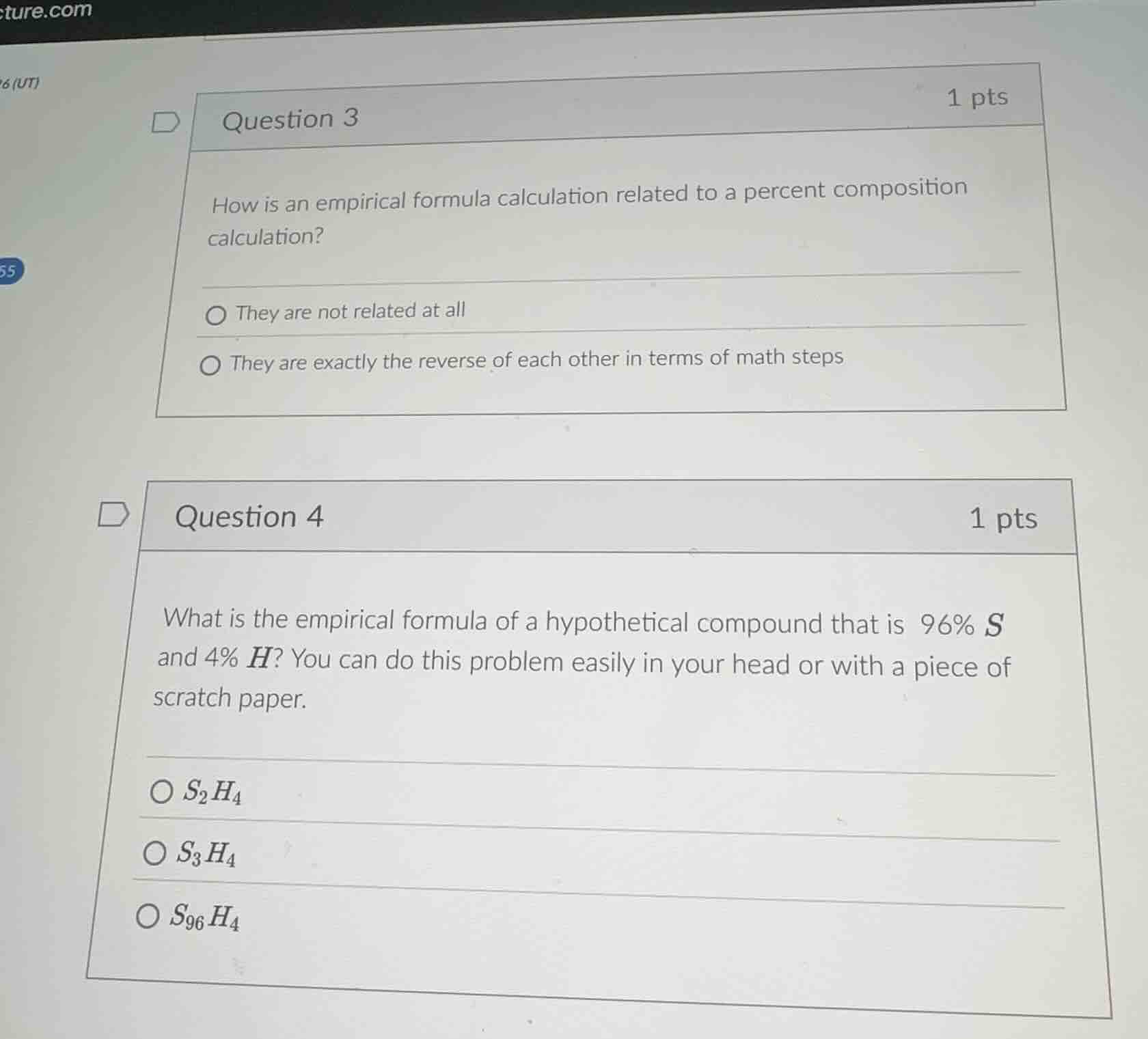
how is an empirical formula calculation related to a percent composition calculation?
○ they are not related at all
○ they are exactly the reverse of each other in terms of math steps
question 4
1 pts
what is the empirical formula of a hypothetical compound that is 96% s and 4% h? you can do this problem easily in your head or with a piece of scratch paper.
○ s₂h₄
○ s₃h₄
○ s₉₆h₄
Question 3
To determine the relationship between empirical formula and percent composition calculations:
- Percent composition gives the mass percentage of each element in a compound. To find the empirical formula, we use these mass percentages (often by assuming a 100g sample to convert percentages to grams, then converting to moles and finding the simplest mole ratio).
- The reverse process: if we know the empirical formula, we can calculate the percent composition of each element (by finding the mass of each element in the empirical formula, dividing by the total mass of the formula, and multiplying by 100). So the math steps for empirical formula from percent composition and percent composition from empirical formula are reverse operations. The first option ("They are not related at all") is incorrect. The second option ("They are exactly the reverse of each other in terms of math steps") is correct.
Step1: Assume a 100g sample
Assume we have a 100g sample of the compound. Then, the mass of S is 96g and the mass of H is 4g.
Step2: Convert mass to moles
Molar mass of S ($M_S$) = 32 g/mol, molar mass of H ($M_H$) = 1 g/mol.
Moles of S: $n_S = \frac{96\ g}{32\ g/mol} = 3\ mol$
Moles of H: $n_H = \frac{4\ g}{1\ g/mol} = 4\ mol$
Step3: Find the mole ratio
The mole ratio of S to H is $3:4$. So the empirical formula is $S_3H_4$.

Snap & solve any problem in the app
Get step-by-step solutions on Sovi AI
Photo-based solutions with guided steps
Explore more problems and detailed explanations
B. They are exactly the reverse of each other in terms of math steps