QUESTION IMAGE
Question
question 7
1 pts
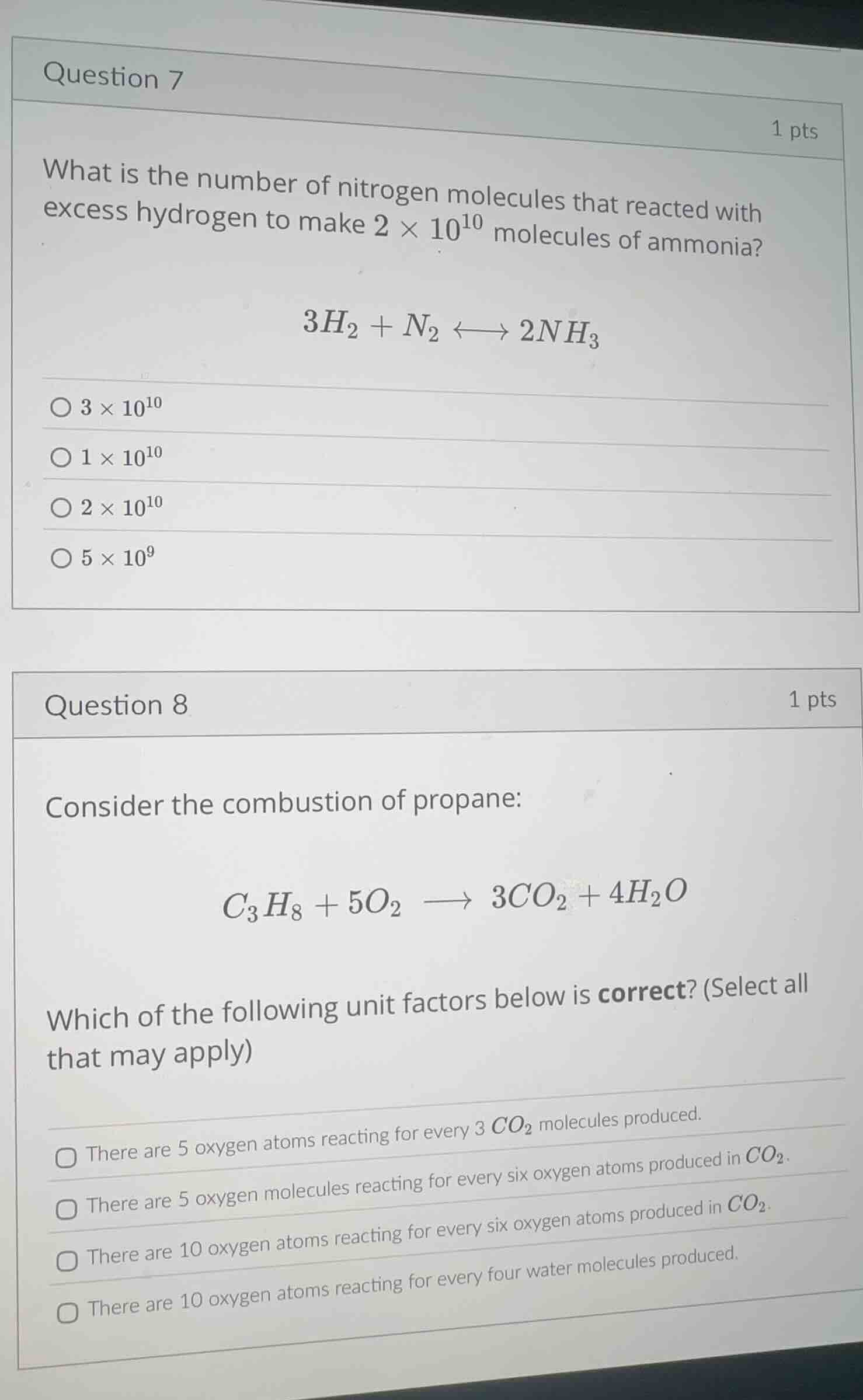
what is the number of nitrogen molecules that reacted with excess hydrogen to make $2 \times 10^{10}$ molecules of ammonia?
$3h_2 + n_2 \longleftrightarrow 2nh_3$
$\bigcirc \\ 3 \times 10^{10}$
$\bigcirc \\ 1 \times 10^{10}$
$\bigcirc \\ 2 \times 10^{10}$
$\bigcirc \\ 5 \times 10^9$
question 8
1 pts
consider the combustion of propane:
$c_3h_8 + 5o_2 \longrightarrow 3co_2 + 4h_2o$
which of the following unit factors below is correct? (select all that may apply)
$\bigcirc$ there are 5 oxygen atoms reacting for every 3 $co_2$ molecules produced.
$\bigcirc$ there are 5 oxygen molecules reacting for every six oxygen atoms produced in $co_2$.
$\bigcirc$ there are 10 oxygen atoms reacting for every six oxygen atoms produced in $co_2$.
$\bigcirc$ there are 10 oxygen atoms reacting for every four water molecules produced.
Question 7
Step1: Analyze the balanced equation
The balanced chemical equation is \(3H_2 + N_2 \longleftrightarrow 2NH_3\). From the equation, we can see that 1 mole of \(N_2\) reacts to produce 2 moles of \(NH_3\) (in terms of molecules, the ratio is the same as the mole ratio since 1 mole of any substance contains Avogadro's number of molecules). So the ratio of \(N_2\) molecules to \(NH_3\) molecules is \(1:2\).
Step2: Calculate the number of \(N_2\) molecules
Let the number of \(N_2\) molecules be \(x\). We know that \(\frac{x}{2\times10^{10}}=\frac{1}{2}\) (from the ratio \(N_2:NH_3 = 1:2\)). Solving for \(x\), we get \(x=\frac{2\times10^{10}\times1}{2}=1\times10^{10}\).
- Analyze each option:
- Option 1: "There are 5 oxygen atoms reacting for every 3 \(CO_2\) molecules produced."
From the equation \(C_3H_8 + 5O_2
ightarrow 3CO_2 + 4H_2O\), 5 \(O_2\) molecules (each with 2 O atoms, so 10 O atoms) react to produce 3 \(CO_2\) molecules. So this is incorrect.
- Option 2: "There are 5 oxygen molecules reacting for every six oxygen atoms produced in \(CO_2\)."
5 \(O_2\) molecules (10 O atoms) react, and 3 \(CO_2\) molecules have \(3\times2 = 6\) O atoms. So 5 \(O_2\) molecules react for 6 O atoms in \(CO_2\). This is correct.
- Option 3: "There are 10 oxygen atoms reacting for every six oxygen atoms produced in \(CO_2\)."
5 \(O_2\) molecules have \(5\times2=10\) O atoms, and 3 \(CO_2\) molecules have \(3\times2 = 6\) O atoms. So 10 O atoms react for 6 O atoms in \(CO_2\). This is correct.
- Option 4: "There are 10 oxygen atoms reacting for every four water molecules produced."
5 \(O_2\) molecules (10 O atoms) react, and 4 \(H_2O\) molecules are produced. Each \(H_2O\) has 1 O atom, so 4 \(H_2O\) has 4 O atoms, but the ratio here is about the reaction of O atoms (from \(O_2\)) to production of \(H_2O\) molecules. The 10 O atoms (from 5 \(O_2\)) react to produce 4 \(H_2O\) molecules. This is correct.
- Option 5: "There are 10 oxygen atoms reacting for every four water molecules produced." (same as option 4, assuming it's a repeat or typo, but based on the equation, as above, this is correct)
- Correct options:
- Option 2: 5 \(O_2\) molecules (10 O atoms? No, 5 \(O_2\) is 10 O atoms? Wait, no, 5 \(O_2\) molecules have 10 O atoms. Wait, re - check option 2: "5 oxygen molecules" (5 \(O_2\)) react, and 3 \(CO_2\) have 6 O atoms. So 5 \(O_2\) (10 O atoms) react for 6 O atoms in \(CO_2\). Option 2 says "5 oxygen molecules reacting for every six oxygen atoms produced in \(CO_2\)" – 5 \(O_2\) (molecules) react, 3 \(CO_2\) have 6 O atoms. So this is correct.
- Option 3: "10 oxygen atoms reacting for every six oxygen atoms produced in \(CO_2\)" – 10 O atoms (from 5 \(O_2\)) react, 6 O atoms (from 3 \(CO_2\)) are produced. Correct.
- Option 4: "10 oxygen atoms reacting for every four water molecules produced" – 10 O atoms (from 5 \(O_2\)) react, 4 \(H_2O\) molecules are produced. Correct.

Snap & solve any problem in the app
Get step-by-step solutions on Sovi AI
Photo-based solutions with guided steps
Explore more problems and detailed explanations
\(1\times 10^{10}\) (corresponding to the option "1 × 10¹⁰")