QUESTION IMAGE
Question
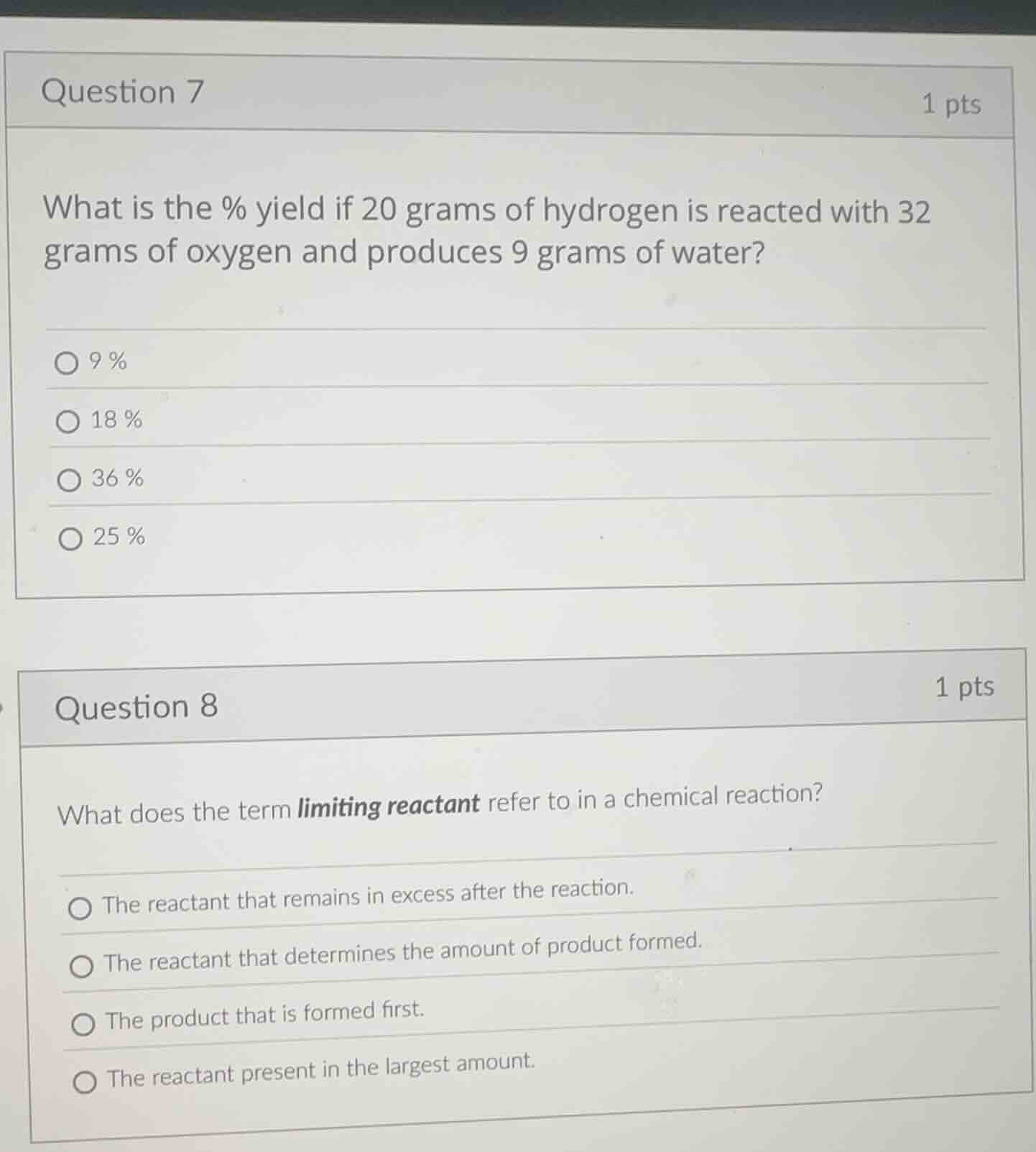
question 7
1 pts
what is the % yield if 20 grams of hydrogen is reacted with 32 grams of oxygen and produces 9 grams of water?
9 %
18 %
36 %
25 %
question 8
1 pts
what does the term limiting reactant refer to in a chemical reaction?
the reactant that remains in excess after the reaction.
the reactant that determines the amount of product formed.
the product that is formed first.
the reactant present in the largest amount.
Question 7
Step1: Write the balanced reaction
The reaction between hydrogen and oxygen to form water is: $$\ce{2H_{2} + O_{2} -> 2H_{2}O}$$
Molar mass of $\ce{H_{2}}$ is $2\ \text{g/mol}$, $\ce{O_{2}}$ is $32\ \text{g/mol}$ and $\ce{H_{2}O}$ is $18\ \text{g/mol}$.
Step2: Find moles of reactants
Moles of $\ce{H_{2}} = \frac{20\ \text{g}}{2\ \text{g/mol}} = 10\ \text{mol}$
Moles of $\ce{O_{2}} = \frac{32\ \text{g}}{32\ \text{g/mol}} = 1\ \text{mol}$
Step3: Determine limiting reactant
From the reaction, 2 moles of $\ce{H_{2}}$ react with 1 mole of $\ce{O_{2}}$.
For 1 mole of $\ce{O_{2}}$, we need $2\ \text{mol}$ of $\ce{H_{2}}$. But we have $10\ \text{mol}$ of $\ce{H_{2}}$, so $\ce{O_{2}}$ is the limiting reactant.
Step4: Calculate theoretical yield of $\ce{H_{2}O}$
From the reaction, 1 mole of $\ce{O_{2}}$ produces 2 moles of $\ce{H_{2}O}$.
Moles of $\ce{H_{2}O}$ (theoretical) $= 2 \times 1\ \text{mol} = 2\ \text{mol}$
Mass of $\ce{H_{2}O}$ (theoretical) $= 2\ \text{mol} \times 18\ \text{g/mol} = 36\ \text{g}$
Step5: Calculate % yield
$\% \text{yield} = \frac{\text{Actual yield}}{\text{Theoretical yield}} \times 100 = \frac{9\ \text{g}}{36\ \text{g}} \times 100 = 25\%$ Wait, no, wait: Wait, 2 moles of water would be 36 g? But actual is 9 g. Wait, $\frac{9}{36} \times 100 = 25\%$? Wait, no, wait, let's recheck. Wait, 1 mole O2 gives 2 moles H2O. 1 mole O2 is 32 g, gives 218=36 g H2O. Actual is 9 g. So (9/36)100 =25%? But the options have 25% as an option. Wait, but let me check again. Wait, moles of H2: 20g /2g/mol=10 mol. Moles of O2: 32/32=1 mol. The ratio of H2 to O2 in reaction is 2:1. So for 1 mol O2, need 2 mol H2. We have 10 mol H2, so O2 is limiting. So theoretical yield of H2O: 2 mol (since 1 mol O2 gives 2 mol H2O). 2 mol H2O is 36 g. Actual is 9 g. So (9/36)100=25%. So the answer is 25%? Wait, but let me check the options. The options are 9%,18%,36%,25%. So 25% is an option. Wait, but maybe I made a mistake. Wait, no, let's recheck. Wait, 2H2 + O2 -> 2H2O. So 2 moles H2 (4g) and 1 mole O2 (32g) make 2 moles H2O (36g). So if we have 32g O2 (1 mole) and 20g H2 (10 moles), O2 is limiting. So theoretical yield is 36g. Actual is 9g. So (9/36)100=25%. So the answer is 25%.
The limiting reactant is the reactant that gets completely consumed first in a reaction and thus determines the maximum amount of product that can be formed. Let's analyze the options:
- "The reactant that remains in excess after the reaction" is incorrect (that's excess reactant).
- "The reactant that determines the amount of product formed" is correct, as it limits the reaction by being consumed first.
- "The product that is formed first" is incorrect (it's about reactants, not products).
- "The reactant present in the largest amount" is incorrect (limiting reactant is not about amount but stoichiometry).

Snap & solve any problem in the app
Get step-by-step solutions on Sovi AI
Photo-based solutions with guided steps
Explore more problems and detailed explanations
25% (Option: 25 %)