QUESTION IMAGE
Question
question 1 of 5
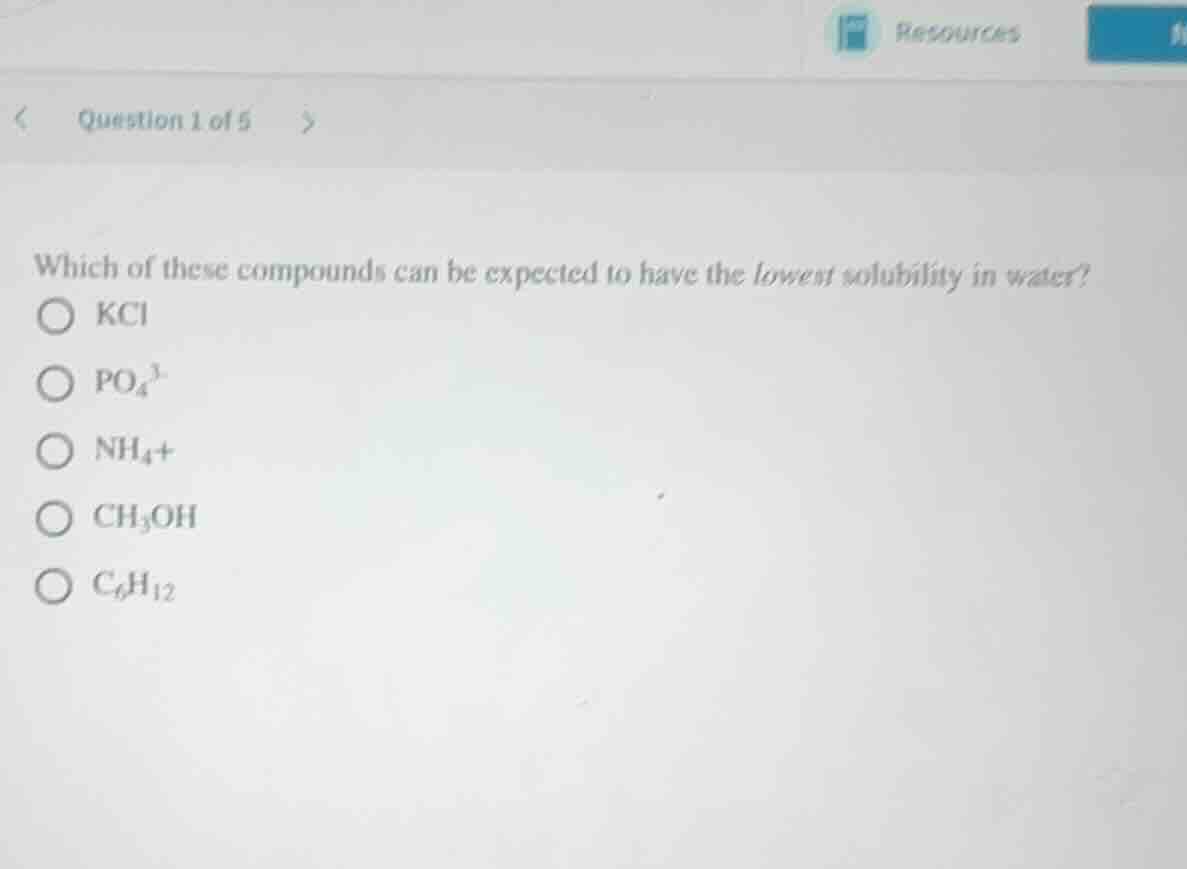
which of these compounds can be expected to have the lowest solubility in water?
kcl
po₄³⁻
nh₄⁺
ch₃oh
c₆h₁₂
Brief Explanations
To determine solubility in water, we use the "like dissolves like" principle. Water is polar, so polar or ionic compounds (or those forming H - bonds) are more soluble.
- \( \text{KCl} \): Ionic, dissolves well.
- \( \text{PO}_4^{3 - } \): Usually part of ionic compounds (e.g., salts), soluble with many ions.
- \( \text{NH}_4^+ \): Part of ionic salts (e.g., \( \text{NH}_4\text{Cl} \)), soluble.
- \( \text{CH}_3\text{OH} \) (methanol): Has an - OH group, forms H - bonds with water, very soluble.
- \( \text{C}_6\text{H}_{12} \) (cyclohexane or hexene): Non - polar hydrocarbon. Non - polar substances have low solubility in polar water.

Snap & solve any problem in the app
Get step-by-step solutions on Sovi AI
Photo-based solutions with guided steps
Explore more problems and detailed explanations
\( \boldsymbol{\text{C}_6\text{H}_{12}} \) (the option with \( \text{C}_6\text{H}_{12} \))