QUESTION IMAGE
Question
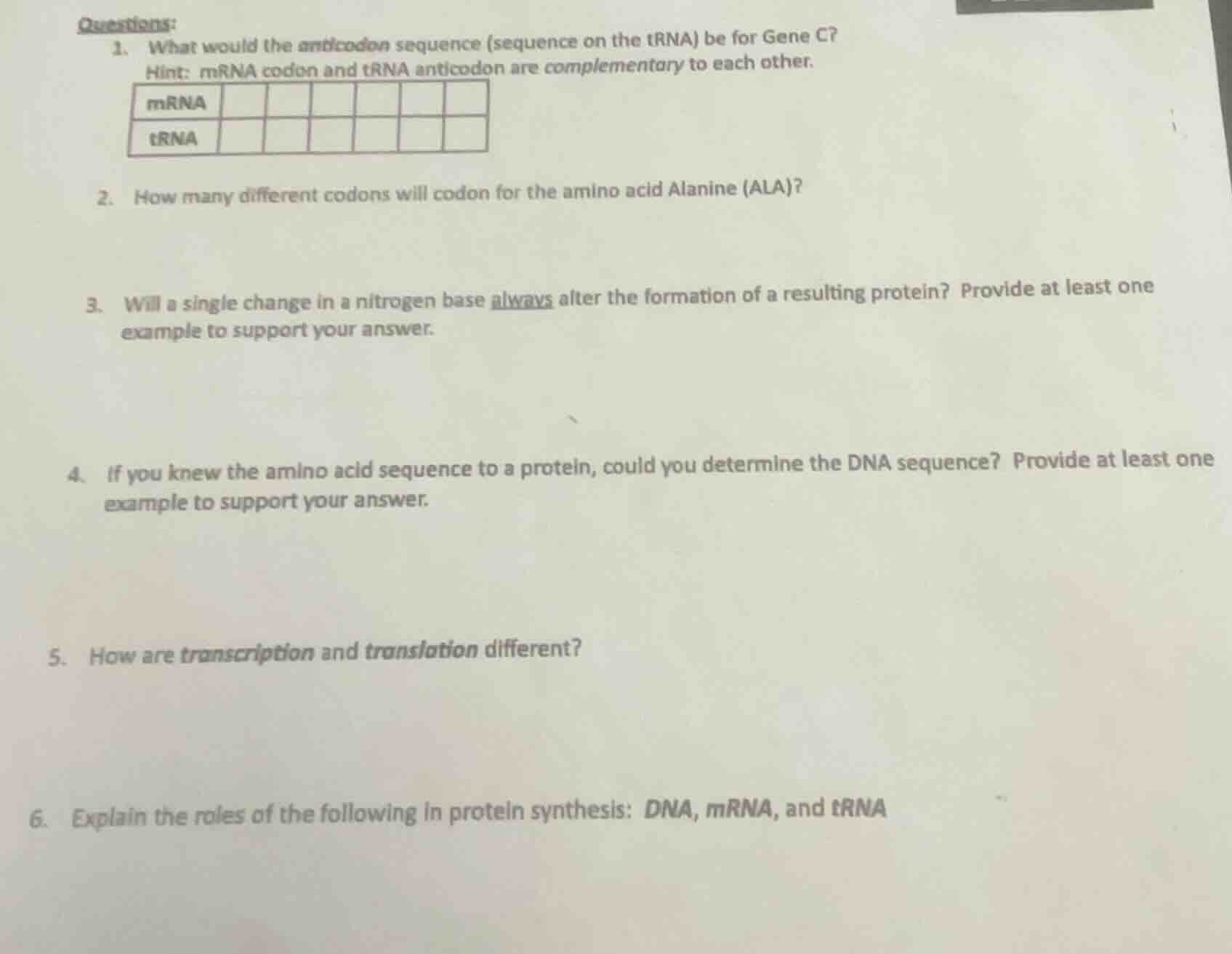
questions:1. what would the anticodon sequence (sequence on the trna) be for gene c?hint: mrna codon and trna anticodon are complementary to each other.mrna trna 2. how many different codons will codon for the amino acid alanine (ala)?3. will a single change in a nitrogen base always alter the formation of a resulting protein? provide at least one example to support your answer.4. if you knew the amino acid sequence to a protein, could you determine the dna sequence? provide at least one example to support your answer.5. how are transcription and translation different?6. explain the roles of the following in protein synthesis: dna, mrna, and trna
- Question 1: The problem is incomplete because the mRNA codon sequence for Gene C is not provided. Complementary base pairing rules are: A (adenine) pairs with U (uracil, in RNA) and C (cytosine) pairs with G (guanine). To find the tRNA anticodon, each mRNA base is paired with its complement.
- Question 2: Alanine is encoded by codons that follow the pattern GCN (N = any nucleotide: U, C, A, G). The specific codons are GCU, GCC, GCA, GCG.
- Question 3: The genetic code has redundancy, meaning multiple codons can code for the same amino acid. A base change (silent mutation) that results in a codon for the same amino acid will not alter the protein.
- Question 4: Most amino acids are encoded by multiple codons (degeneracy of the genetic code). This means a single amino acid can correspond to different mRNA codons, which in turn correspond to different DNA sequences.
- Question 5: Transcription and translation differ in their location, molecules involved, and end product. Transcription converts DNA to mRNA, while translation converts mRNA to a protein.
- Question 6: Each molecule has a distinct, sequential role in the two main stages of protein synthesis (transcription and translation).

Snap & solve any problem in the app
Get step-by-step solutions on Sovi AI
Photo-based solutions with guided steps
Explore more problems and detailed explanations
- Sorry, the mRNA sequence for Gene C is not provided. To solve this, pair each mRNA base with its complement: A↔U, C↔G, then fill the tRNA row with these complementary bases.
- 4
- No. A silent mutation is an example: if the mRNA codon changes from GCU to GCC, both code for alanine, so the protein remains unchanged.
- No. For example, the amino acid alanine can be encoded by GCU, GCC, GCA, or GCG. Each of these mRNA codons corresponds to a different DNA sequence (CGA, CGG, CGT, CGC on the template strand), so a single amino acid sequence cannot map to one unique DNA sequence.
- - Transcription occurs in the nucleus (eukaryotes) and uses DNA to make mRNA; translation occurs in the cytoplasm at ribosomes and uses mRNA to make a polypeptide/protein.
- Transcription involves RNA polymerase and DNA nucleotides; translation involves tRNA, ribosomes, and amino acids.
- - DNA: Stores the genetic code (gene sequence) that dictates the amino acid order of the protein; serves as the template for mRNA synthesis during transcription.
- mRNA: Carries the complementary copy of the DNA gene sequence from the nucleus to the ribosome; its codons specify the order of amino acids in the protein.
- tRNA: Transports specific amino acids to the ribosome; its anticodon pairs with complementary mRNA codons to ensure the correct amino acid is added to the growing polypeptide chain.