QUESTION IMAGE
Question
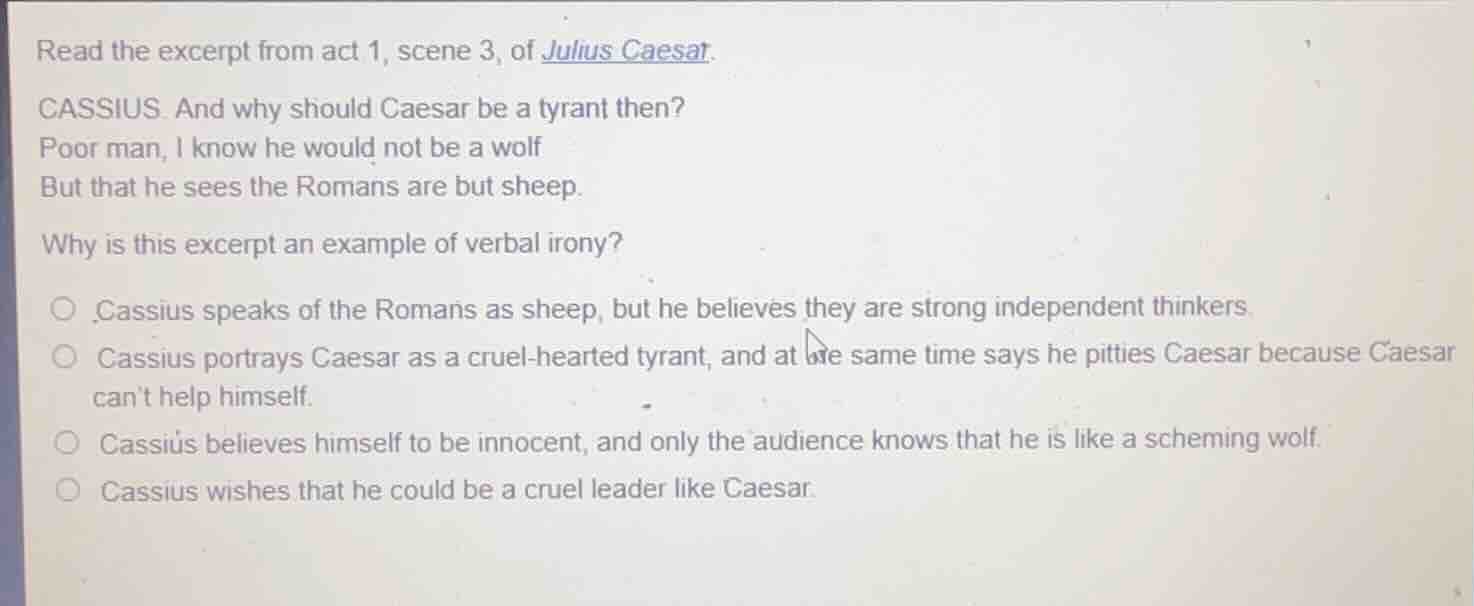
read the excerpt from act 1, scene 3, of julius caesar. cassius. and why should caesar be a tyrant then? poor man, i know he would not be a wolf but that he sees the romans are but sheep. why is this excerpt an example of verbal irony? ○ cassius speaks of the romans as sheep, but he believes they are strong independent thinkers. ○ cassius portrays caesar as a cruel - hearted tyrant, and at the same time says he pities caesar because caesar cant help himself. ○ cassius believes himself to be innocent, and only the audience knows that he is like a scheming wolf. ○ cassius wishes that he could be a cruel leader like caesar.
Verbal irony occurs when a speaker says the opposite of what they truly mean, or when their words carry a contradictory meaning. In the excerpt, Cassius calls Caesar a "tyrant" and a "wolf" but immediately frames Caesar's behavior as a response to the Romans being "sheep" (compliant, weak followers), implying Caesar's tyranny is enabled by the Romans, not inherent cruelty. This creates irony: he labels Caesar a cruel tyrant while also suggesting Caesar's actions are a reaction he can't fully control, pitting the harsh label against a mitigating explanation.

Snap & solve any problem in the app
Get step-by-step solutions on Sovi AI
Photo-based solutions with guided steps
Explore more problems and detailed explanations
Cassius portrays Caesar as a cruel-hearted tyrant, and at the same time says he pities Caesar because Caesar can't help himself.