QUESTION IMAGE
Question
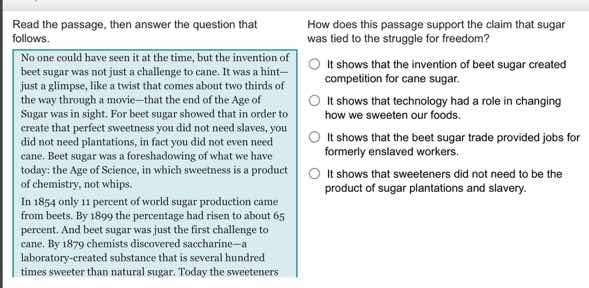
read the passage, then answer the question that follows.
no one could have seen it at the time, but the invention of beet sugar was not just a challenge to cane. it was a hint—just a glimpse, like a twist that comes about two thirds of the way through a movie—that the end of the age of sugar was in sight. for beet sugar showed that in order to create that perfect sweetness you did not need slaves, you did not need plantations, in fact you did not even need cane. beet sugar was a foreshadowing of what we have today: the age of science, in which sweetness is a product of chemistry, not whips.
in 1854 only 11 percent of world sugar production came from beets. by 1899 the percentage had risen to about 65 percent. and chemists discovered saccharine, a laboratory - created substance that is several hundred times sweeter than natural sugar. today the sweeteners used in the foods you eat may come from corn, from fruit, or directly from a lab.
how does this passage support the claim that sugar was tied to the struggle for freedom?
- it shows that the invention of beet sugar created competition for cane sugar.
- it shows that technology had a role in changing how we sweeten our foods.
- it shows that the beet sugar trade provided jobs for formerly enslaved workers.
- it shows that sweeteners did not need to be the product of plantations and slavery.
To answer this, we analyze each option:
- Option 1: The passage says beet sugar was a challenge to cane, but the claim is about freedom. This option is about competition, not freedom. Eliminate.
- Option 2: The passage states beet sugar was a "hint of what we have today: the Age of Science, in which sweetness is a product of chemistry, not whips." It shows technology (science/chemistry) changed how we sweeten food, moving from relying on slave - labor (cane) to scientific methods, which relates to the struggle for freedom from the reliance on slave - based production.
- Option 3: The passage doesn't mention beet sugar trade providing jobs for formerly enslaved workers. Eliminate.
- Option 4: The passage is about the shift from cane (involving slavery) to beet sugar (involving science), not about sweeteners not needing to be from plants/slavery in general. Eliminate.

Snap & solve any problem in the app
Get step-by-step solutions on Sovi AI
Photo-based solutions with guided steps
Explore more problems and detailed explanations
B. It shows that technology had a role in changing how we sweeten our foods.