QUESTION IMAGE
Question
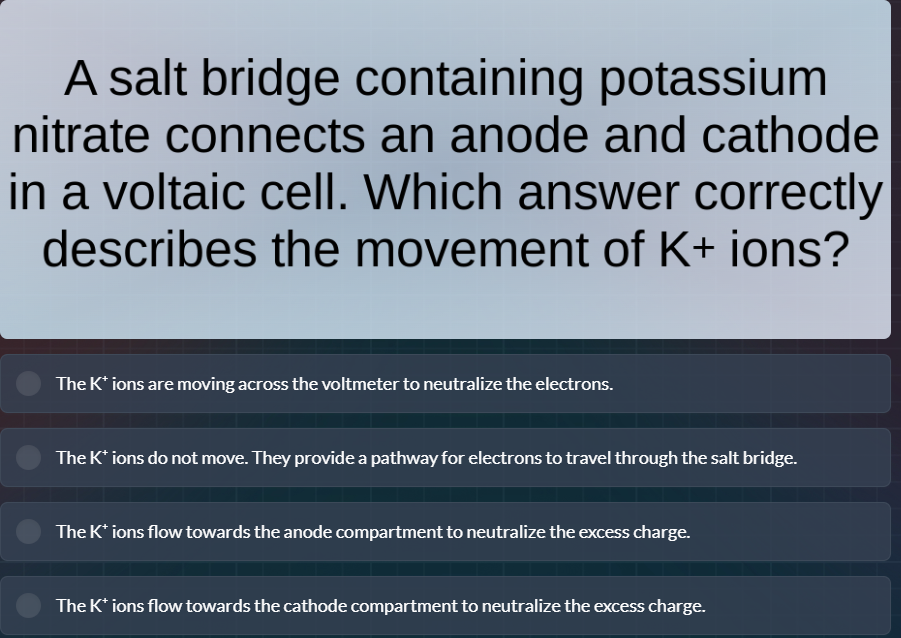
a salt bridge containing potassium nitrate connects an anode and cathode in a voltaic cell. which answer correctly describes the movement of k+ ions? the k+ ions are moving across the voltmeter to neutralize the electrons. the k+ ions do not move. they provide a pathway for electrons to travel through the salt bridge. the k+ ions flow towards the anode compartment to neutralize the excess charge. the k+ ions flow towards the cathode compartment to neutralize the excess charge.
In a voltaic cell, oxidation occurs at the anode (electrons are released, leaving a positive charge), and reduction occurs at the cathode (electrons are consumed, leaving a negative charge). The salt bridge's ions move to neutralize excess charge. \( \text{K}^+ \) (positive ion) moves towards the cathode (negative charge from electron consumption) to neutralize the excess negative charge there. Other options are incorrect: ions don’t move through the voltmeter, ions do move in the salt bridge, and \( \text{K}^+ \) doesn’t move to the anode (anode is positive, repelling positive ions).

Snap & solve any problem in the app
Get step-by-step solutions on Sovi AI
Photo-based solutions with guided steps
Explore more problems and detailed explanations
The K⁺ ions flow towards the cathode compartment to neutralize the excess charge.