QUESTION IMAGE
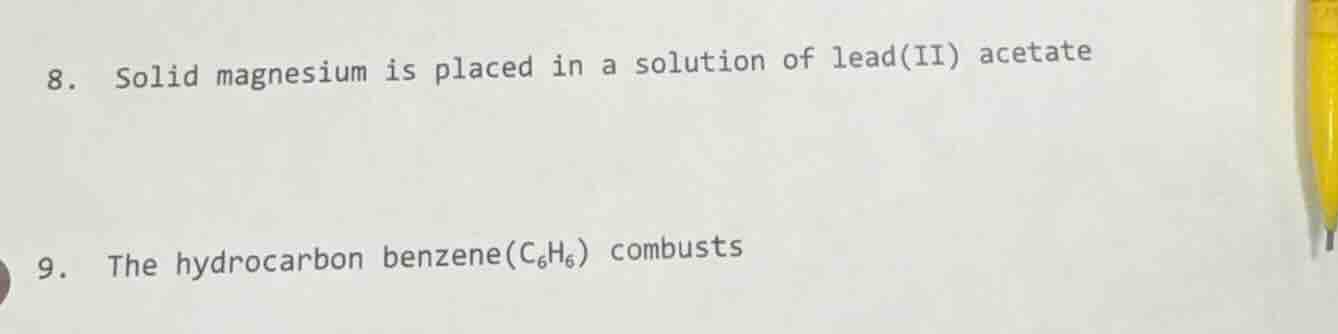
Question
- solid magnesium is placed in a solution of lead(ii) acetate
- the hydrocarbon benzene($c_6h_6$) combusts
For Question 8:
Step 1: Identify the reaction type
This is a single - displacement reaction. Magnesium (Mg) is a more reactive metal than lead (Pb) (based on the activity series of metals). The general form of a single - displacement reaction is \(A + BC
ightarrow AC + B\), where \(A\) is the more reactive metal, \(BC\) is the ionic compound, \(AC\) is the new ionic compound, and \(B\) is the less reactive metal.
Step 2: Write the chemical formulas of reactants and products
The reactants are solid magnesium (\(Mg(s)\)) and lead(II) acetate solution. The formula for lead(II) acetate is \(Pb(CH_{3}COO)_{2}(aq)\) (since lead(II) has a charge of \(+ 2\) and acetate (\(CH_{3}COO^{-}\)) has a charge of \(-1\), so we need two acetate ions to balance the charge of one lead(II) ion).
The products will be magnesium acetate (\(Mg(CH_{3}COO)_{2}(aq)\)) and solid lead (\(Pb(s)\)) (because magnesium displaces lead from its compound).
Step 3: Write the balanced chemical equation
The unbalanced equation is:
\(Mg(s)+Pb(CH_{3}COO)_{2}(aq)
ightarrow Mg(CH_{3}COO)_{2}(aq)+Pb(s)\)
To balance the equation, we check the number of each atom on both sides. For magnesium: 1 on the left and 1 on the right. For lead: 1 on the left and 1 on the right. For acetate groups (\(CH_{3}COO\)): 2 on the left (from \(Pb(CH_{3}COO)_{2}\)) and 2 on the right (from \(Mg(CH_{3}COO)_{2}\)). So the equation is already balanced.
Step 1: Identify the reaction type
Combustion of a hydrocarbon (benzene, \(C_{6}H_{6}\)) in the presence of oxygen (\(O_{2}\)) produces carbon dioxide (\(CO_{2}\)) and water (\(H_{2}O\)). The general equation for the combustion of a hydrocarbon is \(C_{x}H_{y}+(x + \frac{y}{4})O_{2}
ightarrow xCO_{2}+\frac{y}{2}H_{2}O\) (for complete combustion).
Step 2: Determine the values of x and y for benzene
For benzene (\(C_{6}H_{6}\)), \(x = 6\) and \(y=6\).
Step 3: Calculate the coefficients for the balanced equation
Substitute \(x = 6\) and \(y = 6\) into the general formula:
The coefficient of \(O_{2}\) is \(x+\frac{y}{4}=6+\frac{6}{4}=6 + 1.5=7.5=\frac{15}{2}\)
The coefficient of \(CO_{2}\) is \(x = 6\)
The coefficient of \(H_{2}O\) is \(\frac{y}{2}=\frac{6}{2}=3\)
So the unbalanced equation is \(C_{6}H_{6}(l)+O_{2}(g)
ightarrow CO_{2}(g)+H_{2}O(l)\)
To get rid of the fraction, we multiply all coefficients by 2:
\(2C_{6}H_{6}(l)+15O_{2}(g)
ightarrow12CO_{2}(g)+6H_{2}O(l)\)
We can check the balance:
- Carbon: Left side: \(2\times6 = 12\), Right side: \(12\times1=12\)
- Hydrogen: Left side: \(2\times6 = 12\), Right side: \(6\times2 = 12\)
- Oxygen: Left side: \(15\times2=30\), Right side: \(12\times2+6\times1 = 24 + 6=30\)

Snap & solve any problem in the app
Get step-by-step solutions on Sovi AI
Photo-based solutions with guided steps
Explore more problems and detailed explanations
The balanced chemical equation is \(Mg(s)+Pb(CH_{3}COO)_{2}(aq)=Mg(CH_{3}COO)_{2}(aq)+Pb(s)\)