QUESTION IMAGE
Question
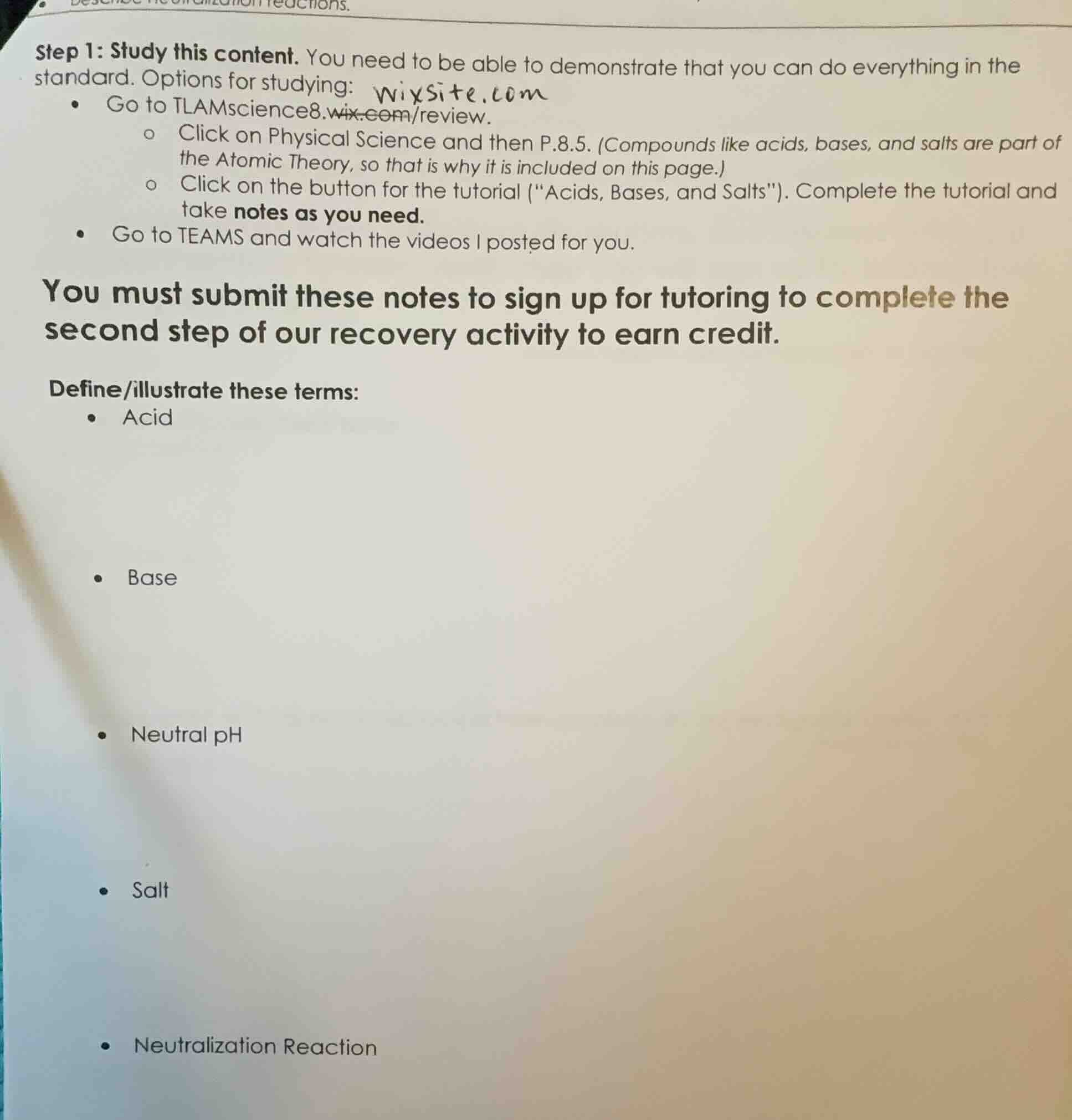
step 1: study this content. you need to be able to demonstrate that you can do everything in the standard. options for studying: go to tlamscienc8.wix.com/review. click on physical science and then p.8.5. (compounds like acids, bases, and salts are part of the atomic theory, so that is why it is included on this page.) click on the button for the tutorial (\acids, bases, and salts\). complete the tutorial and take notes as you need. go to teams and watch the videos i posted for you. you must submit these notes to sign up for tutoring to complete the second step of our recovery activity to earn credit. define/illustrate these terms: acid base neutral ph salt neutralization reaction
- Acid: A substance that donates hydrogen ions ($H^+$) in solution, has a pH less than 7, and tastes sour (e.g., vinegar, lemon juice). Chemically, it can be defined as a proton donor (Brønsted - Lowry) or an electron - pair acceptor (Lewis). For example, hydrochloric acid ($HCl$) dissociates in water as $HCl
ightarrow H^++Cl^-$.
- Base: A substance that accepts hydrogen ions ($H^+$) or donates hydroxide ions ($OH^-$) in solution, has a pH greater than 7, and tastes bitter (e.g., baking soda, ammonia). By Brønsted - Lowry theory, it is a proton acceptor, and by Arrhenius theory, it produces $OH^-$ ions in water. For example, sodium hydroxide ($NaOH$) dissociates as $NaOH
ightarrow Na^++OH^-$.
- Neutral pH: A pH value of 7 (at 25°C), which is the pH of pure water. At this pH, the concentration of hydrogen ions ($H^+$) is equal to the concentration of hydroxide ions ($OH^-$), i.e., $[H^+]=[OH^-]=1\times10^{-7}\ M$. Solutions with neutral pH are neither acidic nor basic, like pure water.
- Salt: An ionic compound formed from the neutralization reaction between an acid and a base. It consists of a cation (from the base) and an anion (from the acid). For example, when hydrochloric acid ($HCl$) reacts with sodium hydroxide ($NaOH$), the salt sodium chloride ($NaCl$) is formed: $HCl + NaOH
ightarrow NaCl + H_2O$.
- Neutralization Reaction: A chemical reaction between an acid and a base that results in the formation of a salt and water. The general equation is $Acid + Base
ightarrow Salt + Water$. For example, sulfuric acid ($H_2SO_4$) reacts with potassium hydroxide ($KOH$) as $H_2SO_4+2KOH
ightarrow K_2SO_4 + 2H_2O$. In this reaction, the $H^+$ ions from the acid combine with $OH^-$ ions from the base to form water, and the remaining ions form the salt.

Snap & solve any problem in the app
Get step-by-step solutions on Sovi AI
Photo-based solutions with guided steps
Explore more problems and detailed explanations
- Acid: A substance that donates $H^+$ ions, has pH < 7 (e.g., $HCl$).
- Base: A substance that accepts $H^+$ or donates $OH^-$, has pH > 7 (e.g., $NaOH$).
- Neutral pH: pH = 7 (pure water, $[H^+]=[OH^-]$).
- Salt: Ionic compound from acid - base neutralization (e.g., $NaCl$ from $HCl + NaOH$).
- Neutralization Reaction: Acid + Base $
ightarrow$ Salt + Water (e.g., $H_2SO_4+2KOH
ightarrow K_2SO_4 + 2H_2O$).