QUESTION IMAGE
Question
temperature and solubility
background knowledge
it is easier to dissolve soluble substances in warm water than in cold water.
however, heat increases the solubility of some substances more than of others.
science activity
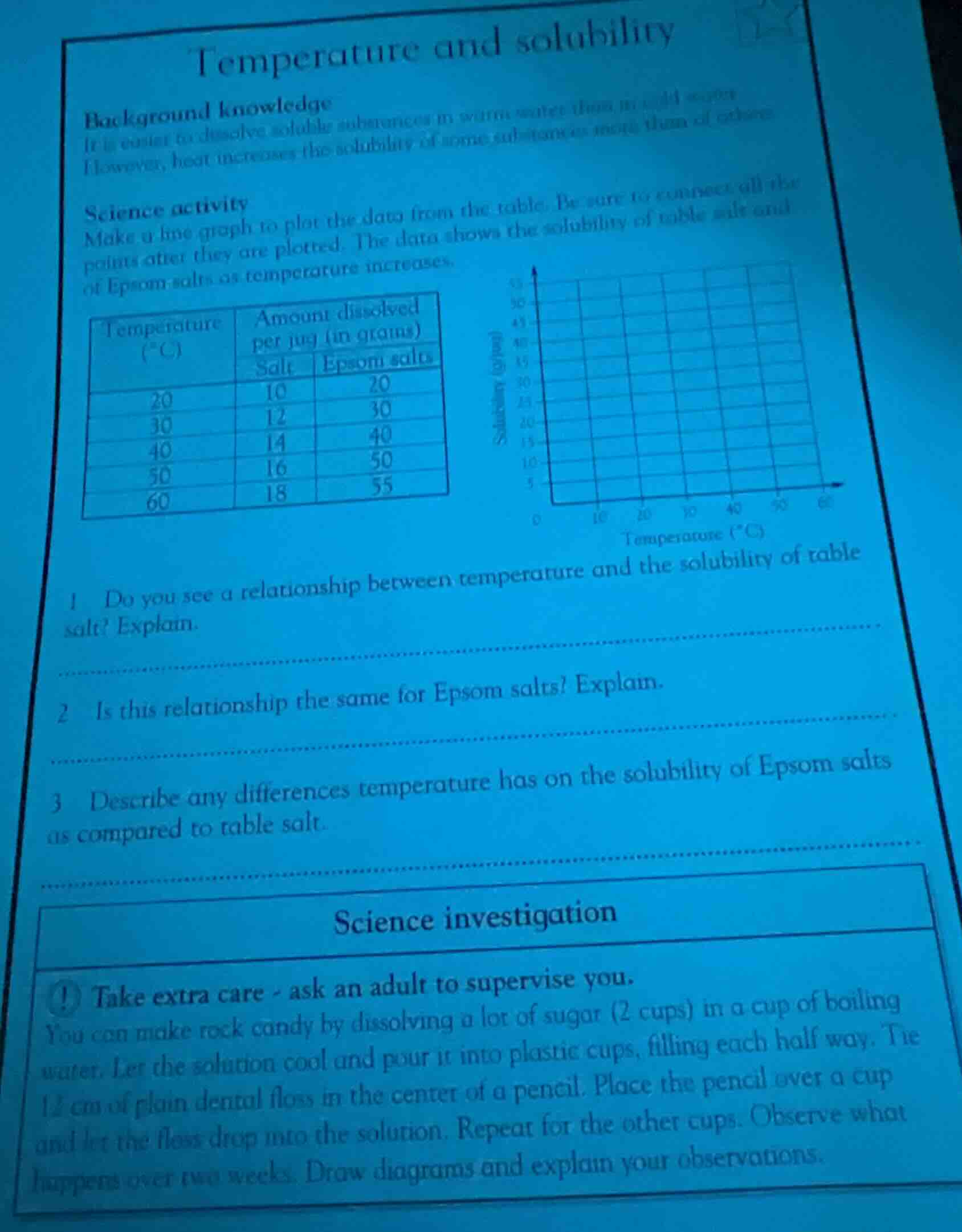
make a line graph to plot the data from the table. be sure to connect all the
points after they are plotted. the data shows the solubility of table salt and
of epsom salts as temperature increases.
| temperature (°c) | amount dissolved per jug (in grams) | |
|---|---|---|
| 20 | 10 | 20 |
| 30 | 12 | 30 |
| 40 | 14 | 40 |
| 50 | 16 | 50 |
| 60 | 18 | 55 |
1 do you see a relationship between temperature and the solubility of table
salt? explain.
2 is this relationship the same for epsom salts? explain.
3 describe any differences temperature has on the solubility of epsom salts
as compared to table salt.
science investigation
! take extra care - ask an adult to supervise you.
you can make rock candy by dissolving a lot of sugar (2 cups) in a cup of boiling
water. let the solution cool and pour it into plastic cups, filling each half way. tie
12 cm of plain dental floss in the center of a pencil. place the pencil over a cup
and let the floss drop into the solution. repeat for the other cups. observe what
happens over two weeks. draw diagrams and explain your observations.
Sub - question 1
To determine the relationship between temperature and the solubility of table salt, we analyze the data in the table. As the temperature (in \(^{\circ}\text{C}\)) increases from 20 to 30, 40, 50, and 60, the amount of table salt dissolved per jug (in grams) increases from 10 to 12, 14, 16, and 18 respectively. This shows a positive correlation, meaning that as temperature increases, the solubility of table salt also increases.
For Epsom salts, we look at the data. When temperature increases from 20 to 30, 40, 50, and 60 \(^{\circ}\text{C}\), the amount of Epsom salts dissolved per jug increases from 20 to 30, 40, 50, and 55 grams. Similar to table salt, as temperature rises, the solubility of Epsom salts also increases, so the relationship (positive correlation between temperature and solubility) is the same as that of table salt.
We compare the rate of increase in solubility for Epsom salts and table salt. For table salt, the increase in solubility per \(10^{\circ}\text{C}\) rise in temperature is relatively constant (e.g., from 20 - 30 \(^{\circ}\text{C}\), it increases by 2 g; 30 - 40 \(^{\circ}\text{C}\), also 2 g, etc.). For Epsom salts, the increase in solubility per \(10^{\circ}\text{C}\) is larger (from 20 - 30 \(^{\circ}\text{C}\), it increases by 10 g; 30 - 40 \(^{\circ}\text{C}\), 10 g; 40 - 50 \(^{\circ}\text{C}\), 10 g; 50 - 60 \(^{\circ}\text{C}\), 5 g). So, while both show an increase in solubility with temperature, the solubility of Epsom salts increases at a faster rate than that of table salt as temperature rises.

Snap & solve any problem in the app
Get step-by-step solutions on Sovi AI
Photo-based solutions with guided steps
Explore more problems and detailed explanations
Yes, there is a relationship. As temperature increases (from \(20^{\circ}\text{C}\) to \(60^{\circ}\text{C}\)), the solubility of table salt (amount dissolved per jug) increases (from 10 g to 18 g), showing a positive correlation between temperature and solubility of table salt.