QUESTION IMAGE
Question
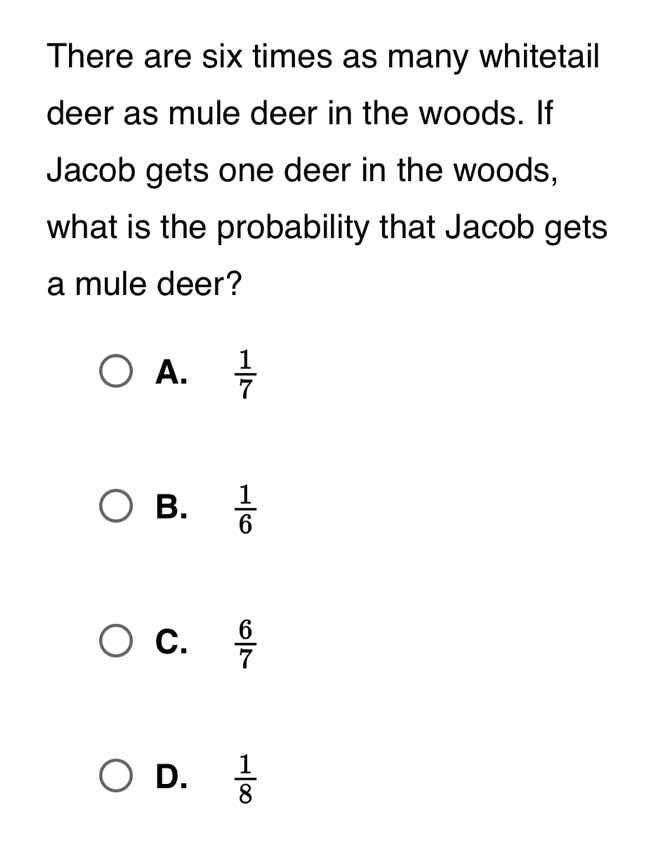
there are six times as many whitetail deer as mule deer in the woods. if jacob gets one deer in the woods, what is the probability that jacob gets a mule deer? a. \\(\frac{1}{7}\\) b. \\(\frac{1}{6}\\) c. \\(\frac{6}{7}\\) d. \\(\frac{1}{8}\\)
Step1: Define Variables
Let the number of mule deer be \( x \). Then the number of whitetail deer is \( 6x \) (since there are six times as many whitetail deer as mule deer).
Step2: Calculate Total Number of Deer
The total number of deer in the woods is the sum of mule deer and whitetail deer. So, total deer \( = x + 6x = 7x \).
Step3: Calculate Probability of Getting a Mule Deer
The probability of an event is the number of favorable outcomes divided by the total number of possible outcomes. Here, the favorable outcome (getting a mule deer) is \( x \), and the total number of outcomes (total deer) is \( 7x \). So the probability \( P(\text{mule deer})=\frac{x}{7x} \). The \( x \) cancels out (assuming \( x
eq0 \), which makes sense because there are deer), so \( P(\text{mule deer}) = \frac{1}{7} \).

Snap & solve any problem in the app
Get step-by-step solutions on Sovi AI
Photo-based solutions with guided steps
Explore more problems and detailed explanations
A. \(\frac{1}{7}\)