QUESTION IMAGE
Question
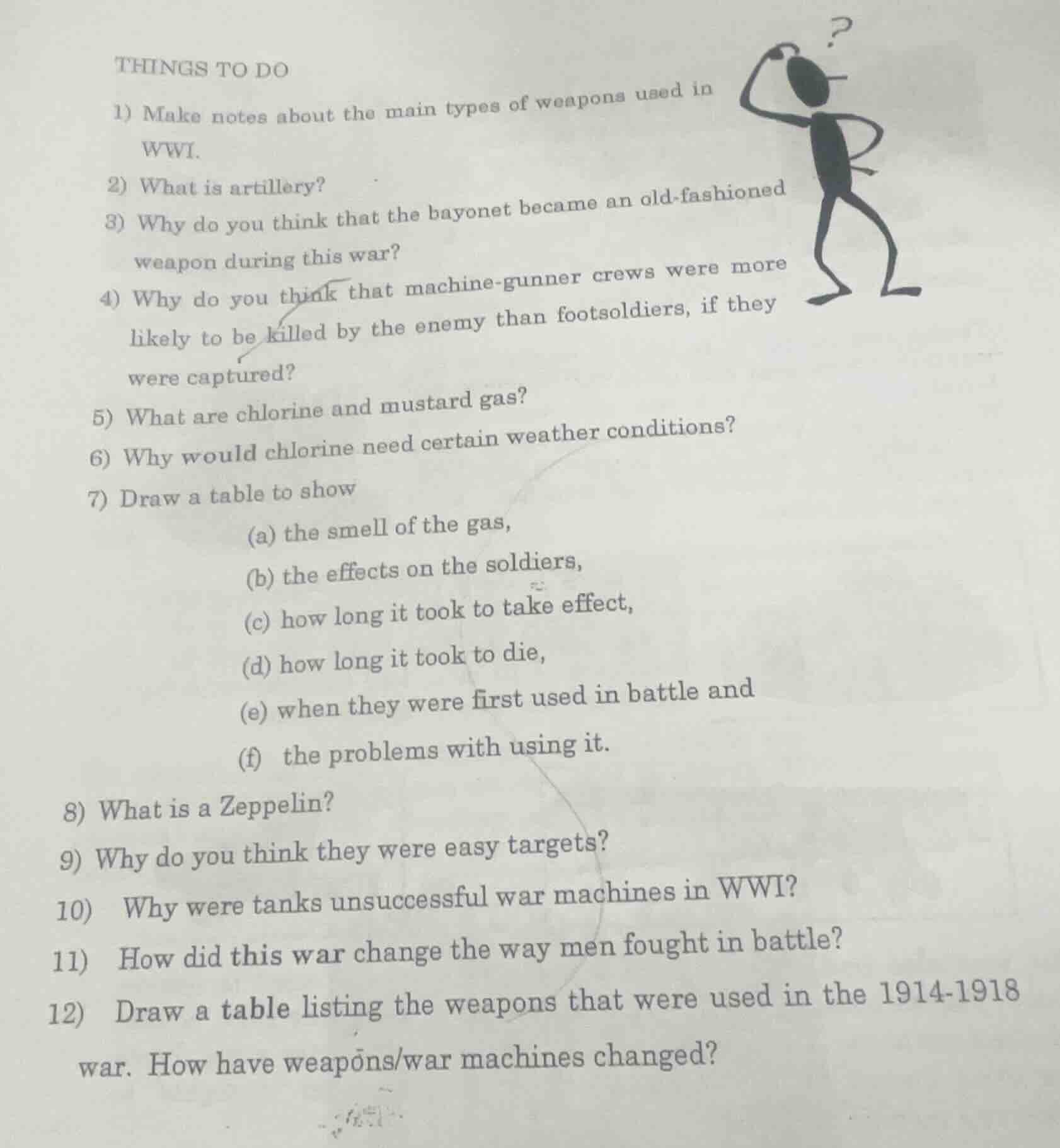
things to do
- make notes about the main types of weapons used in wwi.
- what is artillery?
- why do you think that the bayonet became an old-fashioned weapon during this war?
- why do you think that machine-gunner crews were more likely to be killed by the enemy than footsoldiers, if they were captured?
- what are chlorine and mustard gas?
- why would chlorine need certain weather conditions?
- draw a table to show
(a) the smell of the gas,
(b) the effects on the soldiers,
(c) how long it took to take effect,
(d) how long it took to die,
(e) when they were first used in battle and
(f) the problems with using it.
- what is a zeppelin?
- why do you think they were easy targets?
- why were tanks unsuccessful war machines in wwi?
- how did this war change the way men fought in battle?
- draw a table listing the weapons that were used in the 1914-1918 war. how have weapons/war machines changed?
Brief Explanations
- Main WWI weapons: Covers infantry, artillery, chemical, aerial, armored, and naval weapons.
- Artillery definition: Large-caliber long-range projectile weapons.
- Bayonet obsolescence: Outmatched by new long-range, high-firepower weapons.
- Machine-gunner execution risk: Their weapons inflicted massive enemy casualties, leading to retaliation.
- Chlorine/mustard gas: Chlorine is a choking agent; mustard gas is a blistering agent.
- Chlorine weather needs: Depends on wind to spread, avoids rain that neutralizes it.
- Gas comparison table: Compares chlorine and mustard gas on the listed traits.
- Zeppelin definition: Large rigid German airships used in WWI.
- Zeppelin vulnerability: Slow, large, flammable, easy to spot and shoot down.
- WWI tank failures: Mechanical unreliability, slow speed, poor visibility.
- Battle tactics shift: Moved from open charges to trench warfare with combined arms.
- Weapons change table: Lists WWI weapons and contrasts with modern advancements.

Snap & solve any problem in the app
Get step-by-step solutions on Sovi AI
Photo-based solutions with guided steps
Explore more problems and detailed explanations
- Main types of WWI weapons include:
- Infantry weapons: Rifles, bayonets, hand grenades, machine guns
- Artillery: Field guns, howitzers, heavy siege guns
- Chemical weapons: Chlorine gas, mustard gas
- Aerial weapons: Zeppelins, fighter planes, bombers
- Armored weapons: Early tanks
- Naval weapons: Dreadnought battleships, U-boats
- Artillery refers to large-caliber firearms (like field guns, howitzers, and heavy siege guns) designed to launch explosive projectiles over long distances to destroy enemy positions, troops, or equipment.
- The bayonet became outdated because WWI saw the rise of long-range rifles, machine guns, and artillery that dominated the battlefield; close-quarters melee combat became rare in the static trench warfare environment, making the bayonet's primary role (hand-to-hand fighting) largely unnecessary.
- Machine-gunner crews were more likely to be killed if captured because their weapons could inflict devastating, high-volume casualties on enemy forces quickly. Enemies viewed them as particularly threatening and often retaliated harshly to eliminate the source of such heavy losses.
- - Chlorine gas: A toxic, pale green choking agent that attacks the respiratory system, causing suffocation.
- Mustard gas: A blistering agent (sulfur mustard) that causes painful blisters on the skin, eyes, and lungs; it can also cause long-term health issues and death.
- Chlorine gas requires specific weather conditions because it is a heavier-than-air gas that relies on steady wind to spread across enemy lines and reach trenches. Wind that is too strong can disperse it harmlessly, while calm conditions or wind blowing back toward friendly forces will endanger one's own troops. Rain can also neutralize chlorine gas, reducing its effectiveness.
- | Trait | Chlorine Gas | Mustard Gas |
| (a) Smell | Pungent, irritating, like bleach or pepper | Faint, sweet, garlic-like or mustard-like |
| (b) Effects on Soldiers | Severe coughing, chest pain, suffocation, damage to respiratory tract; can cause death by asphyxiation | Painful blisters on skin/eyes, blindness, lung damage, internal organ injury; long-term health issues |
| (c) Time to Take Effect | Immediate (within seconds of exposure) | Delayed (2-12 hours after exposure) |
| (d) Time to Die | Can kill within 1-2 hours in high concentrations; non-lethal doses may still cause fatal complications later | Can kill within days to weeks from infection or organ failure; many survivors had lifelong disabilities |
| (e) First Battle Use | April 22, 1915 (Second Battle of Ypres) | July 12, 1917 (Battle of Passchendaele) |
| (f) Problems with Use | Wind-dependent (can blow back), easily detected by smell, neutralized by rain, gas masks reduced its effectiveness | Slow-acting so troops could sometimes escape, lingers on surfaces/ground, can contaminate friendly areas, difficult to control |
- A Zeppelin was a large, rigid, hydrogen-filled airship developed by the German Count Ferdinand von Zeppelin. It was used by Germany during WWI for reconnaissance, bombing raids on Allied cities, and naval patrols.
- Zeppelins were easy targets because they were large, slow-moving, highly visible, and filled with flammable hydrogen. Allied forces used anti-aircraft guns, fighter planes with incendiary bullets, and searchlights to spot and destroy them; even small damage could ignite the hydrogen and cause the airship to crash.
- Tanks were unsuccessful early in WWI because they were mechanically unreliable (prone to breakdowns), slow-moving (top speed of ~4 mph), had poor visibility for crews, and were limited by rough trench terrain. They also had thin armor that could be penetrated by heavy artillery.
- WWI changed battle tactics by ending the era of open-field infantry charges. Static trench warfare became dominant, with troops relying on cover, barbed wire, and heavy artillery to defend positions. It also introduced combined arms warfare, integrating infantry, artillery, machine guns, and later tanks/aircraft, and shifted focus to attrition warfare (wearing down the enemy through sustained losses).
- | WWI Weapon | Modern Equivalent/Change |
| Bolt-action rifle | Assault rifles (fully automatic, high capacity, modular attachments) |
| Heavy machine gun (static) | Lightweight, portable machine guns, squad automatic weapons |
| Early tanks | Main battle tanks (thick composite armor, high speed, precision cannons, advanced targeting systems) |
| Zeppelins | Stealth bombers, drones, fighter jets with supersonic speed and precision weapons |
| Chlorine/mustard gas | Banned by international treaty; modern chemical weapons are more targeted, but their use is widely prohibited |
| Dreadnought battleships | Nuclear-powered aircraft carriers, guided missile destroyers, submarines with long-range precision weapons |
Weapons have changed by becoming more precise, mobile, and lethal; integrating advanced technology like GPS, drones, and stealth capabilities; and shifting toward long-range, standoff attacks to reduce troop exposure.