QUESTION IMAGE
Question
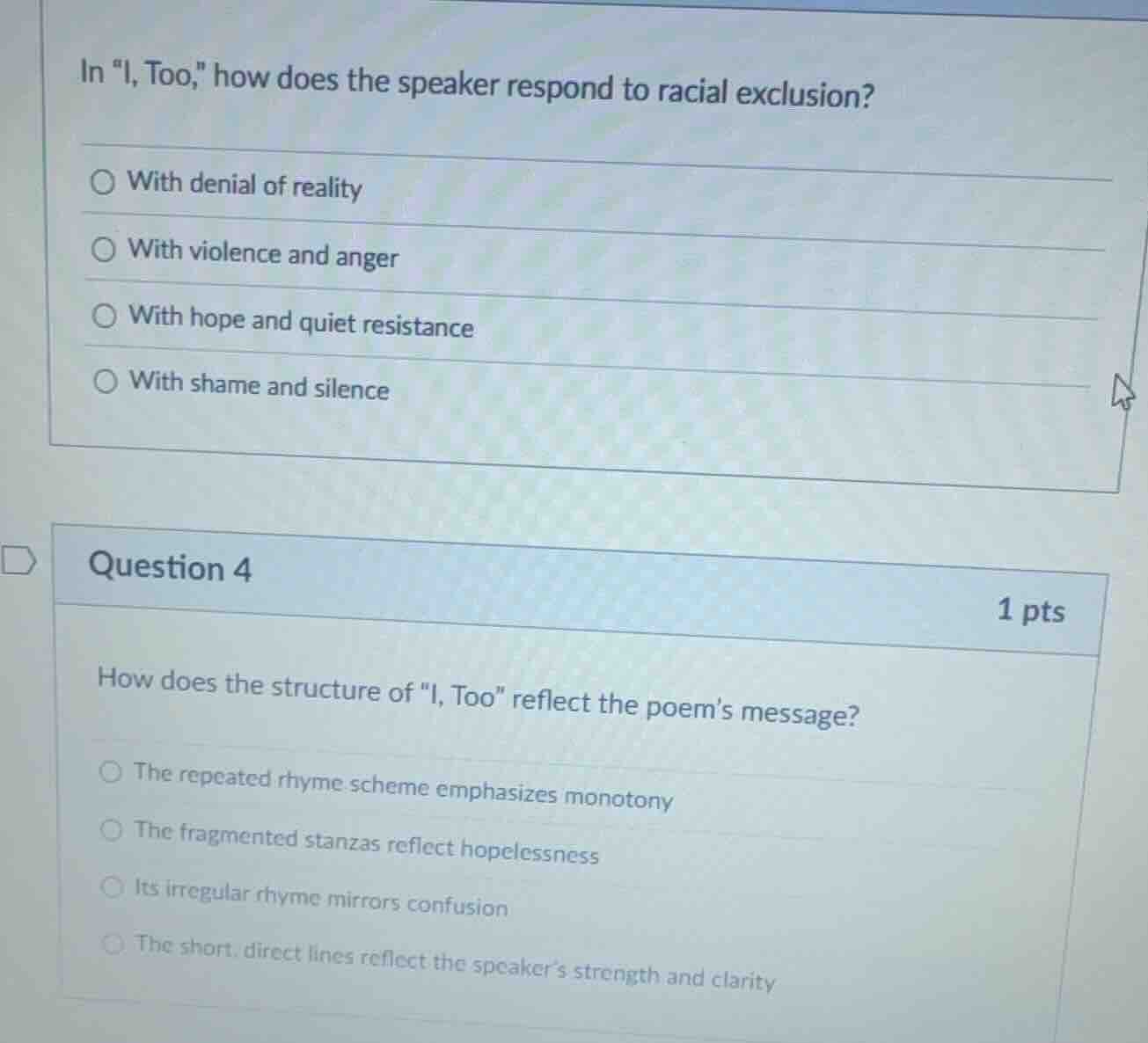
in \i, too,\ how does the speaker respond to racial exclusion?
with denial of reality
with violence and anger
with hope and quiet resistance
with shame and silence
question 4
1 pts
how does the structure of \i, too\ reflect the poem’s message?
the repeated rhyme scheme emphasizes monotony
the fragmented stanzas reflect hopelessness
its irregular rhyme mirrors confusion
the short, direct lines reflect the speaker’s strength and clarity
First Question (In "I, Too," how does the speaker respond to racial exclusion?):
In the poem "I, Too" by Langston Hughes, the speaker is a Black person who is sent to eat in the kitchen when company comes. The speaker does not deny the reality (so first option is wrong), does not respond with violence/anger (second option), and does not feel shame or stay silent (fourth option). Instead, the speaker says "I, too, sing America" and "Tomorrow, / I'll be at the table" showing hope for equality and a quiet resistance to the exclusion.
The poem does not have a repeated rhyme scheme to emphasize monotony (first option wrong), the stanzas are not fragmented to show hopelessness (second option wrong), and the rhyme is not irregular to mirror confusion (third option wrong). The lines are short and direct, like "I, too, sing America" and "I am the darker brother" which reflect the speaker's strength in asserting their place in America and clarity of their message about equality.

Snap & solve any problem in the app
Get step-by-step solutions on Sovi AI
Photo-based solutions with guided steps
Explore more problems and detailed explanations
C. With hope and quiet resistance