QUESTION IMAGE
Question
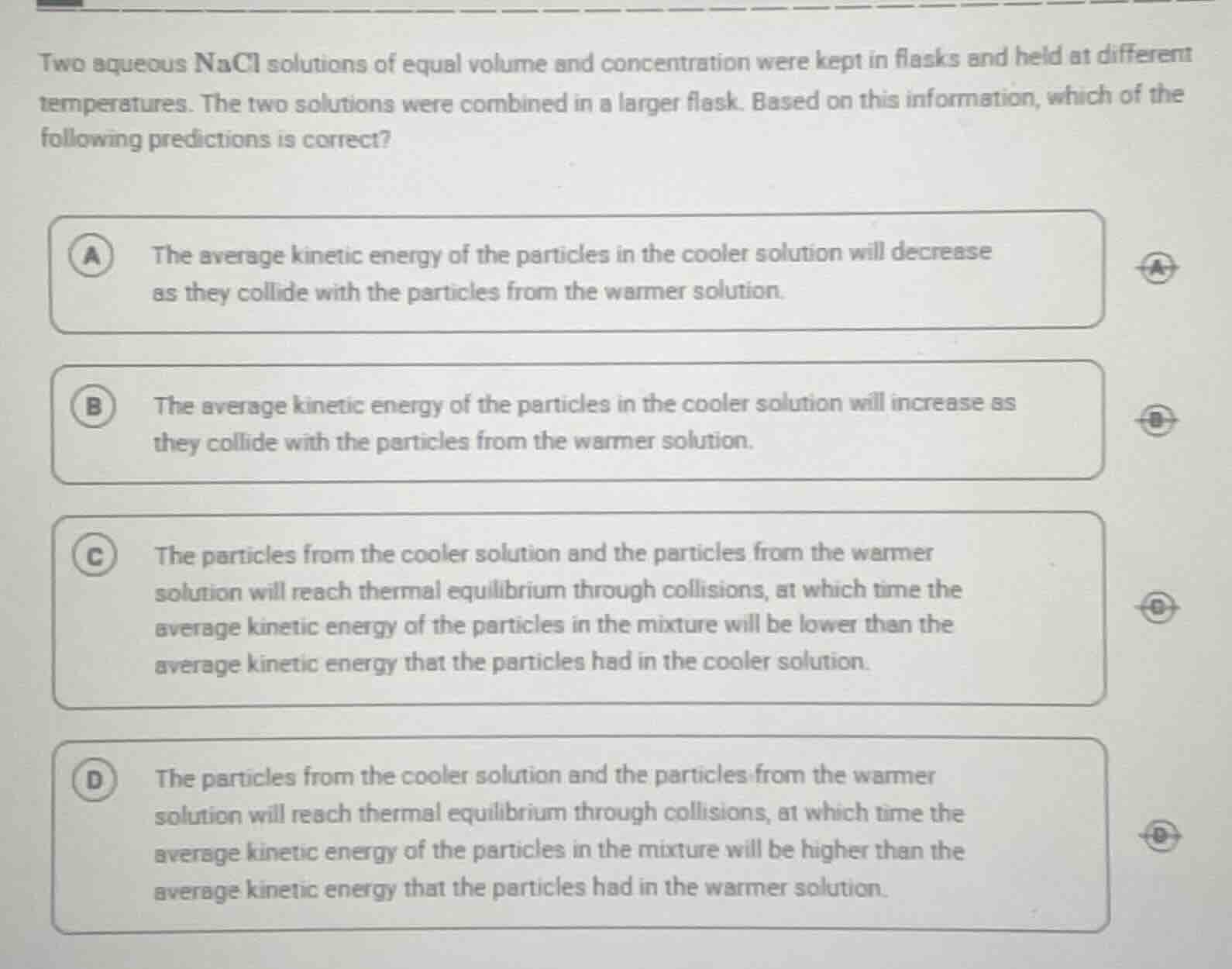
two aqueous nacl solutions of equal volume and concentration were kept in flasks and held at different temperatures. the two solutions were combined in a larger flask. based on this information, which of the following predictions is correct?
a the average kinetic energy of the particles in the cooler solution will decrease as they collide with the particles from the warmer solution.
b the average kinetic energy of the particles in the cooler solution will increase as they collide with the particles from the warmer solution.
c the particles from the cooler solution and the particles from the warmer solution will reach thermal equilibrium through collisions, at which time the average kinetic energy of the particles in the mixture will be lower than the average kinetic energy that the particles had in the cooler solution.
d the particles from the cooler solution and the particles from the warmer solution will reach thermal equilibrium through collisions, at which time the average kinetic energy of the particles in the mixture will be higher than the average kinetic energy that the particles had in the warmer solution.
- Recall the concept of thermal energy transfer: Heat flows from a warmer object (higher temperature) to a cooler object (lower temperature) until thermal equilibrium is reached. Temperature is related to the average kinetic energy of particles (\(KE_{avg} \propto T\), where \(T\) is absolute temperature).
- Analyze Option A: If the cooler solution's particles collide with warmer ones, heat should flow into the cooler solution, increasing its particles' kinetic energy, not decreasing. So A is incorrect.
- Analyze Option B: Warmer particles have higher kinetic energy. When they collide with cooler particles, energy is transferred to the cooler particles, increasing their average kinetic energy. This matches the heat transfer direction (warmer to cooler) and the relationship between temperature and kinetic energy.
- Analyze Option C: At thermal equilibrium, the mixture's temperature (and thus average kinetic energy) should be between the initial temperatures of the two solutions. So the mixture's average kinetic energy should be higher than the cooler solution's initial average kinetic energy (since heat was added to the cooler solution), not lower. Thus C is incorrect.
- Analyze Option D: At thermal equilibrium, the mixture's temperature is between the two initial temperatures. So the mixture's average kinetic energy should be lower than the warmer solution's initial average kinetic energy (since heat was lost from the warmer solution), not higher. Thus D is incorrect.

Snap & solve any problem in the app
Get step-by-step solutions on Sovi AI
Photo-based solutions with guided steps
Explore more problems and detailed explanations
B. The average kinetic energy of the particles in the cooler solution will increase as they collide with the particles from the warmer solution.