QUESTION IMAGE
Question
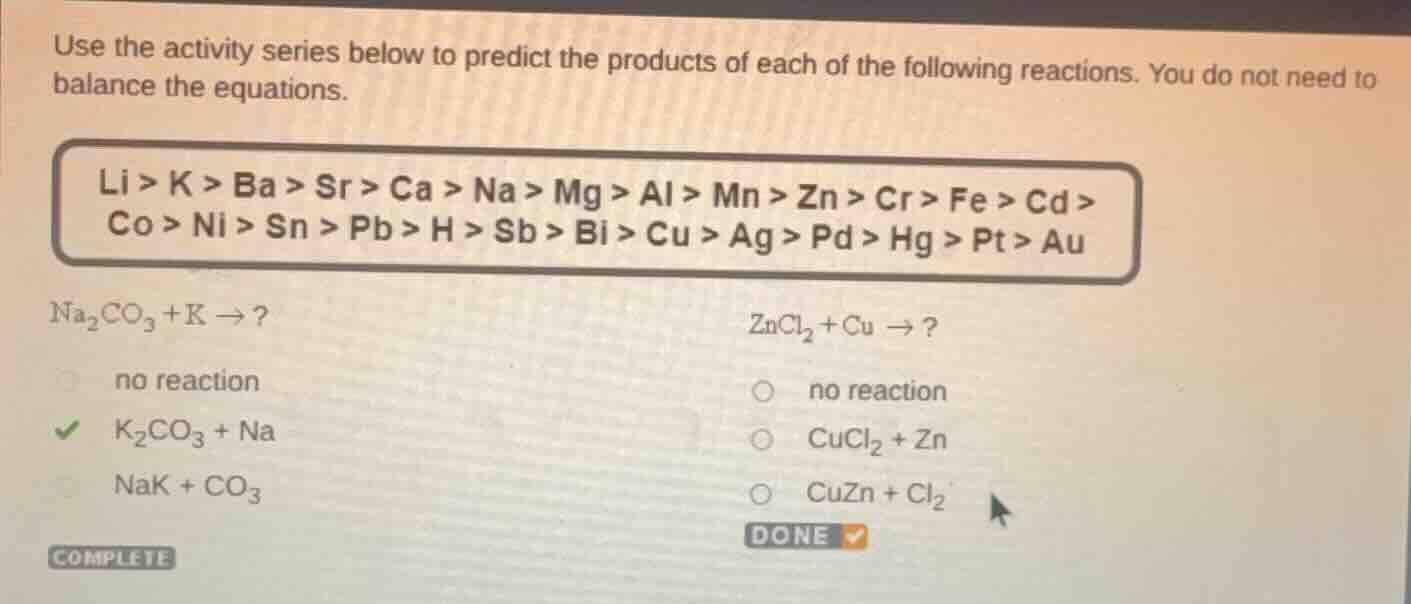
use the activity series below to predict the products of each of the following reactions. you do not need to balance the equations.
li > k > ba > sr > ca > na > mg > al > mn > zn > cr > fe > cd > co > ni > sn > pb > h > sb > bi > cu > ag > pd > hg > pt > au
na₂co₃ + k → ?
no reaction
k₂co₃ + na
nak + co₃
zncl₂ + cu → ?
no reaction
cucl₂ + zn
cuzn + cl₂
For the reaction \( \boldsymbol{\ce{Na2CO3 + K
ightarrow}} \):
Step1: Check activity series
In the activity series, \( \text{K} > \text{Na} \) (since K is to the left of Na in the series \( \text{Li} > \text{K} > \dots > \text{Na} > \dots \)). A more reactive metal (K) can displace a less reactive metal (Na) from its compound (\( \ce{Na2CO3} \)).
Step2: Predict products
The reaction is a single - displacement reaction. The potassium (K) will replace sodium (Na) in \( \ce{Na2CO3} \). So the products are \( \ce{K2CO3} \) and \( \ce{Na} \), with the reaction \( \ce{Na2CO3 + K
ightarrow K2CO3 + Na} \).
For the reaction \( \boldsymbol{\ce{ZnCl2 + Cu
ightarrow}} \):
Step1: Check activity series
In the activity series, \( \text{Zn} > \text{Cu} \) (since Zn is to the left of Cu in the series \( \dots > \text{Zn} > \dots > \text{Cu} > \dots \)). A less reactive metal (Cu) cannot displace a more reactive metal (Zn) from its compound (\( \ce{ZnCl2} \)).
Step2: Determine reaction outcome
Since Cu is less reactive than Zn, there will be no reaction between \( \ce{ZnCl2} \) and Cu.

Snap & solve any problem in the app
Get step-by-step solutions on Sovi AI
Photo-based solutions with guided steps
Explore more problems and detailed explanations
s:
- For \( \ce{Na2CO3 + K
ightarrow} \): \( \ce{K2CO3 + Na} \)
- For \( \ce{ZnCl2 + Cu
ightarrow} \): no reaction